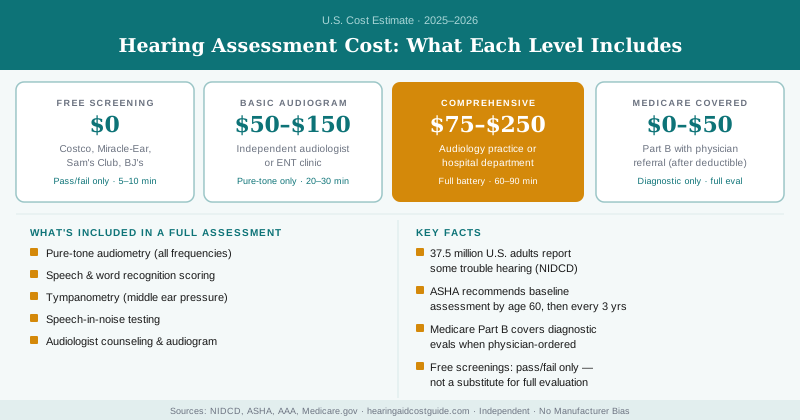
Costco will test your hearing for free. Walk in, sit down for about ten minutes, and you’ll leave knowing whether you passed or failed. That’s a screening. A full hearing assessment — the kind that tells an audiologist exactly what’s happening at each frequency, what type of loss you have, and how well you understand speech — is a different thing entirely, and it costs anywhere from $0 to $250 depending on where you get it and what it includes.
Here’s what actually separates the two, and how to decide which one you need.
Hearing Assessment Cost by Setting
| Provider Type | Service | Typical Cost |
|---|---|---|
| Costco, Sam’s Club, BJ’s | Basic hearing screening | Free |
| Miracle-Ear, HearingLife, Beltone | Hearing screening | Free |
| Independent audiologist (private pay) | Comprehensive audiological evaluation | $75–$250 |
| ENT or hospital audiology department | Diagnostic audiologic evaluation | $100–$350 (specialist copay if insured) |
| Academic medical center | Full audiological battery | $150–$300 |
| Medicare Part B (physician-ordered) | Diagnostic audiologic evaluation | $0–$50 after deductible |
| Medicare Advantage | Routine hearing assessment | Often $0 (plan varies) |
What a “Comprehensive” Hearing Assessment Actually Includes
This is where the marketing language gets slippery. Retailers advertise “comprehensive hearing assessments” that are, in practice, free screenings designed to get you in front of a hearing aid salesperson. A truly comprehensive hearing assessment from an audiologist covers four distinct components:
Pure-tone audiometry — You listen through headphones and press a button when you hear a tone. The audiologist tests both air conduction (sound through the air) and bone conduction (sound vibrated directly to the inner ear), mapping the exact frequencies where your hearing drops off. This produces your audiogram — the chart that shows your hearing thresholds across 250 Hz to 8,000 Hz.
Speech audiometry — Word recognition testing at comfortable volumes. The audiologist reads single-syllable words; you repeat them back. A score below 80% signals that even well-fitted hearing aids may not fully restore speech clarity — an important finding that a simple tone test misses entirely.
Tympanometry — A probe measures eardrum movement and middle ear pressure. It takes about 90 seconds and catches fluid, perforations, or Eustachian tube dysfunction that could explain hearing problems that aren’t sensorineural at all.
Speech-in-noise testing — How well you understand speech when there’s background noise. This is the real-world test that predicts hearing aid success better than pure-tone thresholds alone.
A free retail screening typically does only part one — a stripped-down version of pure-tone testing at a handful of frequencies. That’s useful information, but it’s not a complete picture.
Before booking, ask: “Does the assessment include pure-tone audiometry at all standard frequencies, word recognition scoring, and tympanometry?” If the answer is yes to all three, it’s a full evaluation. If the staff says “we check your hearing across all pitches” without mentioning speech testing or tympanometry, it’s a screening — possibly a good one, but not a complete assessment.
Who Provides Hearing Assessments
The credential matters more than the setting. An audiologist (AuD) holds a clinical doctorate and can diagnose hearing disorders, interpret complex results, and coordinate with physicians on medical cases. A hearing instrument specialist (HIS) is state-licensed primarily for hearing aid dispensing — appropriate for uncomplicated adult fittings but not for diagnostically complex situations.
Retail chains like Costco Hearing Centers and HearingLife primarily employ HIS-credentialed staff. Hospital audiology departments and independent audiology practices typically employ AuDs. For routine screening purposes, either works. If you’re dealing with sudden hearing changes, one-sided hearing loss, tinnitus, or any symptom that might have a medical cause, you want an audiologist — and you want your primary care doctor to order the evaluation so Medicare or insurance covers it as a diagnostic test. See our full breakdown at audiologist visit cost.
When a Free Screening Is Enough
A free retail screening is sufficient if you’re simply curious about your hearing, want a baseline before symptoms develop, or you want to quickly check whether you should seek a professional evaluation. The NIDCD estimates that approximately 37.5 million American adults report some trouble hearing — most of them haven’t been tested. A free screening is a better first step than no step at all.
It’s not enough if you’re experiencing any of the following: hearing loss that came on suddenly, hearing that’s worse in one ear than the other, ringing or noise in the ears, dizziness paired with hearing changes, or any symptom that’s appeared in the past 90 days. Those patterns need a full hearing test ordered through your doctor and interpreted by a clinical audiologist.
Medicare and Insurance Coverage
Medicare Part B covers a diagnostic audiological evaluation — including pure-tone audiometry, speech testing, and tympanometry — when your physician or ENT orders it due to a medical condition. In 2025, after meeting your Part B deductible ($257), you pay 20% of the Medicare-approved amount. For a standard diagnostic evaluation, that typically works out to $20–$50 out of pocket.
The key phrase is “physician-ordered.” A routine screening you schedule on your own, with no physician referral and no documented medical reason, is not covered. If your doctor has already noted hearing concerns in your chart, ask them to write the referral — that turns the same appointment from a $150 out-of-pocket visit into a $20–$50 one.
Medicare Advantage (Part C) plans frequently include expanded hearing benefits. Many cover one routine hearing assessment per year at no charge, with discounts on hearing aids from network providers. If you’re on Medicare Advantage, check your Evidence of Coverage document for hearing benefits before paying anything.
ASHA (the American Speech-Language-Hearing Association) recommends that adults get a baseline hearing assessment by age 60, and every three years after that — or sooner if any hearing change is noticed. The earlier hearing loss is identified, the better the outcomes with treatment, including significantly lower risk of the cognitive decline associated with untreated hearing loss.
Bottom Line
A free retail screening at Costco or Miracle-Ear is a reasonable first step — it costs nothing and takes minutes. But if you’re making decisions about hearing aids, if your results show a loss, or if anything about your hearing seems unusual, a full audiological evaluation ($75–$250 without insurance, often covered with a physician referral) gives you the complete picture you need. Don’t let the “free” label make the decision for you. The test that leads to the right answer is worth the cost.
Frequently Asked Questions
A basic hearing assessment (pure-tone audiogram) costs $0 at chain retailers like Costco, Miracle-Ear, and Sam's Club, or $50–$150 at audiology clinics. A comprehensive hearing assessment including speech-in-noise testing, tympanometry, and word recognition scoring costs $75–$250 at an audiology practice. Medicare Part B covers a diagnostic audiologic evaluation when ordered by a physician — your cost is typically $0–$50 after the deductible.
A hearing screening is a pass/fail test — it tells you whether you need further evaluation. A full hearing assessment (audiological evaluation) measures your hearing across multiple frequencies, determines the type and degree of loss, and produces an audiogram that audiologists use to program hearing aids. Screenings take 5–10 minutes and are often free; full assessments take 60–90 minutes and require a trained audiologist.
Medicare Part B covers a diagnostic audiological evaluation (including audiogram and related tests) when your physician or ENT orders it due to a medical reason — you pay 20% of the Medicare-approved amount after your Part B deductible ($257 in 2025). Routine hearing screenings not ordered by a physician are not covered. Medicare Advantage plans often include broader hearing benefits including routine assessments.