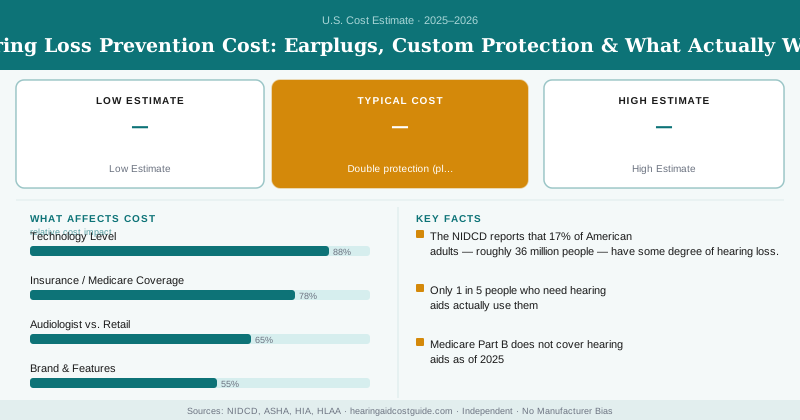
The NIDCD reports that 17% of American adults — roughly 36 million people — have some degree of hearing loss. Noise exposure is the leading preventable cause. That word matters: preventable. Unlike age-related hearing loss, which is partly biological, noise-induced hearing loss is entirely a matter of what you choose to expose yourself to and what protection you use when you do.
The good news is that protecting your hearing doesn’t have to be expensive. The most effective tools start at pennies each. What costs you is not knowing how to use them correctly.
How Noise Damages Hearing
Sound waves enter the ear canal, vibrate the eardrum and middle ear bones, and travel as fluid waves through the cochlea. Tiny hair cells lining the cochlea convert these waves into electrical signals sent to the brain. Those hair cells don’t regenerate. Once they’re gone, the hearing range they covered is gone permanently.
Loud noise — anything above 85 decibels — causes physical trauma to those hair cells. A single extremely loud event (a gunshot, an explosion) can destroy hair cells outright. More commonly, damage accumulates gradually: years of concerts, power tools, loud workplaces, motorcycles, and earbuds at high volume add up. Each exposure causes micro-damage. Eventually the cumulative loss becomes measurable on an audiogram.
The National Institute for Occupational Safety and Health (NIOSH) sets the safe exposure limit at 85dB for an 8-hour workday. Every 3dB increase halves the safe exposure time.
Hearing Protection Options and What They Cost
| Protection Type | NRR | Cost | Best Use Case |
|---|---|---|---|
| Foam earplugs (disposable) | 29–33 | $0.10–$0.50 each | High-noise work, power tools, concerts |
| Pre-molded reusable plugs | 22–28 | $5–$30 | Frequent use, easy insertion |
| Flanged musician plugs (generic) | 12–20 | $10–$30 | Music, maintaining sound clarity |
| Custom musician earplugs | 9–25 (flat) | $100–$200 | Musicians, live performances |
| Custom shooter’s plugs (passive) | 25–29 | $150–$250 | Shooting sports, hunting |
| Electronic earmuffs (active) | 22–30 | $50–$250 | Shooting ranges, amplified speech |
| Standard earmuffs (passive) | 24–30 | $20–$80 | Power tools, workshops |
| Double protection (plug + muff) | ~36 effective | $25–$310 | Extreme noise (>100dB) |
NRR (Noise Reduction Rating) is the EPA-standardized lab rating. Real-world protection is typically 50–70% of the rated NRR due to fit variability. NIOSH recommends derating NRR by 50% for practical planning.
Foam Earplugs: The Most Underrated Option
Foam earplugs cost pennies, offer the highest NRR (29–33) of any common product, and are available everywhere. They’re also the most commonly misused product in hearing protection.
Most people don’t insert them deep enough. The correct technique:
- Roll the earplug tightly between your fingers into a narrow cylinder.
- Reach over your head with the opposite hand and pull your outer ear up and back to straighten the ear canal.
- Insert the plug as far into the canal as comfortable.
- Hold it in place for 20–30 seconds while it expands.
Done correctly, a $0.30 foam plug outperforms a $25 flanged plug worn incorrectly. A 2017 study published in the Journal of the Acoustical Society of America found that real-world attenuation for foam plugs worn correctly averaged 29dB — nearly the full rated NRR — while incorrect insertion produced attenuation as low as 12dB. The plug isn’t the problem; the technique is.
Custom Musician Earplugs: Worth the Premium for Regular Performers
Standard foam earplugs muffle sound — they reduce high frequencies more than low ones, which makes music sound muffled and dull and makes it harder to hear fellow musicians. That’s fine for a power drill. It’s not fine for a rehearsal or performance.
Custom musician earplugs use flat-attenuation filters to reduce all frequencies by the same amount. You hear music and speech at a lower volume, but with full fidelity. At $100–$200 per pair (including audiologist impression and lab fabrication), they’re a significant investment compared to foam plugs. For anyone who plays music regularly — in a band, in an orchestra, at church, in any rehearsal setting — they pay for themselves quickly in preserved hearing.
Filter options come in 9dB, 15dB, and 25dB attenuation levels. The 15dB filter is the most common starting point for musicians in rehearsal settings.
If you have to raise your voice significantly to be heard by someone an arm’s length away, ambient noise is likely at or above 85dB. You can measure it precisely with NIOSH’s free SLM app (iOS and Android), which uses your phone’s microphone to display real-time and average decibel levels. Common sources that regularly exceed 85dB: lawn mowers (~90dB), shop tools (~95–100dB), motorcycle engines (~95dB), concerts and stadiums (~100–115dB), shooting ranges (~140–165dB for gunshots). If you’re regularly in any of these environments without protection, hearing loss is accumulating.
Electronic Earmuffs: Smart Protection for Shooters
Electronic earmuffs have become the standard for sport shooters. They use microphones and speakers to pass through normal conversation and environmental sounds at safe levels — then compress or suppress loud impulse noises (gunshots) instantaneously. The result: you can hear range commands, talk to fellow shooters, and still be protected from muzzle blast.
Passive shooter’s earplugs (custom or generic) provide significant NRR but cut out all sound. Electronic muffs ($50–$250) allow situational awareness. For hunting, where hearing game movement matters, electronic protection is often preferred over passive plugs.
WHO Data: The Scale of the Problem
The World Health Organization estimates that 1.1 billion young people worldwide are at risk of hearing loss from recreational noise exposure. In the U.S., the NIDCD documents noise-induced hearing loss as the most common cause of hearing impairment in adults under 65. Yet surveys consistently show that fewer than 20% of people in high-noise recreational environments use any hearing protection.
This isn’t a medical complexity issue. Foam earplugs cost less than a cup of coffee. The barrier is habit and awareness, not cost.
When to Get an Audiogram
If you’ve had significant noise exposure — occupational or recreational — regular audiograms are the early-warning system that lets you catch damage before it’s severe. ASHA and the American Academy of Audiology recommend baseline audiograms for anyone with significant noise exposure history, with annual follow-ups if exposure continues. An audiogram costs $200–$350 at a private audiology practice and is often covered by insurance as a diagnostic procedure.
No earplugs or earmuffs provide 100% protection, and none of them reverse damage that’s already occurred. If you’re regularly exposed to noise above 100dB — concerts, shooting ranges, heavy industrial machinery — use double protection (foam plug plus earmuff worn simultaneously) and get annual audiograms to track any threshold changes early. The combination of plugs and muffs provides roughly 36dB effective attenuation — more than either alone — and is recommended by NIOSH for extreme noise environments.
Prevention Is Cheaper Than Treatment
A pair of custom musician earplugs costs $150. A pair of entry-level hearing aids costs $2,500–$3,500. That math makes prevention the most cost-effective investment in hearing health you can make. Protection worn consistently starting in your 30s and 40s can make a meaningful difference in whether you need hearing aids at 65 or 75 — and how severe that loss turns out to be.
It doesn’t take expensive custom gear to protect your hearing. It takes foam earplugs, the right insertion technique, and the habit of reaching for them before the noise starts.
Frequently Asked Questions
Yes — but only when inserted correctly. Studies show that the real-world noise reduction most people achieve from foam earplugs is roughly half the rated NRR because of improper insertion. Rolling the plug tightly, inserting it deep into the canal, and holding it while it expands is essential. When worn correctly, foam plugs with NRR 29–33 are among the most protective options available.
NIOSH sets the safe exposure limit at 85 decibels for 8 hours. Every 3dB increase cuts the safe exposure time in half: 88dB for 4 hours, 91dB for 2 hours, 94dB for 1 hour. A rock concert at 110dB exceeds safe limits in under 2 minutes without protection.
Temporary hearing loss after loud exposure (temporary threshold shift) usually resolves within 16–48 hours. But repeated episodes cause cumulative, permanent damage to hair cells in the cochlea — cells that don't regenerate. There is no treatment that reverses established noise-induced hearing loss. Prevention is the only intervention that works.