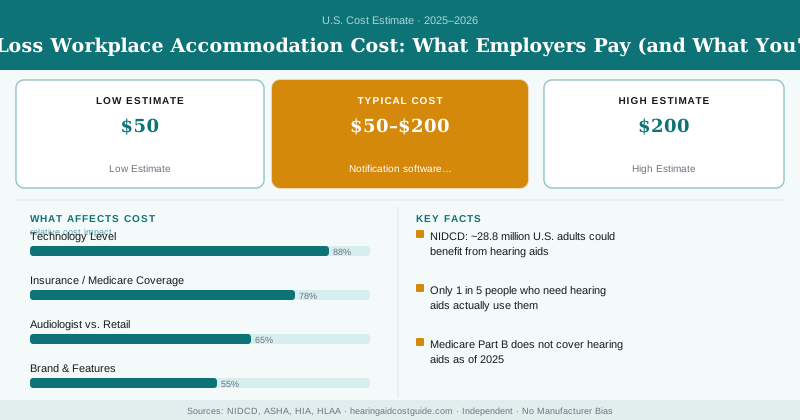
Here’s something most workers with hearing loss don’t know: the average cost of a workplace accommodation is $500. That’s the median figure from the Job Accommodation Network (JAN), which surveys employers annually. Not $5,000. Not a huge operational burden. Five hundred dollars — for accommodations that frequently allow employees to do their jobs as well as or better than before.
Yet many workers with hearing loss never ask. Either they don’t know their rights, or they’re worried the request will affect how they’re perceived at work, or they simply don’t know what to ask for. This guide covers what accommodations cost employers, what you’re legally entitled to under the ADA, and how to have that conversation without making it harder than it needs to be.
Common Hearing Accommodation Costs for Employers
| Accommodation Type | Typical Employer Cost | Notes |
|---|---|---|
| Captioning services for meetings (CART) | $100–$200/hour | Live remote captioning; per-session or contract rate |
| Video relay / captioned phone service | $0 | FCC-funded; no cost to employer |
| Assistive listening device (ALD) for meeting room | $200–$800 one-time | Loop system, FM system, or IR system |
| Visual alert system (flashing fire alarm, doorbell) | $100–$500 | One-time installation |
| Adjustable desk setup for lip reading (facing away from windows) | $0–$200 | Often no cost; desk repositioning |
| Qualified sign language interpreter | $50–$150/hour | For deaf employees; live or via VRI |
| Video Remote Interpreting (VRI) | $1–$3/minute | On-demand interpreter via video screen |
| Real-time captioning software subscription | $50–$200/month | CART alternatives; Verbit, Otter, Zoom CC |
| Notification software (visual alerts for emails, calls) | $50–$200 | One-time software cost |
Your ADA Rights: The Short Version
The Americans with Disabilities Act (ADA) requires employers with 15 or more employees to provide reasonable accommodations for qualified employees with disabilities — including hearing loss. A reasonable accommodation is any modification that helps you perform the essential functions of your job without causing “undue hardship” on the employer.
Key points:
- You have to ask. Employers aren’t required to proactively offer accommodations they don’t know you need. You initiate the process.
- “Reasonable” is genuinely broad. Courts have upheld captioning services, seating changes, written communication policies, modified alarm systems, and telework as reasonable accommodations for hearing loss.
- Hearing aids are your cost, not your employer’s. The ADA doesn’t require employers to pay for your hearing aids or other personal medical devices. But the assistive technology that helps your hearing aids work better in your workplace — loop systems, FM transmitters, captioning — can be employer-provided.
- Undue hardship is a high bar. A $500 accommodation is almost never “undue hardship” for any employer, including small ones. Even substantial accommodations are rarely found to be undue hardship unless they would fundamentally alter the business’s operation.
Use this framework when requesting accommodations:
- Put it in writing — email HR or your supervisor with a brief note stating you have a hearing impairment and requesting an accommodation meeting.
- Focus on job function — “I have difficulty understanding speech in meetings and am requesting captioning or an assistive listening device” is cleaner than detailed medical disclosure.
- You don’t have to disclose diagnosis — you’re entitled to say “I have a hearing disability” without providing audiograms or medical records, though HR may ask for general documentation of disability.
- Propose specific solutions — employers respond better to concrete, reasonably priced requests than open-ended asks. “I’d like to try a Roger system for the conference room” is more actionable than “I need help hearing in meetings.”
What Accommodations Actually Work
The ASHA reports that hearing loss affects approximately 1 in 8 Americans age 12 and older. In the workplace, common challenges include group meetings, phone calls, background noise in open offices, and auditory alert systems. Here are the solutions that actually address these:
Meetings: Communication Access Realtime Translation (CART) provides live speech-to-text captioning, either in-room or via remote service. A captioner transcribes speech in real time; you read on a laptop or tablet. Cost: $100–$200/hour for sessions. For regular recurring meetings, many employers negotiate monthly rates with CART providers that bring per-session costs down.
Phone calls: Captioned telephone service (CaptionCall, InnoCaption) is federally funded and costs the employer nothing. Alternatively, a desk phone with a captioned display or visual ringers can be provided at low cost.
Open office / background noise: FM or hearing loop systems that connect directly to hearing aids with telecoil (T-coil) capability. Roger systems by Phonak (a desktop microphone that transmits audio directly to compatible hearing aids) run $500–$900 for the transmitter — generally a one-time employer cost.
Notifications: Visual alert systems for fire alarms, phone ringing, and door knocking. Simple visual alert systems run $100–$300.
Federal Programs That May Subsidize Costs
For small employers, federal and state programs can reduce accommodation costs further:
Work Opportunity Tax Credit (WOTC): Employers who hire workers with disabilities may qualify for tax credits. This doesn’t directly pay for accommodations, but offsets related costs.
State Vocational Rehabilitation (VR) programs: If you’re a VR client, your state VR counselor can sometimes arrange for employers to receive assistive technology at no cost as part of supporting your employment. Ask your VR counselor explicitly if this applies to your situation.
ADA National Network: Free consultation for employers on low-cost accommodation solutions. Many employers genuinely don’t know what options exist at what price — directing HR to this resource sometimes produces faster results than negotiating directly.
If your employer denies an accommodation request, ask for the denial in writing and request an explanation. An employer who refuses a $300 CART session for someone who otherwise couldn’t participate in meetings needs to articulate why that’s “undue hardship.” Many accommodation disputes resolve at this stage — employers often reconsider when asked to formally document a refusal. If the denial stands, the EEOC handles ADA accommodation complaints, and filing a charge is free. You have 180 days (or 300 days in some states) from the discriminatory action to file.
Costs You’re Responsible For
While employers cover workplace accommodations, hearing aids and personal amplification devices remain your personal expense. However:
- HSA/FSA funds can pay for hearing aids with pre-tax dollars (up to $4,300 in 2025 for individual HSA accounts)
- Vocational Rehabilitation may cover hearing aids if hearing loss is affecting your employment — apply through your state VR agency
- VA benefits cover aids at no cost for eligible veterans
- Medicare Advantage plans provide $500–$2,500 per year in hearing aid benefits for enrolled seniors
The combination of workplace accommodations (employer-funded) and hearing aid coverage assistance (through insurance and public programs) means the total out-of-pocket burden for employed workers with hearing loss can be significantly lower than the sticker prices suggest.
Frequently Asked Questions
The median cost of a workplace hearing accommodation is approximately $500, according to the Job Accommodation Network (JAN). However, costs can range from $500 to $5,000 depending on the type of accommodation needed, such as assistive listening devices, captioning services, or modified workstations.
Health insurance typically does not cover workplace accommodations, as these are the employer's legal responsibility under the ADA rather than a medical benefit. You may have out-of-pocket costs only if your employer denies the accommodation request, in which case you could appeal through the EEOC or pursue legal action.
You should submit a formal accommodation request to your HR department or manager, ideally in writing, explaining your hearing loss and the specific accommodation needed. Most employers respond within 1–4 weeks; if denied, you have the right to file a complaint with the EEOC within 180–300 days depending on your state.