42% of Americans have never had a hearing test — including most adults under 50 who have gradual, progressive hearing loss they haven’t noticed yet. That statistic from the NIDCD is exactly why at-home hearing tests matter: they lower the barrier to discovering a problem that most people wouldn’t otherwise seek out.
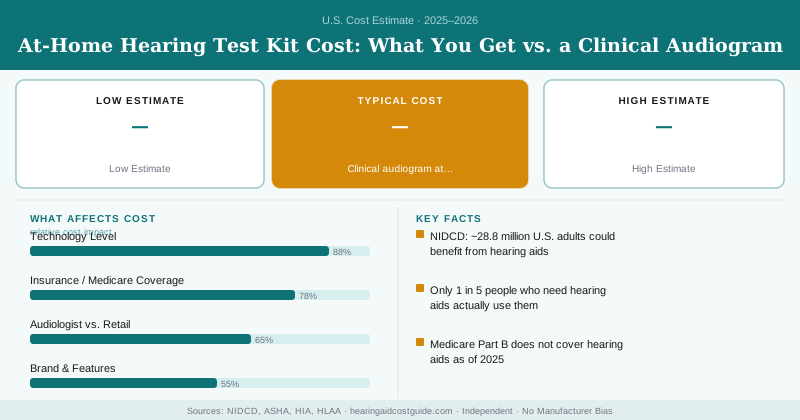
But here’s the honest limitation: an at-home test tells you whether your hearing deserves clinical attention. It doesn’t tell you what type of loss you have, which ear is affected, whether the cause is treatable, or what kind of hearing aid you’d need. Those answers require a licensed audiologist and about $150–$300.
At-Home Hearing Test Costs
| Test Type | Cost | What It Measures |
|---|---|---|
| Online screening test (Mimi, hear.com, HHIA) | $0 | Basic speech-in-noise or tone detection |
| Smartphone app (SoundCheck, Starkey HearingCheck) | $0 | Pure-tone screening via phone speaker or earbuds |
| OTC hearing aid companion apps (with REM features) | $0 (bundled with device) | In-situ audiogram via OTC hearing aid |
| Mail-in audiometry kit (BioSig-ID, legacy services) | $20–$75 | Pure-tone air conduction at key frequencies |
| Clinical-quality at-home audiometer (Shoebox Audiometer home tier) | $50–$150/year subscription | Calibrated pure-tone thresholds via calibrated headphones |
| Clinical audiogram at audiologist or ENT | $150–$300 | Full air and bone conduction, speech recognition, middle ear function |
Free Online and App Tests: What They Actually Do
Free online hearing tests are screening tools. They play tones or words through your device’s speakers or earbuds and ask you to respond. The results are typically a pass/fail or a loose estimate of whether your hearing is “normal,” “borderline,” or “needs attention.”
The problem is environmental noise, uncalibrated output levels, and inconsistent earphone acoustics. A test run through laptop speakers in a quiet room produces different results than the same test through cheap earbuds in a noisy kitchen. These tools haven’t been validated against clinical audiometry standards in most cases.
That said, they’re useful. If a quick online test flags potential loss, that’s a prompt to book a real evaluation. The Hearing Handicap Inventory for Adults (HHIA) — a validated questionnaire (not an audiometric test) available free online — is actually more reliable for detecting functional impact of hearing loss than many tone-based apps.
The Hearing Handicap Inventory for Adults (HHIA) is a 25-question self-report tool developed by audiologists and validated against clinical diagnosis. It asks about real-world situations: do you struggle to hear in restaurants, on the phone, in crowds? A score above 18 suggests significant handicap and a clinical referral is warranted. You can find it free at the American Academy of Audiology’s website. It takes five minutes and doesn’t require a calibrated tone — just honest answers.
In-Situ Audiograms Through OTC Hearing Aids
Several OTC hearing aids — Sony CRE, Jabra Enhance, and others — include an in-situ audiogram as part of their setup app. You insert the devices, follow the app’s prompts, and the aids play tones through their own speakers while you respond. The app then programs the aids based on the estimated thresholds.
This is more accurate than a freeware app because the playback hardware is calibrated and the aids are already in your ear canal at a consistent insertion depth. It’s not equivalent to a clinical audiogram — bone conduction, tympanometry, and speech recognition testing are still missing — but it’s a legitimate screen that feeds directly into device programming.
The NIDCD estimated in 2021 that approximately 28.8 million U.S. adults could benefit from hearing aids. The OTC rule change in 2022, which opened sales without prescription for adults with mild-to-moderate loss, made in-situ audiograms increasingly important as a substitute for professional fittings.
Clinical-Grade At-Home Audiometry
A step above apps: calibrated at-home audiometry systems. Shoebox Audiometer has consumer-facing products that use calibrated ear cups and validated test protocols to produce results comparable to a clinical pure-tone audiogram. These are subscription-based ($50–$150/year) and designed for ongoing monitoring rather than single-point screening.
These tools are most useful for:
- Adults with documented hearing loss who want to track progression between audiology appointments
- Caregivers monitoring elderly relatives with known hearing loss
- Remote employees or residents of areas without nearby audiologists
They don’t replace an audiologist evaluation — middle ear assessment, bone conduction testing, and speech discrimination scores still require clinical equipment — but they provide genuinely useful longitudinal data.
| At-Home Test Method | Accuracy Level | Limitations |
|---|---|---|
| Free online tone test | Low | Uncalibrated, environmental noise, no bone conduction |
| Smartphone app (speaker-based) | Low-moderate | Device-dependent, no validation standard |
| OTC hearing aid in-situ audiogram | Moderate | Air conduction only, no speech or middle ear data |
| Calibrated at-home audiometer (Shoebox consumer) | Moderate-high | No bone conduction, no tympanometry, no SRS |
| Clinical audiogram (audiologist) | Highest | Requires appointment, costs $150–$300 |
When At-Home Testing Is Enough — and When It Isn’t
At-home testing is enough if you’re:
- Screening yourself because you’ve been putting off a checkup
- Checking whether a family member’s hearing warrants professional attention
- Monitoring known stable hearing loss between clinical appointments
At-home testing is not enough if you:
- Have sudden hearing loss (see an audiologist or ENT same day — this can be a medical emergency)
- Have one ear that’s noticeably worse than the other
- Have ear pain, drainage, tinnitus, or dizziness alongside hearing changes
- Need a hearing aid fitting or prescription
- Are seeking documentation for disability, employment, or legal purposes
Sudden hearing loss is a medical emergency. If you wake up with significantly reduced hearing in one ear — even if it seems to improve slightly — call an ENT immediately and do not use an at-home kit as a substitute for same-day evaluation. Sudden sensorineural hearing loss (SSHL) responds to corticosteroid treatment best within 72 hours of onset. An app can’t diagnose or treat it.
The Bottom Line
Free at-home hearing tests are worthwhile if they motivate you to seek clinical evaluation you’d otherwise skip. They cost nothing and take five minutes. The step beyond free — OTC hearing aid in-situ audiograms or calibrated home audiometers — provides more reliable data for people actively managing known hearing loss. Neither replaces the $150–$300 clinical audiogram for diagnosis, prescription, or documentation.
Frequently Asked Questions
At-home hearing test kits typically cost between $0 and $150, with many available free through hearing aid manufacturers or retailers like Best Buy and Costco. A clinical audiogram, which provides a more comprehensive evaluation, costs $150–$300 and is often necessary after an at-home screening shows potential hearing loss.
Most insurance plans do not cover at-home hearing test kits since they are screening tools, not diagnostic tests. Clinical audiograms may be covered by Medicare (typically 100% if ordered by a physician) and some private insurance plans, though you should verify your specific coverage before scheduling an appointment.
At-home hearing tests typically take 5–15 minutes to complete using your smartphone or computer, making them convenient for initial screening. If your results suggest hearing loss, you should schedule a clinical audiogram within 1–2 weeks to confirm the diagnosis and determine the appropriate treatment options.