“Is my baby’s hearing test really free?” It’s one of the most common questions new parents ask — and the answer, in nearly every U.S. state, is yes. Every state has some form of universal newborn hearing screening law, meaning your baby gets tested before leaving the hospital, at no direct cost to you. What comes after that first screening is where costs start to vary.
Pediatric Hearing Test Costs by Type
| Test Type | Typical Cost | Setting |
|---|---|---|
| Newborn hearing screening | Free (state-mandated) | Hospital, before discharge |
| School-based screening | Free | Public school health programs |
| Well-child visit hearing check | Included in visit / $0–$50 copay | Pediatrician’s office |
| Diagnostic audiologist evaluation | $150–$350 | Audiology clinic, referral-based |
| Auditory brainstem response (ABR) test | $200–$600 | Specialized clinic, for infants/toddlers |
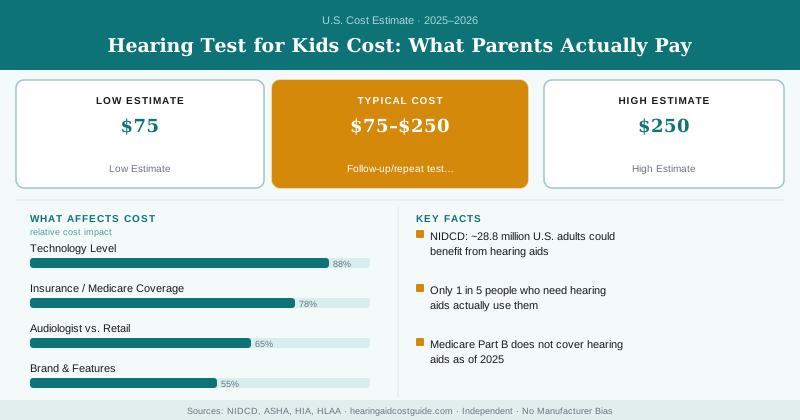
| Follow-up/repeat testing | $75–$250 | Audiology clinic |
Why Newborn Screening Is Free (And Mandatory)
The Early Hearing Detection and Intervention (EHDI) program, supported federally and implemented at the state level, requires that all newborns be screened for hearing loss before hospital discharge or within the first month of life. According to the CDC, about 1.7 per 1,000 babies screened are born with some degree of hearing loss — a rate significant enough that universal, no-cost screening became standard practice nationwide rather than an opt-in service.
If your baby doesn’t pass the initial screening, a follow-up diagnostic test — typically an auditory brainstem response (ABR) test — is scheduled, and this second-stage test does sometimes carry a cost if not covered by your state’s EHDI program or insurance.
School Screenings vs. Clinical Evaluations
Public schools commonly conduct basic hearing screenings, often in kindergarten and periodically through elementary years, at no cost to families. These are pass/fail screenings, not diagnostic evaluations — they’re designed to flag kids who need further testing, not to characterize hearing loss in detail.
If your child fails a school screening, or you or a teacher notices signs like frequently saying “what?”, sitting close to the TV, or falling behind in a noisy classroom, the next step is a full diagnostic evaluation at an audiology clinic, which runs $150–$350 without insurance coverage.
- Delayed speech or language development compared to peers
- Frequently asking “what?” or misunderstanding instructions
- Turning up the TV or tablet volume unusually high
- Not responding consistently to their name being called
- Recent history of ear infections, especially recurrent ones
- A teacher or daycare provider raising concerns about attentiveness or hearing
Any of these warrants a diagnostic evaluation now rather than waiting for a routine school screening cycle.
Insurance and Medicaid Coverage for Kids
Diagnostic hearing evaluations for children are typically covered by both private insurance and Medicaid when medically indicated — meaning a pediatrician referral or a failed screening result usually triggers coverage. Medicaid’s EPSDT (Early and Periodic Screening, Diagnostic, and Treatment) benefit specifically guarantees hearing screening and diagnostic services for children under 21 in every state, regardless of that state’s adult Medicaid hearing benefit rules.
Where costs sneak in: routine screenings requested without a medical referral, out-of-network audiology clinics, and follow-up testing beyond what insurance authorizes per year.
What Happens After Diagnosis
If a diagnostic test confirms hearing loss, next steps and their approximate costs include:
- ENT evaluation to rule out medically treatable causes (fluid, infection, structural issues) — often covered by insurance, $150–$300 if not
- Hearing aid fitting if amplification is needed — pediatric hearing aids run $2,000–$6,000/pair, though many states’ Medicaid and EHDI early intervention programs cover this for qualifying children
- Early intervention services through your state’s Part C program (birth to age 3), which is federally required to be available regardless of ability to pay
Don’t dismiss a “refer” result on a newborn screening as a false alarm, even though many are. Follow-up ABR testing must happen within the timeframe your state’s EHDI program specifies — typically by 3 months of age for diagnosis — because early intervention for confirmed hearing loss dramatically improves speech and language outcomes. Delaying follow-up testing, even when it feels like a formality, can push back the intervention timeline that matters most for development.
If your child needs a diagnostic hearing test, ask your pediatrician for a referral to a pediatric audiologist specifically — general audiology clinics see far fewer young children and pediatric-specific testing protocols and equipment make a real difference in accuracy.
Frequently Asked Questions
A pediatric hearing test costs $50–$350 out-of-pocket depending on the type of test and setting, though newborn hearing screenings are free or state-mandated in all 50 states, and school-based screenings are typically free as well.
Most private insurance plans and Medicaid cover diagnostic hearing tests for children when medically indicated (referred by a pediatrician or after a failed screening), though routine screening without a referral may not be covered.
All newborns should be screened before hospital discharge or within the first month of life per universal newborn hearing screening laws in all 50 states. After that, the American Academy of Pediatrics recommends screening at well-child visits, plus additional testing anytime a parent or teacher notices a concern.