You’re at a shooting range. The guy in the next lane fires a .308 without warning. Even with foam earplugs in, you feel the pressure wave. A single unsuppressed rifle shot reaches 160–170 dB — above the level at which a single exposure can cause permanent, irreversible hearing damage.
Foam plugs help. But if you’re a serious shooter or hunter, the question isn’t foam vs. nothing. It’s foam vs. electronic protection that actually lets you hear what’s happening around you while blocking the impulse noise that damages hearing. Here’s what it costs, what the differences actually are, and where the value falls.
Why Shooting Noise Is Different
Most hearing damage happens gradually. Workplace noise at 90 dB, repeated over years, slowly destroys cochlear hair cells. Shooting noise is different — it’s impulse noise, a massive peak pressure spike that happens in milliseconds and exceeds the “safe exposure” threshold by orders of magnitude.
The CDC and NIOSH classify any exposure above 140 dB as immediately harmful with no safe duration. Unsuppressed gunfire ranges from 140 dB for a .22 LR to 175 dB for a large-bore rifle. A single unprotected shot can produce immediate tinnitus, temporary threshold shift (TTS), or permanent hearing loss.
The American Academy of Audiology notes that approximately 17% of adults in the US have noise-induced hearing loss — and recreational firearm use is a significant contributor that’s almost entirely preventable.
NRR ratings are tested against continuous noise, not impulse noise. For gunfire, an NRR 33 foam plug and an NRR 22 quality electronic earmuff may perform similarly in real-world impulse protection — because how fast the protection responds to the impulse matters as much as the steady-state attenuation number. Dual protection (earmuffs over earplugs) adds 5–8 dB of practical protection and is recommended for indoor ranges and high-caliber shooting.
Hearing Protection Options for Shooters and Hunters
Standard Foam Earplugs
The cheapest and highest-NRR option, but with a critical hunting trade-off: you can’t hear ambient sound. You can’t hear conversation. You can’t hear game moving.
- Cost: $0.10–$0.50 each
- NRR: 29–33
- Best for: Indoor range sessions where hearing ambient sound doesn’t matter
For hunting, standard foam is a last-resort option, not a first choice. You’re essentially hunting partially deaf.
Passive Earmuffs
Passive earmuffs (no electronics) give you consistent, reliable protection and are easy to don and doff. They muffle everything.
- Cost: $15–$50
- NRR: 22–31
- Best for: Static range shooting, trap/skeet where all the action is in front of you
Peltor Sport Tactical 100 ($30), Howard Leight Sync ($25), 3M Peltor X5A (~$45, NRR 31) are the benchmark passive options.
Electronic Earmuffs: The Real Choice for Active Shooters
Electronic earmuffs use microphones to pick up ambient sound, amplify it to a comfortable level, and then instantaneously cut off when the sound exceeds ~82 dB. You hear conversation, range commands, and game sounds normally — until the shot, which the electronics suppress.
| Model | Price | NRR | Key Feature |
|---|---|---|---|
| Howard Leight Impact Sport | $30–$45 | NRR 22 | Budget standard, 2-mic stereo |
| Walker’s Razor Slim | $40–$60 | NRR 23 | Low-profile for rifle stock clearance |
| Howard Leight Impact Pro | $55–$75 | NRR 30 | Higher NRR, larger cup |
| Peltor Sport Tactical 300 | $90–$120 | NRR 24 | Digital circuitry, low-profile |
| Peltor Sport Tactical 500 | $130–$180 | NRR 26 | Bluetooth, digital processor |
| 3M Peltor ComTac (Pro series) | $250–$400 | NRR 22 | Military-grade, tactical comms |
| MSA Sordin Supreme Pro | $200–$300 | NRR 19 | Slim profile, gel cups, SNR 25 |
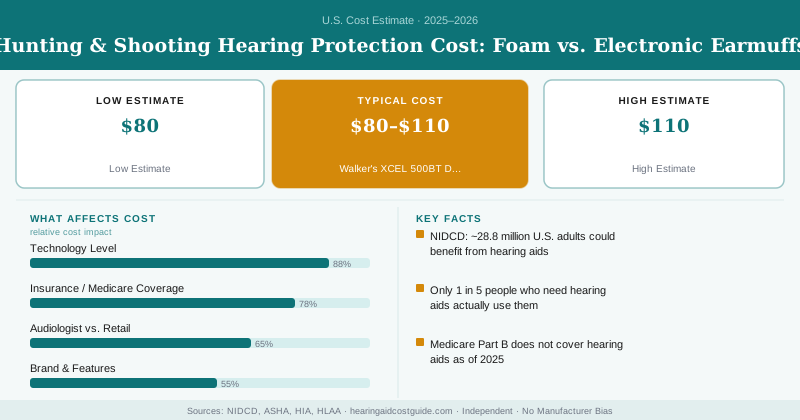
| Walker’s XCEL 500BT Digital | $80–$110 | NRR 29 | Digital, Bluetooth, affordable |
The Howard Leight Impact Sport ($30–$45) is the single most popular shooter’s earmuff in the market. It’s reliable, affordable, has 3.5mm audio input, and does exactly what it’s supposed to do. For most recreational shooters and hunters, it’s the right answer.
Electronic In-Ear Protection (Custom and OTS)
In-ear electronic protection solves the earmuff problem for hunters: bulk and interference with rifle stocks. These are small, discrete, and sit flush in or in the ear canal.
Over-the-counter electronic plugs:
- Caldwell E-Max Shadows: $50–$80
- Walker’s Silencer BT 2.0: $100–$150
- SureFire EP10 Sonic Defenders (passive filtered): $15–$25
Custom digital in-ear protection: These are custom-molded to your ear canal with electronic amplification and suppression built in. They’re used by competitive shooters, law enforcement, and serious hunters who need a low-profile solution that fits perfectly and lasts years.
- SureFire EP7 Sonic Defenders (OTS, banded): $20–$40
- Etymotic GunSport Pro: $200–$250 (NRR 15, excellent clarity)
- Westone DefendEar Hunter: $450–$650 (custom-molded, level-dependent)
- Starkey SoundGear Custom Digital: $700–$1,200 per pair
- InEar DefendEar: $800–$1,200 (audiologist-fitted, full custom)
Custom digital in-ear protection requires impressions from an audiologist ($50–$100 per ear, often included in total price). Turnaround is typically 2–3 weeks.
For hunting: electronic in-ear plugs or low-profile electronic earmuffs are the priority. You need ambient hearing for game awareness, and you need protection for the shot itself. Budget $100–$650 depending on how serious you are.
For range use only: a quality passive earmuff in the $25–$50 range does the job. Add foam plugs underneath (dual protection) if you’re shooting indoors or running high-caliber rifles regularly.
The Suppressor Option (Cost vs. Hearing Protection)
A suppressor (silencer) reduces gunshot noise by 20–35 dB depending on caliber and suppressor design. A suppressed .22 LR drops to roughly 115–120 dB — still loud, but below the instant-damage threshold. A suppressed 5.56 NATO runs about 130–135 dB.
Suppressors don’t replace hearing protection for centerfire cartridges, but they dramatically reduce exposure. Cost: $400–$1,500 for the suppressor, plus a $200 NFA tax stamp and 9–12 months wait time. Not a hearing-protection purchase per se, but it’s part of how serious shooters manage cumulative noise exposure.
What Long-Term Shooting Does to Your Hearing
The NIDCD reports that approximately 28.8 million Americans could benefit from hearing aids — and noise exposure, including recreational firearm use, is among the leading preventable causes. Veteran populations show significantly higher rates of tinnitus and hearing loss than matched civilian populations.
Tinnitus — persistent ringing — is often the first sign that shooting noise has done damage. It doesn’t always go away. Treating tinnitus costs $1,500–$5,000+ annually in tinnitus maskers and therapy. Preventing it costs $30 for a decent set of electronic earmuffs.
For shooters who’ve already noticed hearing changes, see our audiologist evaluation guide and noise-induced hearing loss overview.
Frequently Asked Questions
Yes — quality electronic earmuffs compress or shut off the amplification circuit within 2–4 milliseconds when a sound reaches approximately 82–85 dB, capping your exposure well below the dangerous threshold. NRR ratings of 22–29 are standard on electronic models. The key is the attack time: lower-quality models (under $30) may react too slowly to fully protect against impulse noise, so buy from established brands like Howard Leight, Peltor, or Walker's.
Reliable electronic earmuffs start around $30–$50 for entry-level models like the Howard Leight Impact Sport, go to $100–$200 for mid-range options from Peltor and Walker's, and reach $300–$800+ for professional-grade or Bluetooth-enabled models. Custom electronic in-ear hearing protection from brands like SureFire or Etymotic runs $400–$1,200 per pair.
Yes. A single unsuppressed gunshot ranges from 140–175 dB depending on caliber — well above the 120 dB threshold at which even brief exposure can cause immediate permanent hearing damage. NIOSH reports that even one unprotected exposure to high-caliber rifle fire can cause instant, irreversible noise-induced hearing loss. Veterans show significantly higher rates of hearing loss and tinnitus than the general population, largely attributable to firearm and explosive noise exposure.