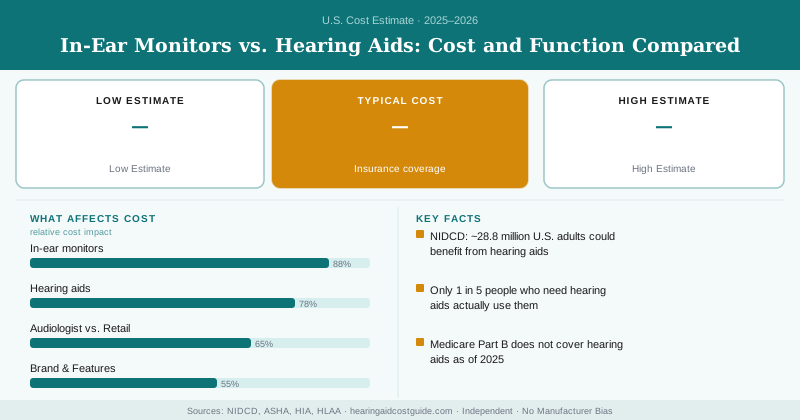
In 2015, a working musician might have paid $600 for custom in-ear monitors to protect their hearing on stage. By 2026, that same musician — now with measurable hearing loss from years of stage volume — might be paying $4,000 for hearing aids to compensate for the damage the IEMs were originally meant to prevent. The contrast tells you almost everything about how differently these two devices function, despite looking nearly identical.
Cost Comparison: In-Ear Monitors vs. Hearing Aids
| Category | In-Ear Monitors (IEMs) | Hearing Aids |
|---|---|---|
| Universal-fit (non-custom) | $20–$500/pair | Not applicable — always custom-fit |
| Custom-molded, entry-level | $200–$500/pair | $200–$1,600/pair (OTC) |
| Custom-molded, professional | $500–$1,800/pair | $3,000–$7,000/pair (prescription) |
| Purpose | Accurate audio reproduction | Amplify and process specific hearing loss |
| Professional fitting required | Impression only, no audiological fitting | Impression + audiological programming |
| Insurance coverage | Never covered | Sometimes partially covered |
Why These Devices Look Alike But Do Completely Different Jobs
Both in-ear monitors and hearing aids can involve a custom ear impression process, both sit in or near the ear canal, and both are sometimes confused by people shopping for either one. But the internal function is fundamentally different:
In-ear monitors contain balanced armature or dynamic drivers designed to reproduce an audio signal (music, a stage mix, a broadcast feed) as accurately and flatly as possible — the goal is fidelity to the source, not modification of ambient sound.
Hearing aids contain microphones, a digital signal processor, and a receiver, calibrated specifically to your individual audiogram. They selectively amplify certain frequencies more than others based on your specific hearing loss pattern, apply noise reduction algorithms, and often include feedback cancellation — none of which an IEM does or is designed to do.
Who Actually Needs Which
- Musicians and performers monitoring their own sound on stage need IEMs, not hearing aids — even if they also happen to have hearing loss (a growing number do, and may eventually need both devices for different purposes)
- Broadcast and audio professionals who need accurate reference monitoring use IEMs
- Anyone with diagnosed hearing loss needing to hear conversations, environmental sounds, and everyday audio better needs hearing aids, not IEMs
- Some musicians with hearing loss genuinely need both: hearing aids for daily life, and specialized “musician’s hearing aids” (a hybrid category) or modified IEMs for performing
Some hearing aid manufacturers now offer devices specifically marketed to musicians, combining wider frequency response and lower processing latency (important for real-time musical performance) with the amplification and hearing-loss-specific programming of a true hearing aid. These typically cost $2,500–$5,000/pair — more than standard IEMs but positioned between conventional hearing aids and professional-grade IEMs in terms of specialized function.
The Hearing Damage Connection
According to the National Institute on Deafness and Other Communication Disorders (NIDCD), noise-induced hearing loss affects an estimated 26 million U.S. adults, and musicians face significantly elevated risk due to prolonged exposure to amplified sound at close range. Ironically, properly used IEMs can reduce this risk compared to traditional stage monitors, because performers can set their own monitor mix at a controlled volume rather than relying on loud stage wedges — but only if used correctly, with volume discipline.
Insurance and Cost Recovery
Neither device is typically covered by health insurance in the way medical hearing aids sometimes are — IEMs are considered professional audio equipment, not medical devices, and are never covered. Hearing aids, despite being medical devices, still face limited insurance coverage as covered elsewhere on this site, but at least occasionally qualify for HSA/FSA funds, state mandates, or Medicaid coverage. IEMs qualify for none of these, since they’re not classified as medical devices by the FDA.
Don’t use in-ear monitors as a substitute for hearing protection or hearing aids based on the assumption that “they’re basically the same thing.” If you’re a musician experiencing hearing changes, get a proper audiogram first — IEMs will not compensate for hearing loss, and continuing to perform at high volumes without addressing diagnosed hearing loss can accelerate further damage.
If you’re a performer weighing these options, get baseline hearing testing before investing in either high-end IEMs or hearing aids — knowing your actual hearing profile determines which device (or both) genuinely serves your needs.
Frequently Asked Questions
No. In-ear monitors (IEMs) are designed to accurately reproduce audio signals for musicians and performers — they don't amplify ambient environmental sound or compensate for specific hearing loss patterns the way hearing aids are engineered to do.
Hearing aids are typically more expensive, running $1,500–$7,000 per pair for prescription devices, compared to $200–$1,800 per pair for custom in-ear monitors, because hearing aids include amplification circuitry, programmable processing, and professional fitting/verification that IEMs don't require.
Both often start with a similar ear impression process, but the resulting shells serve different purposes — an IEM shell houses audio drivers for sound reproduction, while a hearing aid shell (or earmold) houses or channels amplification components calibrated to a specific hearing loss pattern.