The market went small, then smaller, then invisible. IIC (invisible-in-canal) hearing aids are now literally invisible from outside the ear — a tiny shell sits deep in the ear canal, completely hidden from view. A decade ago, this would have seemed remarkable. Today it’s a standard product category at most major manufacturers.
But there’s a catch. The smaller you go, the more you give up — in amplification power, processing features, battery life, and durability. The IIC that looks stunning on paper can be a real disappointment in a noisy restaurant. Here’s what the progression from full-shell ITE down to IIC actually means, in dollars and in performance.
In-the-Ear Styles: The Full Lineup
All five ITE styles live entirely within your ear. The differences are size, where in the ear they sit, and what features can fit inside.
Full Shell ITE: Fills the entire bowl (concha) of your outer ear. Largest ITE style, most visible but also most capable — directional microphones fit, volume controls fit, larger batteries fit, and these can handle significant hearing loss. Easiest to handle for people with dexterity concerns.
Half Shell ITE: Fills the lower portion of the ear bowl. Smaller than full shell, still includes directional microphones and volume controls in most models. A good middle ground between cosmetics and features.
ITC (In-the-Canal): Sits mostly in the ear canal with a small faceplate visible at the canal opening. Significantly smaller than half shell, partially visible from the front. Directional mics may or may not be included depending on model — ask specifically.
CIC (Completely-in-Canal): Sits fully inside the ear canal. Only a small clear retrieval cord is visible at the canal opening. No external volume control on most models. Directional microphones typically not included. Uses size 10 batteries (smallest zinc-air battery, shortest life — 3–5 days per battery).
IIC (Invisible-in-Canal): Sits deepest in the canal, past the second bend. Nothing visible from outside the ear. No directional microphones, no Bluetooth in most models, no rechargeability, no volume control. Size 10 battery (some models are slightly larger). Must be removed daily by audiologist or at home with the included handle — not intended to be left in permanently (though some extended-wear models like Lyric are worn for months at a time).
| Style | Typical Cost Per Aid | Directional Mics | Bluetooth | Rechargeable |
|---|---|---|---|---|
| Full Shell ITE | $1,500–$3,500 | Yes | Some models | Some models |
| Half Shell ITE | $1,800–$3,800 | Yes | Some models | Rare |
| ITC | $2,000–$4,000 | Sometimes | Some models | No |
| CIC | $2,200–$4,000 | Rarely | Rarely | No |
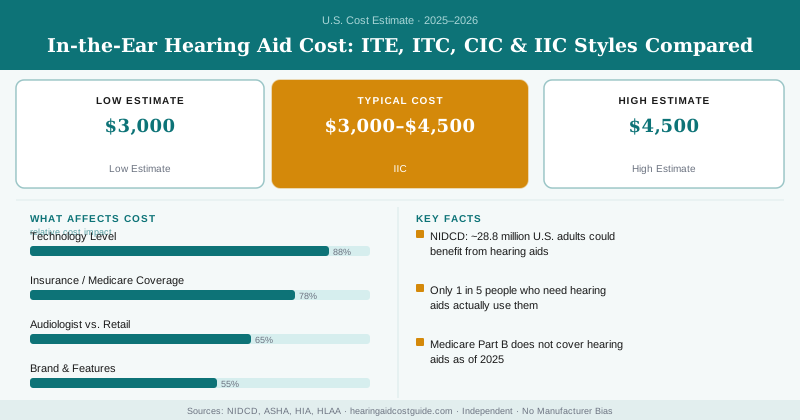
| IIC | $3,000–$4,500 | No | No | No |
Note the counterintuitive pricing: smaller doesn’t mean cheaper. IIC aids are precision-manufactured custom devices requiring advanced miniaturization — they typically cost more than full shell ITEs despite having fewer features.
The Custom Earmold Process
Every ITE style starts with an ear impression. Your audiologist takes a mold of your ear canal and outer ear using silicone impression material — a painless process that takes about 10 minutes. That impression goes to the manufacturer, who fabricates a custom shell for your ear. Typical turnaround is 1–2 weeks.
The fit matters enormously. A poorly fitted ITE style causes feedback (whistling), discomfort, and poor sound quality. Good audiologists take careful impressions and don’t rush the process. Some use digital scanning instead of traditional impression material — it’s faster and potentially more accurate, but not universally available.
What You Give Up Going Smaller
The feature tradeoffs at the small end of the ITE spectrum are significant and worth understanding before you commit to an IIC or CIC.
Directional microphones. This is the big one. Most IIC and CIC aids have only a single microphone, which means they can’t focus on a sound source in front of you and reduce noise from behind. HIA market research and clinical studies from the Journal of the American Academy of Audiology consistently show that directional microphone processing provides meaningful speech-in-noise benefit — typically 2–5 dB improvement in signal-to-noise ratio. In a noisy restaurant, that’s the difference between following a conversation and guessing at words.
Bluetooth streaming. Streaming phone calls, TV audio, or music directly to your hearing aids has become one of the most-used features in modern devices. Most CIC and IIC aids don’t have it. You’d need a separate streaming accessory (if available), or you’d use your phone’s speaker.
Rechargeability. Rechargeable hearing aids are now standard in most premium RIC and BTE styles. None of the IIC styles currently offer it. You’re handling tiny size-10 batteries every 3–5 days — potentially multiple times a week.
Volume and program control. Most CIC and IIC aids have no manual controls on the device itself. All adjustments happen through an app (if available) or automatically. Some users prefer this; many don’t.
ITE aids work best for: people with mild-to-moderate hearing loss (especially high-frequency loss), people who wear glasses or headwear that makes behind-the-ear styles uncomfortable, people with good manual dexterity and the fine motor control to insert and remove small devices, people whose ear canals are large enough to accommodate the style (smaller canals may not fit CIC or IIC). Your audiologist will evaluate your ear canal anatomy at the initial assessment — this isn’t optional, it’s a prerequisite.
Moisture, Wax, and the Deep Canal Problem
In-the-ear aids live in a warm, humid, waxy environment. Every ITE style is more vulnerable to moisture and cerumen (earwax) damage than behind-the-ear styles that keep their electronics outside the ear. CIC and IIC aids sit deepest of all — right in the path of wax migration.
Most ITE aids come with a wax filter (a small replaceable screen over the speaker opening). You’ll replace this every few weeks depending on your wax production. Replacement filters cost about $5–$15 for a pack. Letting the filter clog is the single most common reason ITE aids stop working — and the fix is often just replacing the filter.
A desiccant drying kit ($10–$50) is essentially mandatory for any ITE style. Removing aids each night and placing them in a desiccant jar or electronic dryer removes accumulated moisture from the canal environment and extends device life.
The Lyric Exception: Extended-Wear IIC
Phonak’s Lyric is a different category entirely. It’s an IIC-style aid fitted by an audiologist and worn continuously — 24 hours a day, including while sleeping, showering, and exercising — for 2–3 months at a time. The audiologist then removes it and inserts a fresh one.
Lyric uses no batteries (it uses the thermal and kinetic energy of the ear canal). It’s genuinely invisible and requires no daily handling.
The cost model is a subscription: approximately $3,000–$4,500 per year for both ears, covering all device replacements. It’s only appropriate for mild-to-moderately-severe high-frequency hearing loss, and not everyone’s ear canal anatomy accommodates it. But for the right candidate, it solves nearly every handling and visibility objection at once.
Don’t choose an IIC or CIC style based on cosmetics alone without walking through the feature comparison with your audiologist. Many patients who buy IIC aids because they’re invisible end up switching to RIC aids within a year because they miss directional processing, Bluetooth, or rechargeability. The switch costs money — you don’t want to learn this lesson the expensive way.
Comparing ITE to RIC at the Same Price Point
At equivalent technology tiers, most audiologists find that patients get more hearing benefit from a premium RIC aid than from a smaller ITE at the same price. A $3,000 RIC aid will typically include AI-based directional processing, Bluetooth, rechargeability, and a robust app ecosystem. A $3,000 IIC aid is a masterpiece of miniaturization that lacks most of those features.
That said, the right hearing aid isn’t always the one with the best spec sheet. It’s the one you’ll actually wear consistently. If cosmetics are the barrier between wearing aids and not wearing them, that changes the calculus. An IIC that gets worn every day beats a premium RIC that sits on the nightstand.
Talk through both options with your audiologist. If you’re leaning toward an IIC for cosmetic reasons, ask them to show you a modern RIC on your ear before you commit — many people are surprised by how discreet they actually are.
Frequently Asked Questions
For mild-to-moderate high-frequency hearing loss in candidates with appropriate ear canals, IIC aids can perform well. But they do have real limitations: most lack directional microphones (which significantly help in noisy environments), Bluetooth streaming, rechargeability, and volume control. Sound quality in quiet environments is generally fine; the gap widens in restaurants, parties, or any noisy setting where directional processing would help. For many users, the cosmetic gain isn't worth the feature loss.
Several groups shouldn't use IIC or CIC aids: people with severe-to-profound hearing loss (not enough amplification power available in that small size), people with small or irregularly shaped ear canals (the device won't fit properly), people who struggle with small objects due to arthritis or tremor (insertion and removal require fine motor control), and people who produce excessive earwax (deep canal placement increases clogging risk). Your audiologist will assess your ear canal geometry during the initial evaluation — it's a prerequisite for any custom style.
Custom ITE/ITC aids cost more than standard RIC aids at the same technology tier, and they offer fewer features at smaller sizes. Most audiologists find that patients are better served by a premium RIC aid than a basic CIC at the same price point. The main case for custom ITE is when the patient genuinely can't wear a behind-the-ear style (ear anatomy, physical activity, headwear) or has a strong cosmetic preference for the IIC style and the audiological profile to support it. Ask your audiologist to walk through the feature comparison at equivalent price points before committing.