Priya, a 38-year-old marketing director, didn’t want colleagues in client meetings to notice she wore hearing aids. Her audiologist recommended an invisible-in-canal (IIC) model — custom-molded to sit deep enough in her ear canal that it’s genuinely not visible even up close. The price: $3,800 for the pair, noticeably more than the mid-tier behind-the-ear devices she’d initially been quoted.
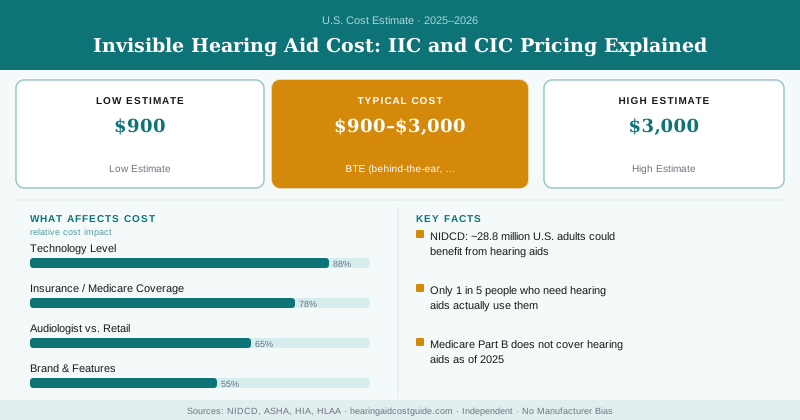
Invisible Hearing Aid Costs by Style
| Style | Typical Cost (Per Device) | Visibility |
|---|---|---|
| IIC (invisible-in-canal) | $1,800–$3,900 | Not visible, deep canal placement |
| CIC (completely-in-canal) | $1,500–$3,500 | Barely visible, small portion at canal opening |
| ITC (in-the-canal) | $1,200–$3,000 | Slightly visible |
| RIC (receiver-in-canal, for comparison) | $1,000–$3,500 | Visible thin wire behind ear |
| BTE (behind-the-ear, for comparison) | $900–$3,000 | Most visible style |
Why “Invisible” Costs More
Invisible-in-canal hearing aids are the most expensive style to manufacture relative to their size, for a few concrete reasons:
- Custom ear impressions required: Unlike standard styles that can sometimes use pre-formed domes, IIC devices require a precise physical impression of your unique ear canal shape, taken by your audiologist and sent to a manufacturing lab
- Miniaturized components: Fitting a microphone, amplifier, receiver, and battery into a shell small enough to sit invisibly deep in the canal requires more advanced (and expensive) miniaturization than larger styles
- Precision manufacturing: The tighter tolerances required for a comfortable, secure deep-canal fit increase both material costs and the skilled labor involved in production
Who’s a Good Candidate for Invisible Styles
IIC and CIC devices work best for people with mild to moderate hearing loss and ear canals large enough to accommodate the components comfortably. They’re generally not recommended for:
- Severe to profound hearing loss, which typically requires a more powerful receiver that doesn’t fit in an invisible shell
- Narrow or unusually shaped ear canals where a secure, comfortable fit isn’t achievable
- Significant dexterity limitations, since the smallest invisible styles can be harder to insert, remove, and handle disposable batteries
Because IIC and CIC devices sit deep in the ear canal, comfort during extended wear (8+ hours daily) matters as much as invisibility. Ask your audiologist for a genuine multi-day trial specifically to test comfort during long wear periods, not just a quick in-office fitting check. Some patients who love the invisibility find the deep placement uncomfortable after a full day and switch to a slightly larger, still-discreet style like ITC instead.
Battery and Feature Tradeoffs
The smallest invisible styles typically use the smallest disposable batteries (size 10), which need replacing more frequently — every 3 to 5 days — than larger battery sizes used in bigger styles. Additionally, some of the smallest IIC models don’t support rechargeable battery technology or Bluetooth streaming due to space constraints, meaning you may be trading some modern features for the invisibility factor. Confirm exactly which features are available in the invisible style you’re considering before assuming it matches the feature set of a larger model from the same product line.
Not every ear canal is anatomically suited for an invisible-in-canal fit. Some patients get quoted for an IIC device before their audiologist has confirmed their canal size and shape can actually accommodate it, only to find out during the impression process that a larger style is needed instead. Confirm candidacy for invisible styles specifically during your initial evaluation, before committing financially to that price tier.
Is the Premium Worth It?
For patients where discretion is a genuine priority — professional settings, social anxiety about visible hearing loss, personal preference — the $500–$1,000 premium over a mid-tier RIC device is often worth it. For patients less concerned about visibility, a receiver-in-canal (RIC) style typically offers comparable sound quality and more feature flexibility at a lower price point.
Frequently Asked Questions
Invisible-in-canal (IIC) hearing aids typically cost $1,800 to $3,900 per device, or $3,600 to $7,800 for a pair, placing them among the more expensive hearing aid styles due to their custom-fit, miniaturized design.
Invisible hearing aids cost more because they require custom ear impressions, specialized miniaturized components that fit deep in the ear canal, and more precise manufacturing, all of which increase production cost compared to standard behind-the-ear or in-the-ear models.
No. Invisible-in-canal devices are generally best suited for mild to moderate hearing loss due to their small size and limited battery capacity, and are typically not recommended for severe to profound hearing loss, which usually requires a larger device with a more powerful receiver.