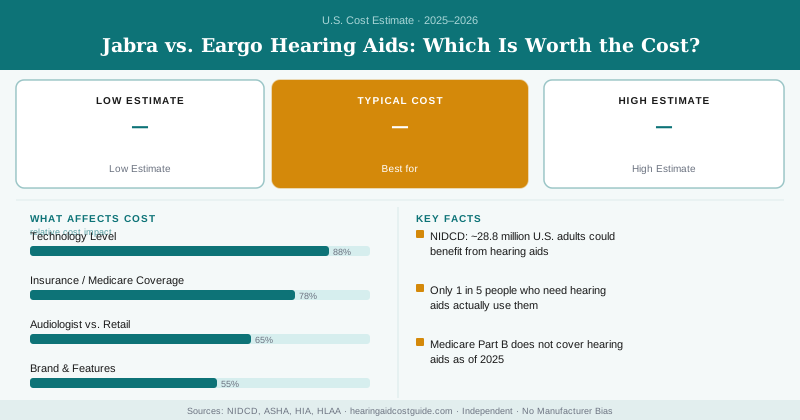
What if you could get hearing aids shipped to your door for under $2,000 and never set foot in a clinic? That’s the pitch from both Jabra Enhance and Eargo, two of the biggest direct-to-consumer brands in the US. They’re aimed at the same buyer — but they’re surprisingly different products under the hood.
Here’s how to pick.
The Price Breakdown
| Factor | Jabra Enhance | Eargo |
|---|---|---|
| Price per pair | $995–$1,995 | $1,650–$2,950 |
| Style | Receiver-in-canal (RIC) | Nearly invisible in-canal |
| Remote audiologist support | Yes, included | Limited |
| Trial period | 100 days | 45 days |
| Best for | Mild-to-moderate loss | Mild-to-moderate, high-frequency |
Both are far below the $4,000–$7,000 of clinic-fitted prescription hearing aids, and both qualify as OTC-style devices for adults with perceived mild-to-moderate loss.
Jabra Enhance: Support-Heavy, Behind-the-Ear
Jabra Enhance — formerly Lively, now owned by GN, the parent of ReSound — sells a behind-the-ear RIC device. Its standout feature is the remote care: every package includes virtual appointments with licensed audiologists who tune your aids over video. If you want the convenience of online buying but worry about going it alone, Jabra splits the difference well.
You can see Jabra’s full lineup in our Jabra Enhance cost guide. The RIC design also means it’s easy to swap domes and replace the receiver if it fails — more on that style in our receiver-in-canal cost breakdown.
Eargo: Invisible, Self-Fit
Eargo’s whole identity is discretion. Its devices sit deep in the canal and are nearly impossible to spot — a big draw for people self-conscious about visible aids. They’re rechargeable, and Eargo tunes its sound profile for the high-frequency loss most common with age.
The trade-off: less hands-on professional support, a shorter trial window, and a fit that suits a narrower range of hearing loss. If your loss is more than mild-to-moderate or skewed toward low frequencies, Eargo may underdeliver.
Jabra Enhance ($995–$1,995) wins on professional remote support and a longer 100-day trial. Eargo ($1,650–$2,950) wins on near-invisibility. Choose Jabra if you want guidance and value; choose Eargo if discretion is your top priority and your loss is mild high-frequency.
Self-Fit vs. Supported Fit
This is the real fork in the road. The FDA created the OTC hearing aid category in 2022, opening the door for both brands. But “OTC” covers a spectrum. Jabra leans into supported fitting with real audiologists; Eargo leans into a slick app-based self-fit.
The NIDCD notes that only about 1 in 5 adults who could benefit from hearing aids actually use them, and self-fit barriers are part of why. If technology intimidates you, the support Jabra bundles in can be the difference between wearing your aids and leaving them in a drawer.
Neither Jabra nor Eargo is a substitute for a medical evaluation. If you have one-sided hearing loss, sudden loss, ear pain, drainage, or dizziness, see a physician or audiologist first. OTC devices are intended for adults 18+ who perceive mild-to-moderate loss — not for diagnosing the cause.
Battery and Maintenance
Both are rechargeable, sparing you the hassle of disposable cells — see our rechargeable hearing aid cost guide for how that affects lifetime cost. Eargo’s deep-canal design can be more prone to earwax clogging, which means more frequent cleaning. Jabra’s behind-the-ear receiver is generally easier to maintain.
Who Should Buy Which
Pick Jabra Enhance if you want professional remote support, a longer risk-free trial, and an easy-to-service device. Pick Eargo if invisibility is non-negotiable and your loss is mild and high-frequency.
Trial Periods and Returns
The trial window is your safety net with any direct-to-consumer purchase, and here Jabra has the edge — its 100-day trial is among the most generous in the category, versus Eargo’s 45 days. That extra time matters, because adjusting to amplification takes weeks, not days. Your brain needs time to relearn sounds it’s been missing. A longer trial lets you push through that adjustment period before deciding. Read both brands’ return terms carefully, though: confirm whether you get a full refund and who pays return shipping.
Real Cost Over Time
Don’t judge either purely on the sticker. Factor in the lifespan — most hearing aids last about four to six years — plus any warranty or loss-and-damage coverage, which the two brands handle differently. Jabra’s bundled remote audiologist visits add ongoing value you’d otherwise pay for separately. Eargo’s lower-support model means fewer touchpoints but also potentially more out-of-pocket cost if you later decide you want professional tuning. Weigh the total cost of ownership, not just day-one price.
Bottom Line
These two brands target the same shopper but solve different problems. Jabra is the more flexible, better-supported value play; Eargo is the discretion specialist. Before buying either, get a baseline hearing test and compare against the broader OTC hearing aid cost landscape so you know exactly what you’re getting for the money.
Frequently Asked Questions
Jabra Enhance hearing aids cost $995–$1,995 per pair, making them the more affordable option for direct-to-consumer purchases. Eargo hearing aids are priced higher at $1,650–$2,950 per pair, depending on the model and features selected.
Most traditional health insurance plans, including Medicare, do not cover hearing aids purchased directly from consumer brands like Jabra Enhance or Eargo, leaving you responsible for the full out-of-pocket cost. However, some employer-sponsored insurance plans or supplemental vision and hearing plans may offer partial reimbursement of $500–$1,000 per pair—check your specific policy for coverage details.
Both companies ship hearing aids directly to your home within 5–10 business days after your order is placed, and you can typically start using them immediately upon arrival. Unlike traditional audiologist visits, there is no need to schedule clinic appointments, though both brands offer remote support and adjustment assistance online.