In 2010 this condition cost most patients a $100 urgent care visit and a week of anti-nausea medication. Today, the same diagnosis can trigger $1,500 in ER costs, an MRI to rule out stroke, a steroid course, and three months of vestibular rehabilitation therapy — especially in older adults who can’t tolerate prolonged dizziness safely. The price tag for labyrinthitis has climbed alongside the sophistication of how we diagnose and treat it.
Labyrinthitis is inflammation of the inner ear (the labyrinth), causing intense vertigo, nausea, and often sudden hearing loss in the affected ear. It’s distinct from the more common vestibular neuritis, which affects only the balance nerve without hearing involvement. Both conditions can be debilitating, and distinguishing between them matters — one carries hearing loss risk, the other doesn’t.
Labyrinthitis Treatment Cost Range
| Treatment Component | Low | Typical | High |
|---|---|---|---|
| Urgent care or primary care visit | $100 | $200 | $400 |
| Emergency room visit (if onset is severe) | $800 | $1,800 | $4,500 |
| MRI brain (to rule out stroke/tumor) | $500 | $1,200 | $3,500 |
| Prescription steroids (methylprednisolone) | $15 | $40 | $120 |
| Anti-vertigo medication (meclizine, Valium) | $10 | $30 | $80 |
| Antivirals (if viral cause suspected) | $50 | $150 | $400 |
| Audiogram (hearing assessment) | $75 | $200 | $400 |
| Vestibular rehabilitation therapy (VRT) | $500 | $1,500 | $4,000 |
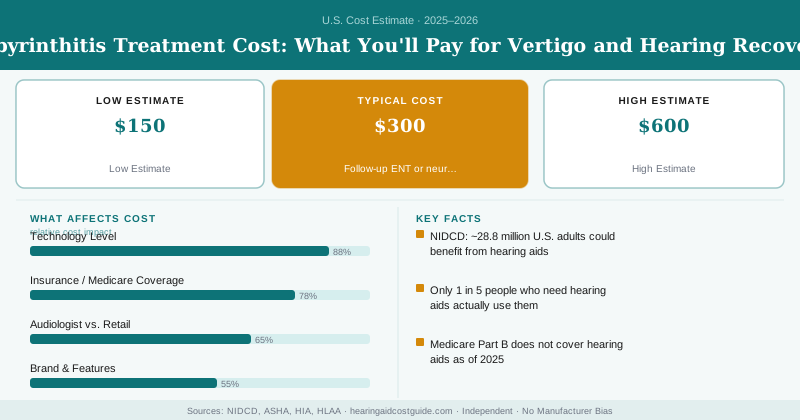
| Follow-up ENT or neurotology visit | $150 | $300 | $600 |
Most patients with mild labyrinthitis spend $300–$800 total. Those with severe onset — who present to the ER, require imaging, and need vestibular rehabilitation — can spend $3,000–$6,000, depending on insurance.
Why MRI Costs So Much
When labyrinthitis presents suddenly with severe vertigo and hearing loss, the immediate concern is ruling out stroke, particularly a posterior circulation (brainstem or cerebellar) stroke. Older adults and those with vascular risk factors should get an MRI-DWI (diffusion-weighted imaging) to exclude this emergency.
At a hospital outpatient facility, brain MRI with contrast runs $1,000–$3,500 before insurance. At a freestanding imaging center, the same scan often costs $400–$900. If your doctor orders imaging, ask specifically whether it can be done at an outpatient radiology center rather than the hospital system — the savings can be substantial.
Under Medicare, MRI is covered under Part B (outpatient diagnostic). You’ll pay 20% coinsurance after the annual deductible; the typical out-of-pocket is $80–$300 depending on your specific plan.
Steroids: The Most Important Treatment
The most effective proven treatment for labyrinthitis-related sudden hearing loss is a short course of oral corticosteroids — typically methylprednisolone or prednisone started as early as possible after symptom onset. The NIDCD notes that sudden sensorineural hearing loss (SSNHL) affects approximately 1 in 5,000 people annually in the United States, with better hearing recovery outcomes when steroids are started within 72 hours of onset.
A 10–14 day steroid taper prescription costs $15–$120 generic at most pharmacies. That’s one of the best value-for-cost interventions in all of otolaryngology. The catch is that steroids must be started promptly — which is why getting to a doctor quickly matters more than where you go.
If you experience sudden hearing loss in one ear — even accompanied by vertigo — treat it as a medical emergency. The window for the best steroid response is the first 72 hours. Don’t wait to see if your hearing “comes back on its own” before calling a doctor. Same-day care significantly improves hearing recovery odds.
Vestibular Rehabilitation Therapy: When You Need It and What It Costs
Most people with labyrinthitis recover spontaneously within 4–12 weeks as the brain compensates for the imbalanced input from the damaged inner ear. But a meaningful minority — especially adults over 60 — don’t fully compensate on their own and need structured vestibular rehabilitation therapy (VRT).
VRT is a specialized form of physical therapy focused on retraining the brain’s balance compensation. Sessions typically last 45–60 minutes and occur once or twice weekly for 6–12 weeks. Individual session costs run $75–$150 at outpatient physical therapy practices; specialty vestibular rehabilitation programs at neurotology centers can charge $150–$250 per session.
Most insurance plans cover VRT when it’s ordered by a physician and the provider is an in-network physical therapist. Check your plan’s physical therapy benefits — many have annual visit limits (20–30 sessions) and require a copay of $20–$60 per session.
Hearing Loss After Labyrinthitis: The Lingering Cost
Unlike vestibular neuritis, labyrinthitis involves the cochlea — the hearing portion of the inner ear. Some patients experience permanent hearing loss in the affected ear even after vertigo resolves. The American Academy of Audiology recommends a follow-up audiogram at 3 and 6 months post-diagnosis to track hearing recovery.
If hearing loss persists, you’ll face a decision:
- Single-sided deafness (SSD) options — CROS hearing aids ($2,000–$5,500) or bone-anchored devices ($5,000–$9,000 with surgery) if the other ear is normal
- Amplification in the affected ear — if loss is moderate and the ear still responds to sound, a conventional hearing aid may restore functional hearing
Budget $75–$400 for post-recovery audiological evaluation, and potentially $1,500–$7,000+ for hearing aids if amplification becomes necessary.
Sudden hearing loss accompanied by vertigo requires immediate medical evaluation — ideally within 24 hours. Don’t assume it’s just an ear infection. Labyrinthitis, SSNHL, acoustic neuroma, and posterior stroke can all present similarly, and some of these require urgent treatment to prevent permanent damage.
Does Insurance Cover Labyrinthitis Treatment?
Yes — all major components of labyrinthitis treatment are medically covered services:
- Physician visits — covered under medical benefit, not hearing benefit
- Imaging (MRI) — covered as diagnostic procedure
- Prescription medications — covered under pharmacy benefit
- Vestibular rehabilitation — covered as physical therapy
- Audiograms — typically covered under medical benefit when ordered for medical diagnosis (not for hearing aid fitting purposes)
The key distinction is that labyrinthitis is a medical condition, not a hearing aid-related service. All treatment flows through your medical benefit — your deductible, coinsurance, and out-of-pocket maximum apply just like for any other illness.
Managing Costs Without Going to the ER
If your vertigo is severe but you’re stable, an urgent care with an ENT on call or a next-day ENT appointment may cost far less than an ER visit. The ER’s primary role in labyrinthitis is ruling out stroke — if you’re young, have no vascular risk factors, and the onset pattern is typical for viral labyrinthitis, many otologists support starting steroid treatment through an urgent ENT visit rather than an emergency room.
That said, never delay care if you have neurological symptoms (double vision, difficulty walking, slurred speech, severe headache) alongside your vertigo. Those symptoms suggest a central rather than inner ear cause and require immediate ER evaluation.
Frequently Asked Questions
An emergency room visit for labyrinthitis diagnosis typically costs $1,500–$2,000 before imaging or specialist consultation, according to 2024 hospital pricing data. If an MRI is ordered to rule out stroke (common with acute vertigo), add $800–$1,200 to the total bill. Some urgent care facilities charge $100–$300 for initial evaluation, but often refer complex cases to the ER, resulting in the higher cost.
Most major health insurance plans cover vestibular rehabilitation therapy when prescribed by a physician, though many require a 10–20% copay per session ($25–$75 per visit). Out-of-pocket costs typically range $150–$300 per session if uninsured, with treatment lasting 8–12 weeks (roughly $1,200–$3,600 total). Some plans limit coverage to 15–20 visits annually, potentially leaving patients responsible for additional sessions.
Most patients experience symptom improvement within 2–4 weeks with corticosteroid treatment and anti-nausea medication, though full recovery typically requires 6–12 weeks of gradual activity resumption. Vestibular rehabilitation therapy accelerates recovery and is usually performed 2–3 times per week for 8–12 weeks, during which time many patients can gradually return to work or light activities. Older adults or those with severe initial symptoms may require extended recovery (3–6 months) and longer therapy courses.