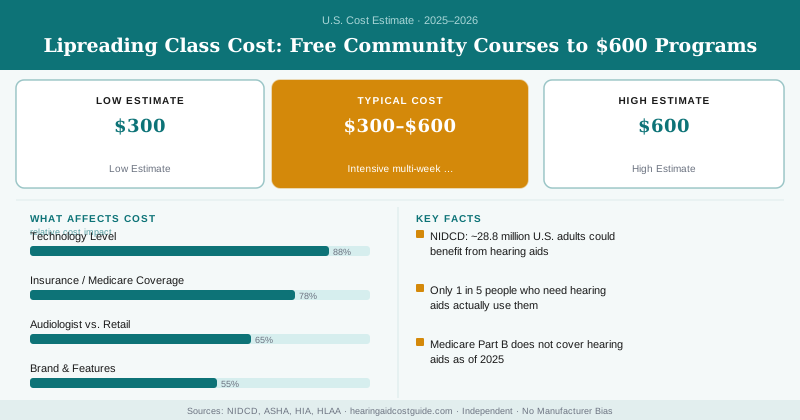
Roughly 40% of speech information is visible on the lips and face, which is why so many people with hearing loss are already lipreading without realizing it. Learning to do it deliberately can make a real difference — and the price tag is friendlier than almost anything else in hearing care. Lipreading classes run from free community courses up to about $600 for intensive private coaching. Here’s the full rundown.
Lipreading Class Costs
| Format | Cost |
|---|---|
| Community / nonprofit group classes | Free–$50 |
| Senior center or library courses | Free–$40 |
| Online self-paced courses | $20–$150 |
| Live online group classes | $100–$300 |
| Private one-on-one coaching | $50–$120/hour |
| Intensive multi-week private program | $300–$600 |
Lipreading — also called speechreading — is one of the few hearing-related skills you can learn for genuinely free in many communities. Nonprofits, senior centers, and hearing-loss associations frequently run no-cost or low-cost classes.
Why Lipreading Is Worth Learning
ASHA describes speechreading as using visual cues — lip movements, facial expression, gestures — to supplement what you hear. It doesn’t replace hearing aids; it complements them. Even people with excellent hearing aids lean on visual cues in noisy rooms, and the NIDCD notes that understanding speech in background noise is one of the most common difficulties for people with hearing loss. Lipreading directly attacks that problem.
The skill also keeps working when technology doesn’t — a dead hearing aid battery, a noisy party, a mask-free face across a loud table.
Lipreading classes cost anywhere from free to about $600. Community and nonprofit group courses are often free or under $50, making this one of the cheapest, highest-value skills in all of hearing care. Reserve paid private coaching for those who want faster, personalized progress.
Group vs. Private
Group classes are the best value — frequently free, socially supportive, and effective for steady learning. The trade-off is pace; you go at the group’s speed.
Private coaching costs $50–$120 an hour and makes sense if you want intensive, customized work or have a specific deadline (a new job, a big life change). It’s faster, but you’re paying for that speed.
Online courses split the difference: cheaper than private coaching, more flexible than in-person groups, and easy to redo as many times as you like.
Lipreading is a supplement, not a substitute. It can’t fully replace hearing, and relying on it alone in important situations (medical appointments, legal matters) is risky. Pair it with appropriate technology and, when accuracy matters, request captioning or an interpreter.
How It Fits Your Hearing Plan
Lipreading pairs naturally with the rest of hearing care. It’s a standard component of formal aural rehabilitation cost programs and complements hearing aid cost investments — the two together beat either alone. If you haven’t had recent testing, a hearing test and audiologist visit help your instructor (and you) understand exactly what you’re working with.
Saving Money
- Check local nonprofits first. Hearing-loss associations and senior centers often run free classes.
- Ask your audiologist. Many keep referral lists for low-cost community programs.
- Use free online videos to start. They’re a no-cost way to see if the skill clicks before paying.
- Practice for free at home. Watch TV with the sound low and captions off to drill the skill daily.
The Bottom Line
Lipreading is the rare hearing-care skill that’s powerful, practical, and frequently free. Start with a community or library class and only step up to paid online or private coaching if you want faster, tailored progress. For most people, this is the best dollar-for-dollar investment in their entire hearing plan.
Frequently Asked Questions
Lipreading classes range from free community courses offered by nonprofits and libraries to group classes costing $100-$300 and intensive private coaching programs reaching up to $600. Online courses typically fall in the $50-$200 range depending on the provider and program length.
Most health insurance plans do not cover lipreading classes as they are considered educational rather than medical treatment. However, some vocational rehabilitation programs and state services for the deaf and hard of hearing may cover or subsidize classes, so it's worth checking with your state's disability services agency.
Basic lipreading skills typically develop within 4-8 weeks of regular practice with group classes meeting once or twice weekly. More advanced proficiency usually requires 3-6 months of consistent study, though many people see meaningful improvement in their ability to follow conversation within the first few weeks.