Most people with mild hearing loss don’t think they have hearing loss. They think everyone else just mumbles. That gap between perception and reality is exactly why the average American waits nearly a decade before addressing a problem they noticed years earlier — and why understanding the cost of acting now versus later actually matters.
Let’s start with the numbers, then get into the decision that’s harder: whether you need to act at all.
What “Mild” Hearing Loss Actually Means
On an audiogram, mild hearing loss sits between 26 and 40 decibels (dB HL). At this level, you can typically hear normal conversational speech in quiet environments without much difficulty. The problems appear in noise — restaurants, group conversations, TV at normal volumes, soft-spoken people.
Below 25 dB is considered normal. At 41 dB, you’ve crossed into moderate territory, where understanding speech without aids becomes genuinely difficult for most people. The 26–40 dB range is the gray zone where the “do I need a hearing aid?” question lives.
Cost by Option Type for Mild Hearing Loss
| Option | Cost (per pair) | Requires Audiologist? |
|---|---|---|
| PSAP (personal sound amplification) | $30–$200 | No |
| FDA-regulated OTC hearing aid | $100–$800 | No |
| Prescription entry-level (bundled) | $1,000–$2,500 | Yes |
| Prescription mid-range (bundled) | $2,500–$4,000 | Yes |
| Prescription premium (bundled) | $4,000–$5,500 | Yes |
| Audiogram evaluation (required for Rx) | $200–$350 (one-time) | Yes |
OTC Hearing Aids: The New Option Worth Taking Seriously
The FDA finalized rules for over-the-counter hearing aids in 2022 — a genuine shift that created a legal, regulated category of hearing devices available without a prescription, specifically for adults with perceived mild to moderate hearing loss. This matters for anyone with mild loss who balks at spending $3,000+ at an audiology clinic.
The best OTC options right now include:
- Sony CRE-10 / CRE-20 — $200–$250 per pair; self-fitting, discreet, solid performance for flat mild loss
- Jabra Enhance Select — $800–$1,200 per pair; includes optional audiologist telehealth support, arguably the most clinical of the OTC options
- Lexie Lumen (powered by Bose) — $499–$799 per pair; app-based self-fitting with a subscription support model
- Eargo 7 — $1,650 per pair; technically in the OTC-adjacent premium space, excellent invisibility, strong tinnitus support
OTC devices are not a consolation prize. For mild, relatively flat hearing loss in someone who’s self-motivated to adjust settings, they deliver measurable benefit at a fraction of prescription costs. The limitation: they don’t provide custom programming matched to your specific audiogram. If your loss has a slope (drops at high frequencies more than low), OTC algorithms are less precise.
OTC is reasonable if:
- Your hearing difficulty is mild and consistent across environments
- You’re under 60 with no cognitive concerns
- You’re comfortable adjusting a smartphone app
- Budget is a significant constraint
Prescription is better if:
- Your audiogram shows an asymmetric or sloping loss pattern
- You’ve already tried OTC and weren’t satisfied
- You have tinnitus alongside your hearing loss
- You’re 65+ (annual audiologist follow-up matters more)
- You need documentation for workplace accommodations or insurance
The “Wait and See” Trap
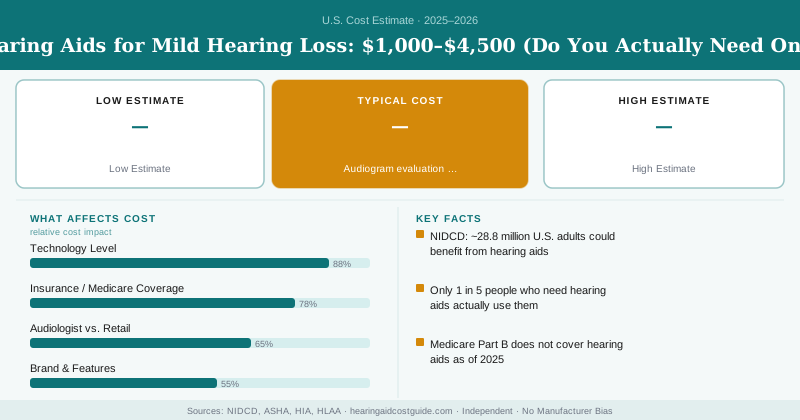
Here’s what the numbers actually say about waiting. The NIDCD reports that approximately 28.8 million U.S. adults could benefit from hearing aids but don’t use them. A significant share of those have mild loss and are in the “it’s not bad enough yet” holding pattern.
The problem is that mild hearing loss doesn’t stay mild. It progresses — slowly for most people, faster for some. And while it’s progressing, there’s accumulating evidence of downstream consequences. A landmark 2011 Johns Hopkins study by Dr. Frank Lin found that mild hearing loss doubles the risk of dementia, independent of age and other factors. The theory is that the cognitive load of straining to hear accelerates brain fatigue and reduces cognitive reserve.
That doesn’t mean everyone with 30 dB loss needs $5,000 hearing aids immediately. It does mean the cost of doing nothing isn’t zero.
Insurance Coverage for Mild Hearing Loss
Here’s where mild loss buyers often get frustrated: insurance coverage for hearing aids is spotty regardless of severity level.
- Original Medicare: doesn’t cover hearing aids at all, regardless of degree of loss
- Medicare Advantage: about 80% of MA plans include some hearing aid benefit, typically $500–$3,000 per ear every 1–3 years
- Medicaid: coverage varies by state; some states cover pediatric hearing aids but not adult
- Private insurance: sporadic; many employer plans now include a hearing aid benefit of $500–$1,500 per year
The degree of hearing loss (mild vs. moderate vs. severe) generally doesn’t determine whether your insurance covers aids — it’s whether your plan includes hearing benefits at all.
Hearing aids — including FDA-regulated OTC devices — are an eligible expense under both FSA (Flexible Spending Account) and HSA (Health Savings Account). If you have these accounts, use them. A $1,500 hearing aid purchased with pre-tax HSA dollars effectively costs you $1,050–$1,200 depending on your tax bracket.
Prescription Entry-Level: Enough Technology for Most Mild Loss
A common mistake with mild hearing loss is overspending on premium-tier technology. The premium aids ($4,000–$6,500 per pair) pack AI processors, health sensors, and sophisticated noise programs designed for moderate-to-severe loss environments. For mild loss, that’s engineering overkill — you’re paying for capability you won’t use.
Entry-level and mid-range prescription aids from reputable brands cover the bases that mild-loss users actually need:
- Basic directional microphones
- Bluetooth streaming from phones
- Comfortable everyday amplification
- Rechargeable batteries
- A proper audiologist-programmed fitting
For $1,500–$2,500 per pair with professional fitting, you’re getting a meaningful upgrade over OTC and paying roughly half the premium-tier price.
Don’t purchase hearing aids — OTC or prescription — without first getting an audiogram. Even if you’re buying OTC, a baseline audiogram ($200–$350) tells you exactly where your hearing drops and helps you make a much more informed decision. Some hearing loss patterns that feel “mild” are actually signs of conditions requiring medical attention before amplification.
The Bottom Line for Mild Hearing Loss
Mild hearing loss is the easiest type to rationalize ignoring. It’s also the most treatable category, with the widest range of options from $100 OTC devices to $5,000 premium aids. The right answer depends on your audiogram shape, your lifestyle, your age, and your budget — but in 2026, the days of “it’s not bad enough yet” as a permanent strategy are well-supported against by the evidence. Start with an evaluation. Then decide.
Frequently Asked Questions
For mild hearing loss (26–40 dB), OTC hearing aids run $100–$800 per pair and are available without a prescription. Prescription entry-level aids from brands like Phonak or Starkey cost $1,000–$2,500 per pair. Premium prescription models run $3,500–$5,500 per pair but are generally more technology than mild loss requires. Most audiologists recommend starting with a mid-range prescription aid or a quality OTC device depending on your specific audiogram pattern.
Not always immediately — but earlier is usually better. Mild hearing loss at 30–35 dB is often perceived as just needing to ask people to repeat themselves, but untreated mild loss in adults over 50 is associated with accelerated cognitive decline according to multiple longitudinal studies. The NIDCD notes that on average, adults wait 10 years from first noticing hearing difficulty to seeking treatment, a delay that worsens outcomes. If you're missing words in noisy environments regularly, an audiologist evaluation is worth the $200–$350 cost.
For truly mild, flat hearing loss (consistent difficulty across frequencies), quality OTC aids like the Jabra Enhance Select, Lexie Lumen, or Sony CRE series ($200–$800 per pair) can provide meaningful benefit. They're FDA-regulated for adults with perceived mild to moderate hearing loss. However, OTC devices work best when your hearing loss is straightforward; if your audiogram shows a sloping pattern or specific frequency drops, a prescription fitting by an audiologist will produce a noticeably better result.