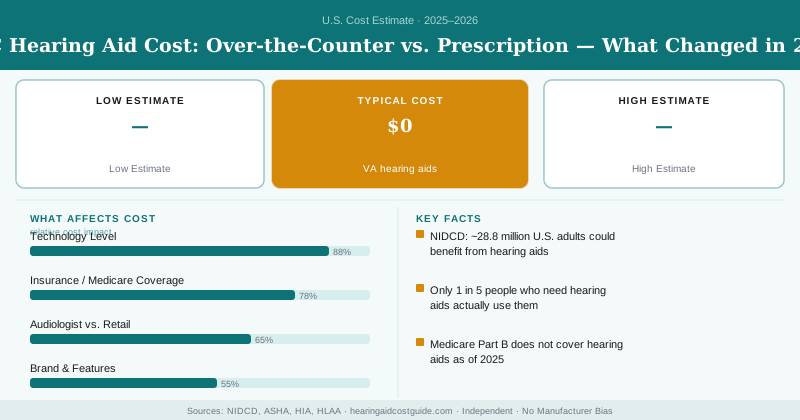
Before October 2022, buying a hearing aid required a prescription, an audiologist fitting, and typically $2,000–$7,000. The FDA changed that. On October 17, 2022, new regulations took effect establishing over-the-counter hearing aids as a distinct product category — legal to sell directly to adults without a medical exam, prescription, or fitting by a licensed professional.
That’s a genuine shift. The question is what it actually delivers — and for whom.
OTC vs. Prescription: The Cost Comparison
| Category | Price Range | What’s Included |
|---|---|---|
| OTC hearing aids (entry) | $200–$600/pair | Basic amplification, app self-fitting |
| OTC hearing aids (premium) | $800–$1,500/pair | Better processing, noise reduction, Bluetooth |
| Costco prescription aids | $1,400–$1,600/pair | Audiologist or HIS fitting, professional follow-up |
| Independent audiology clinic | $3,000–$7,000/pair | Full audiological workup + fitting |
| VA hearing aids | Free | For eligible veterans |
What the FDA’s OTC Category Actually Means
The FDA’s final rule on OTC hearing aids defines the category precisely. Key restrictions:
- Adults only: OTC aids are for people 18 and older
- Mild-to-moderate loss only: OTC aids are designed and regulated for perceived mild-to-moderate hearing loss — defined as audiometric thresholds no worse than 70 dB HL
- Self-perceived need: No audiogram required to purchase
- Output limits: FDA caps maximum output at 120 dB SPL and maximum gain at 25 dB for most OTC devices
This last point matters. OTC aids are hardware-limited to prevent dangerous over-amplification in untrained hands. Prescription aids have no such cap — they’re programmed to your audiogram by a professional and can be fit to any severity of loss.
Top OTC Brands and Their Costs
Sony CRE-10 / CRE-20 ($999–$1,299/pair): Self-contained rechargeable aids with an app-based fitting quiz. Independent testing has found the Sony CRE line competitive with prescription aids in quiet environments. The CRE-20 adds rechargeable batteries.
Jabra Enhance Plus ($799/pair): Earbuds that double as hearing aids. Self-fitting via app. Good Bluetooth integration. Best for people comfortable with in-ear earbuds. Strong return policy.
Lexie Lumen ($799/pair): Powered by Bose audio technology. App-based self-fitting, subscription model option. Good choice for tech-comfortable users.
Eargo 7 ($1,499/pair): Receiver-in-canal design, very discreet, app-based fitting. Eargo has a direct-to-consumer model and a dedicated support team. Has faced regulatory scrutiny in the past; currently FDA-cleared under the OTC category.
Amazon Basics Hearing Aid ($199–$299/pair): Budget entry. Limited programming options. May help with mild, flat hearing loss. Not recommended for anyone with sloping or complex loss.
Real-ear measurement (REM) is the gold standard for verifying that a hearing aid is delivering the right amount of amplification at each frequency for your specific ear canal. It’s a quick in-office procedure — but it requires specialized equipment and a trained professional. No OTC device can replicate it. Research from the Journal of the American Academy of Audiology shows that prescription aids fitted with REM outperform non-verified fittings significantly in speech intelligibility. This is the core tradeoff with OTC devices.
Who OTC Works For
OTC aids deliver real value for a specific population. You’re a good candidate if:
- You’re an adult who’s noticed gradual, symmetric (both ears similar) difficulty understanding speech in noise
- Your loss is in the mild-to-moderate range
- You’re comfortable with smartphone apps and self-adjustment
- You want to try hearing aids before committing to a full audiological workup
- You have mild loss and can’t afford prescription aids
Who Needs Prescription Instead
Don’t use OTC aids as a substitute for professional evaluation if:
- Your hearing loss is severe or profound
- You have asymmetric loss (one ear notably worse than the other)
- Your hearing loss started suddenly or recently
- You have tinnitus, dizziness, or ear pain alongside hearing difficulty
- You’ve tried OTC aids and they’re not helping
- You’re under 18
Asymmetric hearing loss — where one ear is significantly worse than the other — can indicate a medically serious underlying cause, including acoustic neuroma. It requires an audiological evaluation and possible MRI before any hearing aid fitting. Don’t self-diagnose this with an OTC device. See an audiologist or ENT first.
Return Policies Matter More Than You Think
Self-fitting means trial and error. Return windows are critical. Current return policies for major OTC brands:
- Jabra Enhance: 100-day return
- Sony CRE: 30-day return at most retailers
- Eargo: 45-day return
- Lexie: 45-day return
- Costco (all brands): 180-day return — the most generous in the industry
If you’re trying OTC aids, prioritize vendors with 45+ day return windows. The first two weeks are adjustment period; you need time beyond that to honestly assess whether the aids are working.
The Costco Middle Ground
Costco isn’t an OTC option — it’s full prescription fitting at dramatically reduced prices. For $1,400–$1,600/pair, you get hearing aids from name-brand manufacturers (Philips HearLink, Rexton, Kirkland Signature), fitted and programmed by a licensed hearing instrument specialist, with follow-up appointments included.
This is the best value in the prescription hearing aid market. If OTC aids haven’t worked for you, or if you want professional fitting without the $4,000–$7,000 price tag of an independent clinic, Costco is worth serious consideration. The $65 membership pays for itself immediately.
The Bottom Line
The FDA’s OTC category was the right policy change — it made hearing healthcare more accessible and affordable. For mild-to-moderate loss, OTC aids are worth trying. But they’re not equivalent to professionally fitted prescription aids in speech intelligibility, especially in noise. If you’re on the fence about your severity level, start with a professional hearing evaluation. It typically costs $0–$100 with insurance — and it tells you exactly where on the spectrum you fall before you spend $1,500 on a device that may not be the right tool.
Frequently Asked Questions
For mild-to-moderate hearing loss in adults, OTC aids can be effective — but 'as good' depends on your specific hearing profile and expectations. OTC aids skip the audiogram-verified fitting and real-ear measurement that prescription aids receive, which means the output may not match your actual hearing loss curve precisely. Consumer Reports testing has found that some OTC aids (Sony CRE, Jabra Enhance Plus) perform well on objective measures. Others don't. The gap widens for people with more complex hearing loss or those who struggle in background noise.
OTC aids are restricted by the FDA to adults 18+ with perceived mild-to-moderate hearing loss. You shouldn't use OTC aids if you have severe or profound hearing loss, if your hearing loss started suddenly (within 90 days), if you have pain, drainage, or dizziness associated with your hearing symptoms, if your hearing loss is different between ears, or if you're under 18. These situations require medical evaluation before any hearing aid fitting.
Yes — Costco is one of the best values in the prescription hearing aid market. Costco sells hearing aids from Philips and Rexton (Signia), as well as its own Kirkland Signature brand, fitted by licensed hearing instrument specialists. Prices typically run $1,400–$1,600/pair for premium devices with professional fitting included — roughly half the price of equivalent devices at independent audiology practices. Costco requires a Costco membership ($65/year). It's not OTC — it's prescription-level fitting at a significantly reduced price.