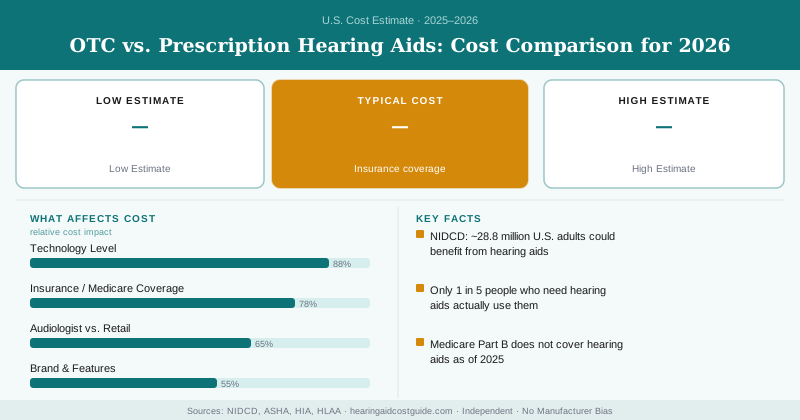
42% of American adults who could benefit from hearing aids have never had a hearing test, according to NIDCD-associated research — and cost is consistently cited as one of the biggest reasons why. The 2022 FDA rule creating a true over-the-counter hearing aid category was designed specifically to chip away at that number, and four years later, it’s reshaping how people shop.
The core tradeoff is straightforward: OTC devices cost a fraction of prescription hearing aids, but you lose the professional fitting, real-ear verification, and ongoing audiologist relationship that comes standard with the prescription path. Whether that tradeoff makes sense depends almost entirely on how severe and complex your hearing loss actually is.
Cost Comparison: OTC vs. Prescription
| Category | OTC Hearing Aids | Prescription Hearing Aids |
|---|---|---|
| Device cost (pair) | $200–$1,600 | $3,000–$7,000 |
| Hearing evaluation | Self-assessment app or online test | $150–$350 audiologist evaluation |
| Professional fitting | None (self-fit via app) | Included — real-ear verification |
| Follow-up adjustments | Self-adjusted via app | Included, typically 1+ year |
| Candidacy | Adults 18+, mild-to-moderate perceived loss | Any age, any severity |
| Insurance coverage | Rarely covered | Sometimes partially covered |
Who OTC Devices Are Actually Built For
The FDA created the OTC category specifically for adults 18 and older with self-perceived mild-to-moderate hearing loss — think difficulty following conversations in noisy restaurants or needing the TV volume higher than others prefer, but not profound or rapidly worsening hearing loss. If that describes your situation, OTC devices from brands like Sony, Jabra, and Lexie can deliver genuinely comparable real-world benefit at a fraction of the cost.
Who Should Skip OTC and Go Prescription
Prescription hearing aids, fitted by a licensed audiologist, remain the better — sometimes only appropriate — path for:
- Children and teens under 18 (OTC devices are adults-only by FDA regulation)
- Moderate-to-severe or profound hearing loss
- Asymmetric hearing loss (one ear significantly worse than the other — this needs medical evaluation first, not just amplification)
- Complex cases involving tinnitus management, cognitive considerations, or prior ear surgery
- Anyone who’s tried OTC and found the self-fit apps insufficient for their needs
Prescription hearing aid fittings include something called real-ear measurement (REM) — a probe microphone placed in your ear canal during fitting to confirm the device is actually delivering the prescribed amplification at your eardrum, not just what the manufacturer’s default programming assumes. OTC devices rely entirely on self-reported adjustment through an app, with no professional verification step. For straightforward hearing loss this usually works fine; for complex cases, the missing verification is exactly where things go wrong.
The Real Cost Difference Isn’t Just the Device
A $3,500 prescription hearing aid isn’t 3,500 dollars of hardware — it’s bundled with the audiologist’s time: the initial evaluation, the fitting appointment, several follow-up adjustment visits over the first year, and often ongoing care for the life of the device. A $400 OTC pair is genuinely just the device. If something doesn’t sound right, you’re troubleshooting through an app and a customer support line, not sitting across from a professional who can measure and adjust in real time.
A Middle Path: Hybrid Approach
An increasing number of people start with a low-cost hearing screening (many audiology practices and OTC brands offer free or cheap online tests) to establish a baseline, try OTC devices first given the low financial risk, and then escalate to a full audiologist evaluation and prescription fitting only if the OTC option doesn’t deliver enough benefit. This staged approach limits your upfront financial exposure while keeping the professional path open if needed.
Don’t buy an OTC device if you have sudden hearing loss, ear pain, drainage, or asymmetric hearing loss between your two ears. These symptoms require medical evaluation first — an OTC hearing aid could mask a treatable underlying condition (infection, tumor, blockage) that needs actual diagnosis, not just amplification.
Whichever path you choose, get a documented hearing test first — even a free online or app-based screening gives you a baseline to compare against later and helps confirm you’re actually a good OTC candidate before spending anything.
Frequently Asked Questions
OTC hearing aids cost $200–$1,600 per pair compared to $3,000–$7,000 for prescription devices — roughly 60–90% less, though prescription devices include professional fitting, verification, and follow-up care that OTC purchases typically don't.
For mild-to-moderate, perceived hearing loss in adults, FDA data supporting the 2022 OTC rule change found comparable real-world benefit to prescription devices in many cases. For moderate-to-severe or complex hearing loss, prescription devices with professional fitting generally outperform OTC options.
Yes. Since the FDA's 2022 OTC hearing aid rule took effect, registered OTC devices meet defined federal safety and output standards for adults 18+ with perceived mild-to-moderate hearing loss, distinguishing them from unregulated personal sound amplifiers.