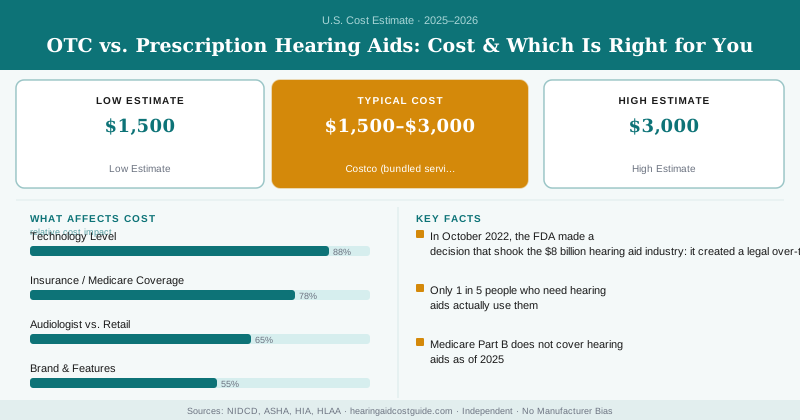
In October 2022, the FDA made a decision that shook the $8 billion hearing aid industry: it created a legal over-the-counter category for hearing aids. No prescription required. No audiologist visit. Buy them at Best Buy, Amazon, or directly from the manufacturer.
The price difference is dramatic. Here’s how to decide which path makes sense for you.
The Core Price Comparison
| Category | Price Range (Per Pair) | Requires Audiologist? |
|---|---|---|
| OTC — basic | $200–$600 | No |
| OTC — mid-tier | $600–$1,200 | No |
| OTC — premium | $1,200–$1,600 | No |
| Prescription — entry | $2,000–$3,500 | Yes |
| Prescription — mid | $3,500–$5,500 | Yes |
| Prescription — premium | $5,500–$8,000+ | Yes |
| Costco (bundled service, low overhead) | $1,500–$3,000 | Yes (hearing instrument specialist) |
What the FDA 2022 Rule Actually Changed
Before October 2022, federal law required that hearing aids be sold only through licensed hearing professionals. That requirement — in place since 1976 — was effectively a monopoly that kept prices high.
The FDA’s new OTC rule allows adults 18 and older with perceived mild-to-moderate hearing loss to buy hearing aids directly, self-fit them using a smartphone app, and adjust them without any clinical involvement. According to the FDA, this change was designed to improve access and reduce cost for the roughly 30 million American adults with untreated hearing loss.
Who Should Choose OTC
OTC hearing aids work well if:
- Your hearing loss is mild to moderate (difficulty in noisy environments, TV turned up, occasional missed words — but you can follow one-on-one conversation in quiet)
- You’re tech-comfortable — most OTC aids require a smartphone app for setup and adjustments
- You want to try amplification before committing to a full audiologist evaluation
- Your budget is limited and you need something functional now
Best OTC options in 2025–2026:
- Jabra Enhance Plus — $799/pair, strong audiologist-designed tuning
- Sony CRE series — $999–$1,299/pair, discreet design, trusted brand
- Lexie Lumen — $799/pair, subscription support available
- Eargo 7 — $1,650/pair (premium OTC, in-canal style)
A 2023 study published in JAMA Otolaryngology compared OTC and prescription hearing aids for adults with mild-to-moderate hearing loss. The OTC devices performed comparably to prescription aids on speech understanding outcomes — at a fraction of the price. For the right candidate, OTC is a clinically legitimate choice.
Who Needs Prescription Hearing Aids
Prescription aids — dispensed by an audiologist or licensed hearing instrument specialist — are the right choice when:
- You have moderate-to-severe or severe hearing loss (difficulty in most environments, struggle to follow conversations even in quiet)
- You have single-sided deafness or a complex loss profile requiring specialized fitting
- You’ve tried OTC aids and they haven’t provided enough help
- You have medical conditions affecting your hearing (ear infections, sudden hearing loss, asymmetric loss) that need evaluation first
- You want premium features: custom ear molds, cochlear implant compatibility, specialized tinnitus programs, or pediatric programming
The audiologist visit included in prescription pricing provides a formal audiogram, real-ear measurement (verifying aids are properly set for your specific ear canal), and ongoing fine-tuning.
The Costco Middle Ground
Costco Hearing Aid Centers offer a compelling middle path: licensed hearing instrument specialists, current-generation technology from brands like Philips, Jabra, and Rexton, and bundled service — at $1,500–$3,000 per pair. That’s 30–50% less than private audiology clinics for comparable equipment.
If you need professional fitting but can’t justify premium clinic pricing, Costco is often the smart answer.
| Factor | OTC | Prescription | Costco |
|---|---|---|---|
| Price | $200–$1,600 | $3,000–$8,000 | $1,500–$3,000 |
| Professional fitting | No | Yes | Yes |
| Audiogram required | No | Yes | Yes |
| Suitable for severe loss | No | Yes | Yes (mid-severe) |
| Smartphone app fitting | Usually | Often | Varies |
| Trial period | 30–60 days | 30–75 days | 180 days |
| Follow-up included | No | Yes (bundled) | Yes |
One Important Warning
The FDA OTC rule applies only to adults with self-perceived mild-to-moderate hearing loss. If you haven’t had a professional hearing evaluation in the last few years, you may have more significant loss than you realize — and OTC aids may leave you underserved.
The American Speech-Language-Hearing Association (ASHA) recommends that any adult considering hearing aids get a baseline audiogram from a licensed audiologist first — even if you ultimately choose OTC devices. A hearing test typically costs $0–$75 with insurance and identifies any medically treatable conditions that need attention before amplification.
Bottom Line
OTC aids are a legitimate, cost-effective choice for mild-to-moderate hearing loss — and the FDA rule has dramatically expanded access. For more significant loss, complex profiles, or anyone who wants professional verification that aids are correctly set, prescription aids via a clinic or Costco remain the better clinical choice. The price difference is real; so are the differences in what each option can deliver.
Frequently Asked Questions
OTC hearing aids typically cost between $200–$1,600 per pair and can be purchased without a prescription or audiologist visit. Prescription hearing aids are significantly more expensive, ranging from $3,000–$8,000 per pair and require a professional fitting and ongoing care from an audiologist.
Most standard health insurance plans, including Medicare, do not cover hearing aids of either type, leaving patients to pay out-of-pocket for the full cost. However, some Medicare Advantage plans and select employer-sponsored plans may offer limited coverage or discounts on prescription hearing aids, typically covering $500–$2,000 of the total cost.
OTC hearing aids work best for adults with mild to moderate hearing loss who want an affordable, quick solution without scheduling an audiologist appointment. Prescription hearing aids are recommended for people with severe hearing loss, complex hearing needs, or those who require ongoing professional adjustments and personalized fitting from an audiologist.