Oticon’s Intent hearing aid arrived in 2024 carrying a big claim: it’s the first hearing aid that uses motion sensors to figure out what you’re trying to listen to — and then adjusts automatically. The price reflects that ambition. Here’s a realistic breakdown of what Intent costs, and whether those extra features are worth it for you.
What Makes Oticon Intent Different
Most hearing aids use microphones to detect sound. Intent adds a 4D Sensor — four motion sensors that detect head movement and body movement. Walking and turning your head toward someone talking? The system reads those cues and prioritizes that speaker.
The underlying processing runs on Oticon’s Deep Neural Network (DNN) — trained on 12 million real-world sound scenes, according to Oticon’s own published clinical data from 2024. That’s the same architecture that powered the Oticon Real, just iterated further.
For people who struggle in noisy environments despite wearing hearing aids, this is a meaningful leap. For someone with mild hearing loss in a quieter lifestyle, it may be overkill.
Oticon Intent Price Guide
Oticon organizes Intent into four technology levels, designated 1 through 4. Level 1 is the premium tier; Level 4 is the most accessible entry point.
| Technology Level | Per Device | Per Pair (Est.) |
|---|---|---|
| Intent 1 (premium) | $2,400–$5,000 | $4,800–$10,000 |
| Intent 2 (advanced) | $1,900–$3,200 | $3,800–$6,400 |
| Intent 3 (standard) | $1,500–$2,400 | $3,000–$4,800 |
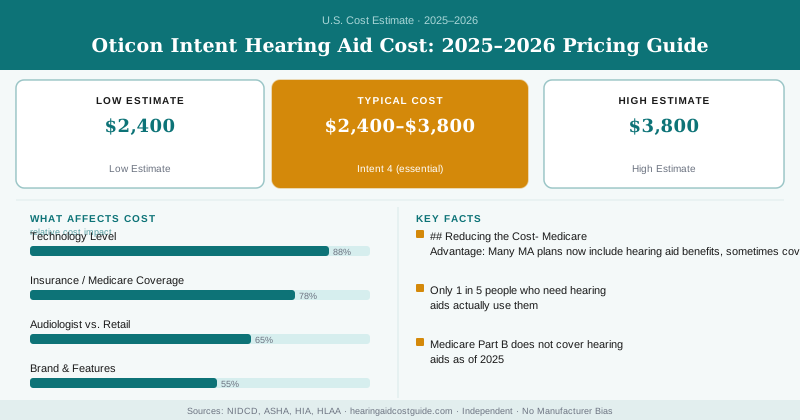
| Intent 4 (essential) | $1,200–$1,900 | $2,400–$3,800 |
Prices quoted by audiologists typically include fitting and standard follow-up care. The wide per-device range reflects regional variation and whether professional services are bundled. Always confirm what’s in the quoted price.
Style Options and What They Cost
Intent currently comes in one primary style: miniRITE R (receiver-in-the-ear, rechargeable). It doesn’t come in a traditional battery version — Oticon moved the flagship line fully to rechargeables.
The charger itself is included. Oticon also sells a SmartCharger that doubles as a portable carrying case and power bank, adding roughly $150–$200.
The 4D Sensor technology is present across all four levels. What changes between tiers is the sophistication of the DNN processing, the number of automatic listening programs, and wind-noise handling. For most conversational settings — dinner table, one-on-one meetings, telephone — Intent 2 performs nearly identically to Intent 1. The premium is most justified for people in highly variable listening environments throughout the day.
How Intent Compares to Oticon Real
Oticon released the Real in 2023, one year before Intent. The Real is still available and typically runs $400–$800 less per pair at equivalent technology tiers. The key difference: Real lacks the 4D motion sensors. If you don’t see yourself benefiting from movement-based adaptation, Real offers excellent value.
How Oticon Intent Compares to Other Premium Brands
At the Intent 1 level, you’re in the same price bracket as Phonak Lumity 90, Signia Integrated Xperience (IX), and Starkey Evolv AI 2400. All perform well. The choice usually comes down to which features matter most in your specific hearing profile — and which fitting philosophy your audiologist prefers.
According to the NIDCD, approximately 28.8 million U.S. adults could benefit from hearing aids. Of those, cost remains the primary reason for non-adoption. Choosing Intent 2 or 3 over Intent 1 can save $1,000–$2,000 per pair while retaining the core 4D Sensor technology.
Reducing the Cost
- Medicare Advantage: Many MA plans now include hearing aid benefits, sometimes covering up to $2,500 per pair per benefit period.
- HSA/FSA funds: Hearing aids are a qualified medical expense — use pre-tax dollars.
- Oticon’s financing: Available through many clinics via CareCredit or HearingLife’s in-house financing options.
- Veterans: The VA covers Oticon devices for eligible veterans with service-connected hearing loss — at no cost.
Be cautious about purchasing Oticon Intent through third-party online resellers who aren’t authorized dealers. Without a proper REM (real-ear measurement) fitting by a licensed audiologist, even the best hardware won’t perform optimally. Proper fitting is as important as the technology tier you choose.
Bottom Line
Oticon Intent 1 is one of the most sophisticated hearing aids on the market in 2025–2026. Expect to pay $4,800–$10,000 for a pair with professional services. If that’s beyond your budget, Intent 2 delivers nearly the same real-world benefit at a meaningfully lower price. Ask your audiologist for a demonstration in a noisy environment — that’s the best way to decide whether the upgrade is worth it for your lifestyle.
Frequently Asked Questions
Oticon Intent hearing aids cost between $2,400 and $5,000 per device, depending on the technology tier and features you select. Most users purchase a pair, which typically ranges from $4,800 to $10,000 total before insurance or manufacturer discounts.
Medicare does not cover hearing aids, leaving most seniors responsible for the full out-of-pocket cost. Some private insurance plans and state Medicaid programs offer partial coverage of $500–$2,000 per device, though many exclude hearing aids entirely—contact your plan directly to verify your specific benefits.
The fitting process typically takes 1–2 weeks from your initial hearing test to receiving your devices, which includes audiogram testing, device programming, and adjustment appointments. Most patients can wear their Intent aids immediately after the fitting appointment, though fine-tuning adjustments may occur over the following weeks.