In 2010, a pair of premium hearing aids amplified the sounds directly in front of you and hoped for the best. Today, Oticon’s latest platforms run a deep neural network trained on 12 million real-world sound scenes — distinguishing voices from background noise not by filtering the noise out, but by letting the brain receive a fuller sound picture and do its own filtering. That’s a philosophically different approach, and the clinical research behind it is genuinely interesting.
Here’s what Oticon More and the newer Intent platform cost, what the technology actually does, and how to decide if the premium is justified.
Oticon More and Intent Prices
Oticon’s Polaris platform (More) was released in 2021. Intent launched in 2024 as the current flagship. Both are widely available.
| Model | Technology Level | Pair Price |
|---|---|---|
| Oticon Intent 1 (top tier) | Premium | $5,000–$7,500 |
| Oticon Intent 2 | Advanced | $4,000–$5,500 |
| Oticon Intent 3 | Standard | $3,000–$4,500 |
| Oticon More 1 (previous flagship) | Premium | $3,500–$6,000 |
| Oticon More 2 | Advanced | $2,800–$4,500 |
| Oticon More 3 | Standard | $2,500–$3,500 |
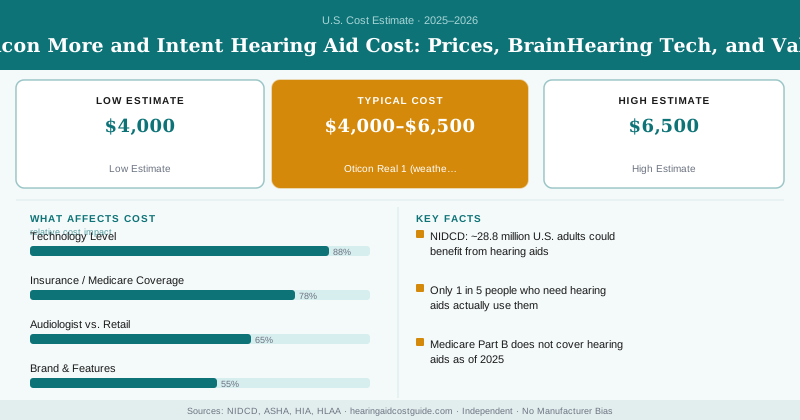
| Oticon Real 1 (weather/moisture) | Premium | $4,000–$6,500 |
Prices include audiologist fitting and follow-up in a bundled model. Unbundled pricing (device only) runs $400–$800 less per pair but doesn’t include follow-up programming visits, which are essential.
What BrainHearing Technology Actually Means
Most hearing aid manufacturers take a subtraction approach to noise: identify speech, identify background noise, reduce the noise. Oticon’s BrainHearing philosophy takes the opposite approach: give the brain as much acoustic information as possible — including directional and spatial cues — and let the brain’s natural auditory processing do what it evolved to do.
The Deep Neural Network (DNN) in the Polaris chip (More) and the newer Polaris+ chip (Intent) was trained on 12 million real-world sound scenes. It can identify and balance hundreds of sounds simultaneously in real time, rather than just suppressing noise.
Clinical data published in a 2021 peer-reviewed study (Oticon white paper, published in the Journal of Hearing Science) showed that More platform users achieved 15% better speech understanding and 20% less listening effort compared to a previous-generation device in challenging listening environments. That’s a meaningful real-world difference, not just a lab metric.
Oticon Intent: The New Addition
Oticon Intent, released in 2024, adds motion sensor technology to the BrainHearing platform — specifically, 4D Sensor technology that detects head movement and distinguishes it from body movement. The intent (pun somewhat intended) is to optimize directional processing based on whether you’ve turned your head toward a speaker.
In social gatherings where you move your head frequently to engage different people, this matters. For someone watching TV or in a quiet one-on-one conversation, the benefit is minimal.
Intent also adds Bluetooth LE Audio support, enabling lower-latency streaming from compatible Android and iOS devices — a practical improvement over More’s Bluetooth Classic implementation.
Oticon and Tinnitus
Oticon includes a built-in tinnitus management program across all More and Intent models. Rather than white noise masking, Oticon uses “Tinnitus SoundSupport” — customizable relief sounds including broadband noise, ocean waves, and naturalistic tones that can be blended with hearing aid amplification.
For the estimated 15–20% of adults with tinnitus who also have hearing loss (CDC, 2022), this eliminates the need for separate tinnitus masking devices and can be fully programmed by the audiologist at no additional cost.
Oticon’s BrainHearing approach works best when the hearing aid is precisely programmed to your audiogram using real-ear measurement (REM) — a procedure where a thin probe microphone is inserted into your ear canal alongside the hearing aid to verify that the sound level in your ear matches the prescribed target.
Without REM, the device may be under- or over-amplifying specific frequencies, undermining everything the DNN processing is trying to do. The American Academy of Audiology recommends REM for all hearing aid fittings. Ask your audiologist specifically whether they use real-ear measurement — not all providers do.
Connectivity and the Oticon Companion App
Oticon’s companion app (iPhone and Android) provides:
- Volume and program adjustments
- Tinnitus sound therapy control
- Remote fine-tuning — your audiologist can make programming changes to your aids over the internet without an in-office visit
- Hearing fitness tracking (daily wear time, sound environment data)
Direct Bluetooth streaming works with iPhone via Made for iPhone (MFi) protocol on More; Intent adds Bluetooth LE Audio for broader device compatibility.
How Oticon Compares to Phonak and Signia
The major premium hearing aid platforms are genuinely close in performance. NIDCD’s 2023 consumer guidance notes that brand preference at the premium tier is legitimately a matter of fitting, comfort, and audiologist expertise rather than a clear acoustic winner. That said:
- Phonak Paradise/Lumity tends to score higher in difficult noise environments in head-to-head studies
- Oticon More/Intent tends to score higher in listening effort and spatial awareness
- Signia IX leads in own-voice processing for first-time wearers who find their voice sounds strange
- Starkey Genesis AI differentiates on integrated sensors and fall detection
Don’t choose a hearing aid platform primarily based on brand name recognition or advertising. The audiologist-patient relationship and the quality of the fitting are consistently stronger predictors of hearing aid satisfaction than device brand. In one study published in Ear and Hearing (2023), patients whose audiologists used real-ear measurement during fitting reported significantly higher satisfaction at 6 months regardless of which brand they wore. Find an audiologist you trust, then discuss platform options together.
Insurance and Out-of-Pocket Reality
Traditional Medicare doesn’t cover hearing aids. Medicare Advantage coverage has expanded: as of 2025, over 80% of Medicare Advantage enrollees have some hearing benefit, with annual coverage amounts typically ranging $500–$2,500 per ear. Oticon is a widely covered brand across most Medicare Advantage networks.
NIDCD reports that only about 1 in 5 adults who could benefit from hearing aids actually wears them. Awareness of insurance benefits is a large part of closing that gap — many people don’t know their plan covers any hearing care at all.
For out-of-pocket budgets, an Oticon More 2 or More 3 at $2,500–$4,000 per pair provides strong real-world performance without the full Intent premium. For most adults in typical social and work environments, the difference between More 2 and Intent 1 is smaller than the $1,500–$3,500 price gap suggests.
Frequently Asked Questions
A pair of Oticon More and Intent hearing aids costs between $2,500 and $7,500, depending on the specific model, features, and whether you purchase from an independent audiologist or large retailer. Premium models with advanced BrainHearing technology and connectivity features typically fall in the $5,000–$7,500 range, while entry-level versions may start closer to $2,500 per pair.
Most traditional health insurance plans, including Medicare, do not cover hearing aids, leaving patients responsible for the full out-of-pocket cost. However, some Medicare Advantage plans and Medicaid programs in specific states offer limited coverage or discounts; you should contact your insurer directly to confirm coverage eligibility and any available benefits.
Initial fitting and setup typically takes 1–2 hours during your first appointment, with the audiologist programming the devices to your hearing loss profile. Most patients can begin using their Oticon hearing aids the same day, though adjustments and fine-tuning may continue over 2–4 weeks as you adapt to amplification.