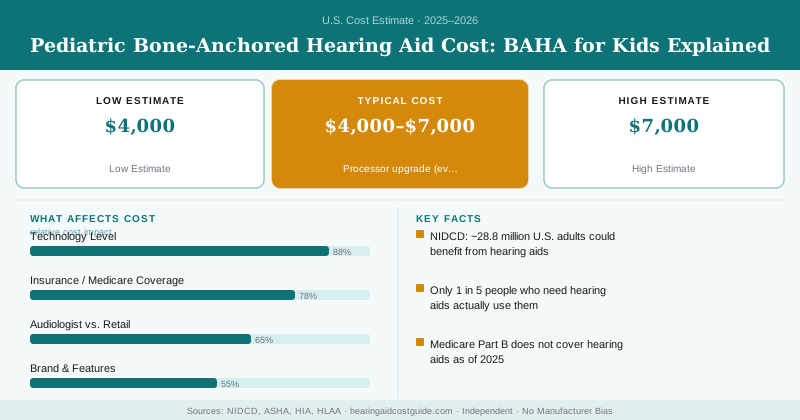
Sarah’s daughter was born with microtia — a malformed outer ear and no usable ear canal on one side. A standard hearing aid couldn’t help, because there was nowhere for sound to go in. The fix her audiologist recommended was a bone-anchored hearing device, and the first quote came in at just under $10,000. Sarah had never heard of a BAHA before that appointment.
If you’re in Sarah’s shoes, here’s the full picture: what a pediatric bone-anchored hearing aid costs, why it’s different, and how families actually pay for it.
What a Bone-Anchored Hearing Aid Is
A bone-anchored hearing aid (BAHA or BAHS) skips the ear canal entirely. It transmits sound through the skull bone directly to the inner ear, using either a surgically placed implant or a soft headband. It’s the go-to solution for conductive or mixed hearing loss, single-sided deafness, and ear-canal malformations where traditional amplification won’t work.
| Item | Cost |
|---|---|
| Softband BAHA (non-surgical, for infants) | $4,000–$6,000 |
| Sound processor (external) | $4,000–$7,000 |
| Implant surgery (facility + surgeon) | $5,000–$15,000 |
| Pre-surgical evaluation | $500–$2,000 |
| Processor upgrade (every 5–7 yrs) | $4,000–$7,000 |
Softband First, Surgery Later
Here’s something parents of babies appreciate: young children usually start with a softband — a headband that holds the processor against the skull, no surgery required. The skull bone isn’t thick enough for a surgical implant until around age five, so the softband bridges those critical early language years.
Once the child is old enough, families can choose the surgical route for a more discreet, secure fit. You can read more about the non-surgical option in our BAHA softband cost guide.
For infants and toddlers, a non-surgical softband BAHA costs $4,000–$6,000 and lets a child start hearing immediately — no operation needed. Surgery becomes an option around age five, adding $5,000–$15,000 but eliminating the headband.
Why It Matters Early
The CDC’s EHDI program reports that early-identified hearing loss treated promptly leads to dramatically better language outcomes. For a child with conductive loss or single-sided deafness, a softband BAHA delivers usable hearing during the brain’s prime language window — long before any surgical decision needs to be made.
The NIDCD notes that even unilateral (one-sided) hearing loss in children raises the risk of academic and speech delays, which is why these devices get fitted early rather than “waiting to see.”
Insurance and Coverage
Because a BAHA is medically necessary for these conditions, coverage is generally strong. Private plans typically cover the implant and surgery as a prosthetic/medical device, and Medicaid’s EPSDT mandate requires states to cover medically necessary hearing treatment for children under 21.
Insurers sometimes classify the softband and the surgical implant under different benefit categories. Get pre-authorization in writing for whichever path you’re taking, and confirm whether the processor counts as durable medical equipment or a prosthetic — the distinction changes your coverage.
Where It Sits Among the Options
A BAHA isn’t the same as a traditional hearing aid or a cochlear implant. For comparison, our pediatric hearing aid cost guide covers air-conduction devices, and the cochlear implant cost guide covers sensorineural cases. A BAHA fills the specific gap between them.
Smart Cost Moves
- Start with the softband to avoid surgery costs during the youngest years.
- Get the candidacy and medical-necessity letter from a pediatric audiologist before submitting to insurance.
- Ask the manufacturer about pediatric financial-assistance programs.
- Plan for a processor upgrade every five to seven years as your child grows.
Bottom Line
A pediatric bone-anchored hearing aid runs $4,000–$6,000 as a softband or $9,000–$22,000 with surgery — but for the conditions it treats, it’s medically necessary and usually well covered. Start with the softband, lock in pre-authorization, and budget for the upgrade cycle ahead.
Frequently Asked Questions
A pediatric BAHA typically costs $4,000–$12,000 or more, depending on the device model, the implant type (percutaneous vs. non-surgical), and whether surgery is required. This total usually includes the processor, abutment or implant hardware, and surgical placement fees, though costs vary significantly by clinic and region.
Many major insurance plans, including Medicare and Medicaid in most states, cover BAHAs for children with qualifying hearing loss or ear canal abnormalities, though coverage often requires prior authorization and documentation of medical necessity. Out-of-pocket costs for insured families typically range from $500–$3,000 after insurance pays their portion, but uninsured families may be responsible for the full $4,000–$12,000+ cost.
Children as young as 5 years old can receive a surgically implanted BAHA, though some non-surgical options are available for younger children; your audiologist will assess candidacy based on hearing loss type and ear anatomy. Surgical recovery typically takes 2–4 weeks, with full integration and optimal device function achieved within 6–8 weeks after implantation.