Two names dominate almost every audiologist’s display case: Phonak and Oticon. They’re the heavyweights, and if you’ve shopped for premium hearing aids, you’ve heard both pitched hard. So which one’s worth your money? The honest answer is that they’re closer in price than the sales talk suggests — and the real difference is in how they handle sound.
Let’s break it down without the jargon.
Phonak vs. Oticon: Price at a Glance
| Tier | Phonak (Audéo Lumity/Sphere) | Oticon (Intent/Real) |
|---|---|---|
| Premium (per pair) | $5,500–$7,000 | $5,500–$6,800 |
| Mid-tier (per pair) | $4,000–$5,000 | $4,200–$5,200 |
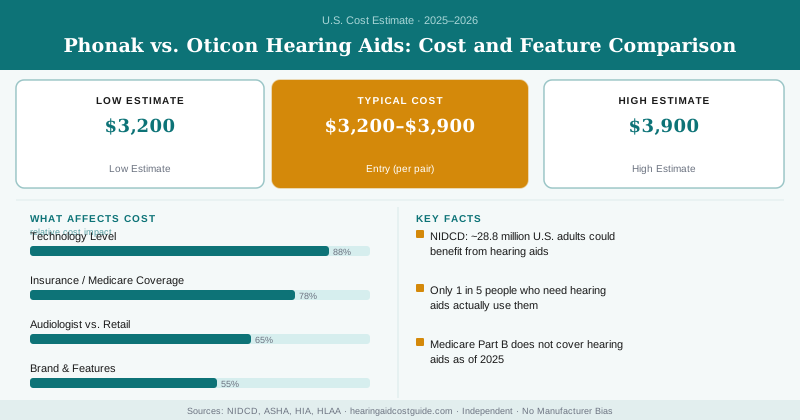
| Entry (per pair) | $3,000–$3,800 | $3,200–$3,900 |
Notice how tight that range is. At the same technology level, you’re rarely looking at more than a few hundred dollars between them. Both are sold through licensed audiologists, and both usually arrive bundled with fitting and follow-up care — though you can sometimes save by asking for unbundled pricing.
The Core Difference: Two Sound Philosophies
Here’s where it gets interesting. Phonak and Oticon take opposite approaches to noisy rooms.
Phonak’s newer chips lean toward directional focus — they narrow in on the voice in front of you and quiet the rest. Their 2023 Sphere model added a dedicated AI chip just for separating speech from background noise. If you spend a lot of time in one-on-one conversations at restaurants, that focused approach often wins.
Oticon does the opposite. Their “open sound” philosophy tries to give your brain a fuller picture of the whole room, trusting your brain to pick out what matters. The 2024 Oticon Intent uses sensors that detect your head movement and conversation activity to adjust. People who want to stay aware of their surroundings — group settings, social events — tend to prefer it.
Neither is objectively better. It depends on your listening life.
Phonak and Oticon cost roughly the same at every tier — typically within $300–$500 per pair. Pick based on sound philosophy, not price: Phonak for focused one-on-one clarity, Oticon for natural awareness in groups. Demo both before deciding.
Connectivity and Streaming
Both brands stream phone calls and audio directly. Phonak has long held an edge for universal Bluetooth — its devices connect to virtually any phone, Android or iPhone, without an intermediate streamer. Oticon’s recent models closed most of that gap, but Phonak still tends to be the smoother pick if you switch devices often.
For TV streaming, both sell add-on accessories that run $200–$300 each, which isn’t usually baked into the quoted price.
Battery and Rechargeability
Both offer rechargeable options with a full day of battery on a single charge. Phonak and Oticon also still sell disposable-battery models for people who’d rather swap cells than carry a charger. Rechargeable versions typically add $200–$400 to the device cost but save you money on batteries over the lifespan.
Why the Prices Are So High
If you’re wincing at these numbers, you’re not alone. The National Institute on Deafness and Other Communication Disorders (NIDCD) reports that roughly 28.8 million US adults could benefit from hearing aids, yet only about 1 in 5 who could benefit have ever used them — and cost is the number-one barrier. The reasons behind these price tags are layered, and we cover them fully in why hearing aids are so expensive.
A 2024 AARP analysis found the average American delays getting hearing aids by nearly a decade after first noticing loss, largely over sticker shock.
Don’t choose between Phonak and Oticon based on a spec sheet alone. The fitting matters more than the brand. A skilled audiologist programming an Oticon will beat a poorly fitted Phonak every time — and vice versa. Always insist on real-ear measurement at your fitting, regardless of brand.
Where to Buy Cheaper
Both brands’ technology shows up at warehouse retailers under different names. Phonak’s parent company Sonova supplies Costco’s Kirkland Signature line, and Demant (Oticon’s parent) supplies Costco’s Philips HearLink. If the absolute newest features aren’t critical, Costco hearing aids can deliver near-identical performance for thousands less.
Bottom Line
Phonak and Oticon are both excellent, and they cost about the same. Phonak edges ahead for focused listening and universal connectivity; Oticon wins for natural, open soundscapes. Demo both with the same audiologist, in a real noisy environment, before you commit. The brand on the box matters far less than how the device sounds in your ears. For broader pricing context, see our full hearing aid cost guide.
Frequently Asked Questions
Both Phonak and Oticon premium hearing aids typically range from $4,500 to $7,000 per pair in 2025. This price covers the devices themselves, but does not include fitting, programming, or follow-up adjustments, which may add $500–$1,500 depending on your audiologist.
Medicare does not cover hearing aids, though some Medicare Advantage plans offer partial coverage of $500–$2,000 per pair. Private insurance rarely covers hearing aids either, though a small number of employer plans and state Medicaid programs may cover 50–80% of costs up to $3,000 per pair.
The initial fitting appointment typically takes 1–2 hours, but most audiologists recommend returning for 2–3 follow-up adjustments over 4–6 weeks to optimize sound quality and comfort. Total time from first consultation to fully adjusted hearing aids is usually 1–2 months.