Here’s a number that should bother you: roughly 30% of hearing aid dispensers in the United States don’t use real-ear measurement (REM) during fitting. That means nearly one in three people walking out of a clinic has hearing aids programmed to a mathematical formula — not verified against their actual ear canal acoustics. The result is often over-amplification, under-amplification, or simply a poor match that gets chalked up to “adjustment period.”
REM is the single most evidence-backed step in hearing aid fitting. And depending on how your purchase is structured, it costs you nothing extra — or up to $250 as a standalone service.
What Real-Ear Measurement Actually Costs
| Pricing Model | What You Pay for REM |
|---|---|
| Bundled hearing aid purchase (most clinics) | $0 — included in device price |
| Unbundled fitting protocol | $100–$250 per fitting session |
| REM-only verification (existing aids, new clinic) | $75–$200 |
| Remote fine-tuning visit that includes REM | $100–$175 |
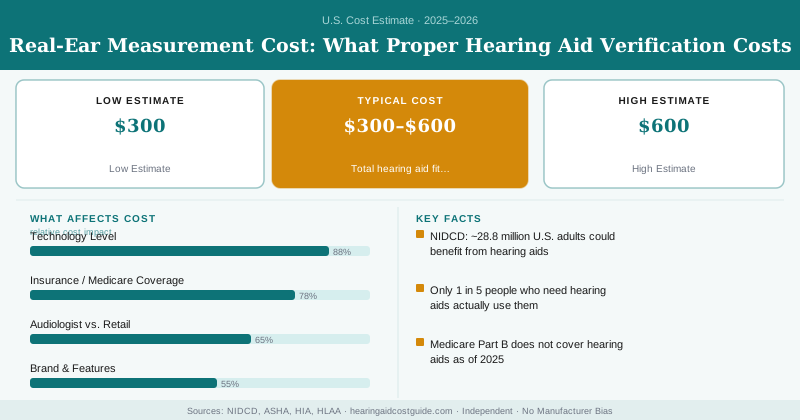
| Total hearing aid fitting including REM (unbundled) | $300–$600 |
When you buy bundled hearing aids — which is how the majority of U.S. audiologists and hearing instrument specialists price their devices — REM should be included in the package. The problem is that bundled doesn’t always mean comprehensive. Some providers bundle fewer services while still rolling the device and basic programming together.
The only way to know is to ask before you buy.
Why It Matters More Than Most Patients Realize
Your ear canal is yours alone. Its length, diameter, and resonance characteristics affect how sound reaches your eardrum. A standard hearing aid programmed to your audiogram using a validated prescription (NAL-NL2 or DSL v5.0) is a good starting estimate — but it’s still an estimate.
REM replaces that estimate with a measurement. A thin probe microphone sits alongside the hearing aid in your ear canal. Calibrated sounds play through a speaker. The system records what’s actually being delivered at your eardrum and compares it to the prescription target. If there’s a mismatch, the audiologist adjusts the programming until the curves align.
The American Academy of Audiology (AAA) and the International Hearing Society both list REM as a best-practice standard. ASHA recommends it as part of evidence-based audiological practice. Despite this, adoption is far from universal — cost pressure, time constraints, and dispensers who simply weren’t trained on the equipment all contribute to the gap.
Before your fitting, ask specifically: “Will you be doing real-ear measurement to verify the hearing aid output?” If yes, ask to see the REM curves after the appointment — a good audiologist will show you the before/after comparison. If no, ask why and consider whether the answer is satisfactory. REM adds 20–30 minutes to a fitting but significantly improves first-fit accuracy and long-term satisfaction.
Who Performs REM and Where to Find It
Most audiologists with full clinical setups have REM equipment. Audiometrically equipped ENT offices often do too. The challenge is that hearing centers inside retail chains — whether in big-box stores or hearing aid franchise locations — are more likely to skip this step.
If you bought OTC hearing aids or have aids from a provider who skips REM, you can seek out a standalone REM verification appointment at a different audiology practice. Bring your current aids. The audiologist will verify your existing programming and adjust or recommend adjustments as needed. Expect to pay $75–$200 for this visit.
REM After Fitting: When You Need It Again
REM isn’t just a one-time event. You may benefit from re-verification when:
- Your hearing changes significantly (new audiogram)
- You switch from open-fit to occluding earmolds or vice versa
- You change hearing aid models or technology levels
- You’re six months in and still struggling in specific listening environments
| Scenario | Estimated REM Cost |
|---|---|
| Initial fitting (bundled purchase) | Included |
| Initial fitting (unbundled) | $150–$250 |
| Transfer patient — verifying existing aids | $100–$200 |
| Follow-up REM after hearing change | $75–$175 |
| Bilateral fitting (both ears verified) | $200–$350 unbundled |
The Evidence Behind It
The NIDCD estimates that 28.8 million U.S. adults could benefit from hearing aids — yet fewer than one in five uses them. Among the reasons people abandon hearing aids, poor initial fit consistently ranks near the top. A 2018 study published in the American Journal of Audiology found that hearing aids fit with REM showed significantly better aided speech recognition scores and higher patient satisfaction than those fit without verification.
This isn’t a luxury feature. It’s the difference between a hearing aid that sounds right and one that just sits in a drawer.
If you’re paying $3,000–$7,000 for a pair of hearing aids and your provider skips real-ear measurement, you’re not getting the standard of care your investment deserves. It’s reasonable to request it — and if a provider refuses or says their equipment doesn’t include it, that’s worth factoring into your decision about where to buy.
The Bottom Line
Real-ear measurement adds $0 if it’s properly bundled into your hearing aid purchase — and $75–$250 if you’re seeking it as a standalone service. Either way, it’s the most evidence-supported step in the fitting process, recommended by every major audiology professional organization in the United States. Ask for it by name.
Frequently Asked Questions
Real-ear measurement typically costs between $0 and $250, depending on how your hearing aids are priced and whether the dispenser bundles it into their fitting fee. Many premium hearing aid packages include REM at no extra charge, while budget options or independent fitters may charge $50–$250 as a separate service.
Most Medicare and private insurance plans do not separately reimburse for real-ear measurement, though some plans may cover it as part of the overall hearing aid fitting visit. You should contact your insurance provider directly, as coverage varies significantly by plan—expect to pay out-of-pocket in most cases unless it is bundled into your hearing aid cost.
A real-ear measurement typically takes 15–30 minutes as part of your overall hearing aid fitting appointment, which usually lasts 1–2 hours total. The procedure is non-invasive and involves placing a small microphone in your ear canal while sounds are played to verify your hearing aids are amplifying at the correct levels for your unique ear anatomy.