Here’s a problem hearing aids can’t fully solve on their own: you’re at a dinner table with four people talking, background noise everywhere, and the person across from you is 6 feet away. Your hearing aids are doing their best — but distance and noise work against you.
Remote microphones sit near the person speaking and transmit their voice directly to your hearing aids. The result is like having that person speak 6 inches from your ear, regardless of noise. This technology is genuinely transformative for the right users — but it costs real money.
Remote Microphone Cost by Type
| Device | Price Range | Best For |
|---|---|---|
| Phonak Roger Pen | $800–$1,100 | Restaurants, meetings, classrooms |
| Phonak Roger Select iN | $900–$1,200 | Group conversations, dinner tables |
| Phonak Roger Clip-On Mic | $500–$700 | One-on-one conversations |
| Oticon RemoteMic | $300–$500 | Oticon hearing aid users |
| Starkey Remote Microphone | $300–$450 | Starkey hearing aid users |
| Partner Mic (Signia) | $250–$400 | Signia hearing aid users |
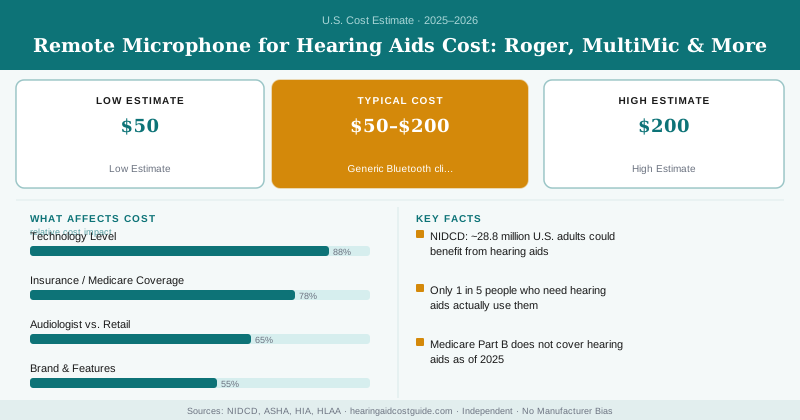
| Generic Bluetooth clip-on mic | $50–$200 | OTC hearing aids with Bluetooth |
Why Remote Mics Cost So Much
The big prices — especially Phonak’s Roger line — reflect proprietary technology. The Roger system uses frequency-hopping spread spectrum (FHSS) radio transmission, which virtually eliminates interference and provides stable connectivity in challenging environments like classrooms and airports.
Many mid-range hearing aids require a Roger Receiver (an add-on) to accept Roger signal — that’s an additional $150–$300 per aid. Some newer Roger devices have built-in receivers.
When a Remote Mic Is Worth Buying
You’re a strong candidate if:
- You regularly eat at restaurants and struggle to follow conversation
- You attend meetings or presentations where the speaker is more than 3 feet away
- You have grandchildren or young children whose voices you miss
- You’re in noisy environments (kitchens, workshops, outdoor events)
- Your hearing loss is moderate-to-severe and your aids alone aren’t sufficient
If you only struggle in very specific situations — like one particular loud family member — a simpler solution (like asking them to speak louder or move closer) might be all you need.
The Phonak Roger system is widely used in K-12 classrooms for students with hearing loss. The teacher wears a Roger transmitter; the student’s hearing aids receive the signal directly. Under IDEA (Individuals with Disabilities Education Act), schools may be required to provide FM or Roger systems as part of a student’s IEP at no cost to the family. Ask the school’s special education coordinator before purchasing privately.
Brand Lock-In: The Catch
Most remote microphones are brand-specific. A Phonak Roger device does not work with Signia hearing aids unless you add a universal receiver. Generic Bluetooth mics can work with any Bluetooth-enabled hearing aids, but they don’t match the reliability or range of branded systems.
Check with your audiologist before purchasing. They can confirm compatibility and sometimes demo devices at an appointment.
Does Insurance Cover Remote Microphones?
Rarely for adults. For children with hearing loss, FM and Roger systems used in school settings may be covered through:
- IDEA Part B (school-provided for IEP students)
- State Medicaid plans in some states
- Some private insurance plans that include hearing rehabilitation benefits
Adults can use FSA/HSA funds for remote microphones as they qualify as medical devices.
The NIDCD on Assistive Hearing Technology
The National Institute on Deafness and Other Communication Disorders (NIDCD) notes that hearing aids alone don’t fully address all listening environments — assistive listening devices like remote microphones play an important complementary role, particularly in noisy or reverberant spaces.
Don’t buy a remote mic without trialing it first. Some audiologists offer loaner programs. A device that doesn’t get used is a complete waste of $600–$1,200. Trial it at a restaurant or in a specific situation where you struggle before committing.
The Bottom Line
Remote microphones are the highest-impact hearing accessory you can buy — in the right situation. Budget $300–$1,200 depending on brand and features. Roger devices are the gold standard for difficult listening environments. If your primary need is one-on-one conversations, a simpler $250–$400 partner mic from your hearing aid brand may be enough.
Frequently Asked Questions
Remote microphones typically cost between $200 and $1,200 depending on the brand and model. Phonak Roger devices are among the most popular and generally range from $500–$1,200, while simpler clip-on microphones may cost $200–$400. Some manufacturers bundle remote mics with hearing aid packages at a discounted rate.
Most health insurance plans, including Medicare, do not cover remote microphones as they are considered optional accessories rather than essential hearing aid components. You will typically pay the full out-of-pocket cost, though some hearing aid manufacturers offer financing plans or bundle discounts that can reduce your total expense.
Once purchased, most remote microphones can be paired and used with your hearing aids within minutes to a few hours, though compatibility depends on your specific hearing aid model. Your audiologist can verify compatibility during your appointment and program the connection, which usually takes less than 30 minutes.