Why do audiologists keep recommending ReSound for iPhone users? It’s not marketing. ReSound was the first hearing aid manufacturer to crack Apple’s Made for iPhone certification — back in 2014, when everyone else was still using Bluetooth intermediary streamers clipped to your collar. That head start built a loyal user base, and the NEXIA platform has expanded that advantage to Android users too. Here’s what it costs and whether it’s worth it.
ReSound at a Glance
ReSound is a Danish company founded in 1943, now part of GN Group — the same conglomerate that makes Jabra headphones and earbuds. That Jabra connection matters for cost-conscious buyers, and we’ll come back to it. ReSound has a long track record of innovation: it pioneered the open-fit hearing aid design in 2003, which became the dominant style across the entire industry.
The current platform is ReSound NEXIA, launched in 2023. It’s the first hearing aid to carry both Made for iPhone (MFi) and Made for Android (MFA) certification simultaneously — meaning direct audio streaming to both iPhone and Samsung/Pixel devices without a relay device in your pocket.
NEXIA Models and Price Tiers
| Model / Tier | Style | Price Per Pair | Notes |
|---|---|---|---|
| NEXIA RIE (Premium) | Receiver-in-ear | $6,000–$7,000 | M&RIE option, Auracast |
| NEXIA RIE (Advanced) | Receiver-in-ear | $4,500–$6,000 | Most popular seller |
| NEXIA BTE (Standard) | Behind-the-ear | $3,000–$4,500 | Power option for severe loss |
| NEXIA ITE Custom (Standard–Premium) | In-the-ear | $3,500–$6,000 | Custom shell |
| NEXIA Micro RIE | Receiver-in-ear, compact | $3,000–$5,500 | Smallest RIE model |
| Entry-level models | Various | $2,000–$3,000 | Limited connectivity |
| Jabra Enhance (Costco/Best Buy) | RIE | $699–$1,299 | OTC, ReSound tech |
Audiologist-channel prices include fitting, a 30–45 day trial, follow-up programming visits, and manufacturer warranty (typically 3 years). Jabra Enhance OTC prices do not include comprehensive audiologist follow-up.
The M&RIE Microphone: What It Is and Why It Matters
ReSound’s headline technology is the M&RIE (Microphone & Receiver-In-Ear) system. Standard receiver-in-ear hearing aids place their microphones on the top of the device, sitting behind or above the ear. M&RIE adds a third microphone directly inside the ear canal — the same position your natural ear uses to collect sound.
That placement matters because the outer ear (pinna) is shaped to direct and filter sound in ways that tell your brain where sounds are coming from. Standard hearing aids largely bypass that filtering. M&RIE captures it, which means directional cues and spatial awareness sound more natural.
A study published in the Journal of the American Academy of Audiology found that M&RIE users showed significantly better localization accuracy and rated sound quality higher than with standard RIE microphone configurations. It’s not a gimmick — the geometry is real.
Paired with ReSound’s All-Access Directionality, which blends omnidirectional and directional processing continuously rather than forcing you into one mode, NEXIA handles crowded restaurant environments better than many competing platforms in independent evaluations.
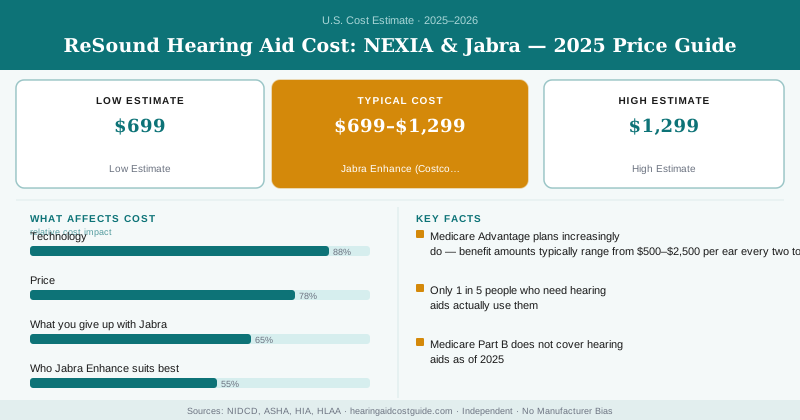
Technology: Jabra Enhance uses the same ReSound hearing aid platform. The chip, receiver, and Bluetooth stack are essentially identical to mid-tier NEXIA models.
Price: Jabra Enhance at Costco runs $699–$1,299/pair. ReSound NEXIA at an audiologist runs $3,000–$7,000/pair.
What you give up with Jabra: Comprehensive audiological evaluation, custom fine-tuning to your specific audiogram, in-depth follow-up visits, and access to the full NEXIA accessory ecosystem. Costco hearing specialists are trained professionals but provide a retail-style fitting, not a clinical one.
Who Jabra Enhance suits best: Adults with confirmed mild-to-moderate loss who’ve already had a recent audiogram, are comfortable with technology, and want significant cost savings with acceptable (not optimal) audiologist support.
App, Streaming, and Accessories
The ReSound Smart 3D app gives you full manual control — volume, bass/treble balance, program switching, and directional microphone steering. You can create location-based memory programs: the app learns your preferred settings at your kitchen table versus your favorite restaurant and applies them automatically when your GPS puts you there.
Accessories worth knowing:
- TV Streamer 2 ($200–$300): Plugs into your television and streams audio directly to your aids at whatever volume you need, independently of the TV’s speaker volume. No more complaints about the TV being too loud.
- Multi Mic ($250–$350): A remote microphone you hand to a speaker at a noisy dinner table or in a lecture hall. Streams their voice directly to your aids.
- Phone Clip+: For Android users who want hands-free phone calls before the NEXIA’s direct Android streaming, or for older Android devices.
The NEXIA also supports Auracast — the new Bluetooth broadcast standard that lets public venues (airports, theaters, houses of worship) stream audio directly to compatible hearing aids. It’s early days for venue adoption, but the infrastructure is coming.
MarkeTrak Data: What Hearing Aid Users Actually Say
MarkeTrak 2022 — the industry’s most comprehensive U.S. hearing aid user survey — shows ReSound consistently in the top tier for smartphone streaming satisfaction and app usability scores. The NIDCD estimates 28.8 million U.S. adults could benefit from hearing aids but haven’t pursued them, often citing cost as the primary barrier. The Jabra Enhance pathway at $699–$1,299 directly addresses that gap for people with documented mild-to-moderate loss.
If you buy Jabra Enhance at Costco, you’ll need an active Costco membership and your fittings will be handled by a Costco hearing specialist — a trained professional, but working in a retail environment with limited appointment time. You won’t have access to an independent audiologist for detailed troubleshooting, aural rehabilitation counseling, or complex programming adjustments. If you have asymmetric hearing loss, significant high-frequency drop-off, or any history of ear surgery or chronic ear conditions, see an independent audiologist before choosing an OTC path.
Insurance and Financing
Medicare doesn’t cover hearing aids. Medicare Advantage plans increasingly do — benefit amounts typically range from $500–$2,500 per ear every two to three years. Check your specific plan’s hearing benefit before your fitting appointment; some plans have preferred provider networks that limit which audiologists qualify for reimbursement.
Most independent ReSound providers offer CareCredit or Allegro Credit financing. Twelve-month, 0% interest promotions are standard. If you’re comparison-shopping, ask for an itemized quote separating device cost from professional service fees so you’re comparing apples to apples.
Bottom Line
ReSound NEXIA is the right choice if reliable smartphone connectivity — to both iPhone and Android — is your priority, or if natural sound directionality matters to you (the M&RIE mic addresses that specifically). Budget $4,500–$6,000/pair for the advanced tier where most audiologists start. If cost is your main concern and your loss is mild to moderate, Jabra Enhance at Costco delivers the same core technology for a fraction of the price — just understand what you’re trading away in follow-up care.
Frequently Asked Questions
ReSound NEXIA hearing aids range from $2,000–$7,000 per pair at an independent audiologist. Essential models start around $2,000/pair; premium NEXIA models with full Auracast and M&RIE technology run $6,000–$7,000/pair. That price includes professional fitting, a trial period, and follow-up visits.
They use the same underlying technology. Both brands are owned by GN Group. Jabra Enhance hearing aids are built on ReSound platforms and sold OTC at Costco and Best Buy for $699–$1,299/pair — significantly cheaper, but without the comprehensive audiologist follow-up you'd get from a ReSound provider.
Yes — ReSound was the first brand to achieve Apple's Made for iPhone (MFi) certification for hearing aids, back in 2014. The NEXIA platform adds Made for Android (MFA) certification as well, making ReSound the first hearing aid with dual certification for both major smartphone platforms. Direct audio streaming without a separate intermediary device is a genuine convenience advantage.