Sensorineural hearing loss accounts for about 90% of all hearing loss in adults — and unlike conductive hearing loss, there’s no surgery that fixes the inner ear damage. The hair cells in your cochlea don’t regenerate. So when an audiologist confirms you have SNHL, the conversation shifts quickly to management: hearing aids, implants, and in the case of sudden onset, emergency steroids.
Here’s what each path costs, and where insurance actually helps.
Sensorineural Hearing Loss Treatment Cost Summary
| Treatment | Cost Range | When It Applies |
|---|---|---|
| Audiological evaluation (diagnosis) | $150–$400 | First step for all SNHL |
| Prescription hearing aids (per pair) | $1,500–$7,000 | Mild to moderate-severe SNHL |
| OTC hearing aids | $200–$1,500 | Mild to moderate adult SNHL |
| Cochlear implant (all-in, before insurance) | $30,000–$100,000 | Severe-to-profound SNHL |
| High-dose oral steroids (sudden SNHL) | $30–$200 | Acute sudden-onset |
| Intratympanic steroid injection | $200–$800 per injection | Sudden SNHL, salvage treatment |
| Auditory rehabilitation/therapy | $2,000–$10,000 | Post-cochlear implant |
| Assistive listening devices | $100–$1,500 | Supplemental at any stage |
The Most Common Path: Hearing Aids
For mild to moderate-severe SNHL — the vast majority of adults with hearing loss — prescription hearing aids are the primary treatment. The NIDCD reports that about 28.8 million U.S. adults could benefit from hearing aids. Only about 1 in 3 adults aged 70 and older who have hearing loss has ever used a hearing aid.
Cost varies enormously by technology level:
- Basic/entry-level aids: $1,500–$3,000/pair. Fine for quiet environments and one-on-one conversations.
- Mid-tier aids: $3,000–$5,000/pair. Better noise processing, Bluetooth streaming, rechargeable.
- Premium aids: $5,000–$7,000/pair. Best-in-class noise suppression, AI-driven sound processing, best for active lifestyles.
Since 2022, FDA-regulated OTC hearing aids have been available for adults with perceived mild-to-moderate loss — no prescription required. Brands like Jabra Enhance Plus, Lexie, and Sony CRE-10 run $200–$1,500. They’re a legitimate starting point for many people with mild SNHL.
Even with OTC options available, getting a formal audiogram before buying anything saves money long-term. Self-assessment of hearing loss is notoriously inaccurate. Many people who think they have mild loss actually have moderate-severe loss that OTC amplifiers won’t adequately address — and they’ll spend $600 on something that doesn’t help before finally seeing an audiologist. The audiogram costs $150–$350. It’s worth it.
Sudden Sensorineural Hearing Loss: An Emergency
Sudden SNHL (SSNHL) is a medical emergency. It’s defined as a loss of 30 dB or more in three connected frequencies occurring within 72 hours. About 66,000 new cases occur in the US each year, according to the NIDCD — and prompt treatment with corticosteroids is critical. Delays in treatment reduce the chance of recovery.
High-dose oral prednisone is the standard first-line treatment. A typical 10–14-day course runs $30–$200 depending on your pharmacy and insurance.
Intratympanic steroid injections — where corticosteroid is injected directly through the eardrum — are used when oral steroids fail or are contraindicated. Each injection: $200–$800. Most protocols involve 3–4 injections, bringing total cost to $600–$3,200 for a full course. These are often covered as in-office medical procedures.
The window for effective treatment is narrow — typically within 4 weeks of onset. If you wake up one morning with sudden unilateral hearing loss or muffled hearing in one ear, don’t wait for a regular appointment. Go to an ENT or emergency department that day.
Sudden hearing loss is sometimes mistaken for ear congestion from allergies or a cold. If your hearing doesn’t clear within 24–48 hours, it’s not congestion — call an ENT immediately. Treatment delays beyond 2 weeks significantly reduce the odds of any hearing recovery.
Severe-to-Profound SNHL: Cochlear Implants
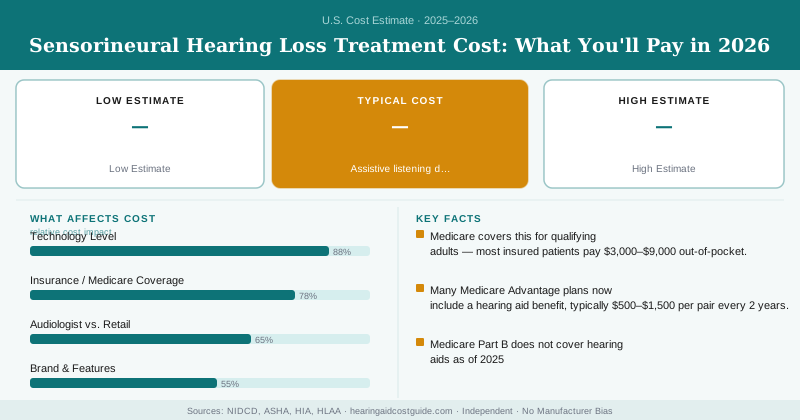
When hearing loss progresses to the point that even the best-fitted hearing aids provide inadequate speech understanding, cochlear implants become the medically appropriate option. Total cost before insurance: $30,000–$100,000 including the device, surgery, and first-year programming. Medicare covers this for qualifying adults — most insured patients pay $3,000–$9,000 out-of-pocket.
Candidacy criteria set by Medicare and most commercial insurers: bilateral severe-to-profound SNHL with word recognition scores below 50% in your best-aided condition.
What Medicare and Insurance Cover
For SNHL specifically:
- Diagnostic audiological evaluation: Covered by Medicare Part B when ordered by a physician — no patient cost beyond standard cost-sharing.
- Hearing aids: Not covered by traditional Medicare. Many Medicare Advantage plans now include a hearing aid benefit, typically $500–$1,500 per pair every 2 years.
- Cochlear implants: Covered by Medicare when medically necessary.
- Sudden SNHL treatment (steroids, injections): Covered as a medical procedure.
Some commercial insurers cover hearing aids — check your specific plan’s “hearing” benefit. If your employer offers an FSA or HSA, hearing aids are a qualified medical expense and you can use pre-tax dollars.
Realistic Out-of-Pocket by Severity
| Severity | Realistic Out-of-Pocket |
|---|---|
| Mild SNHL | $200–$1,500 (OTC aids) |
| Moderate SNHL | $1,500–$4,000 (prescription aids) |
| Severe SNHL | $2,000–$5,000 (premium aids, possible VA or insurance benefit) |
| Profound SNHL | $3,000–$9,000 (cochlear implant with Medicare) |
| Sudden SNHL | $100–$3,500 (steroid treatment, audiogram) |
The numbers are real — but so is the fact that untreated hearing loss carries its own costs. Research links untreated SNHL to accelerated cognitive decline, social isolation, and falls. Getting fitted is an investment, not just an expense.
Frequently Asked Questions
Hearing aids for SNHL typically cost $1,500–$6,000 per pair, depending on technology level and features. Basic models start around $1,500–$2,500, while premium digital hearing aids with advanced noise reduction and connectivity range from $4,000–$6,000 per pair.
Most Medicare plans do not cover hearing aids, leaving patients to pay out-of-pocket, though some Medicare Advantage plans offer limited coverage up to $500–$1,000 annually. Private insurance coverage varies widely; some plans cover 50–80% of costs after deductibles, while others exclude hearing aids entirely as non-essential devices.
Most audiologists can schedule a hearing aid fitting appointment within 1–2 weeks of your diagnosis, with devices typically ready within 2–4 weeks after your fitting. For sudden sensorineural hearing loss, faster fitting is often recommended since prompt treatment may slow progression, making early appointments critical.