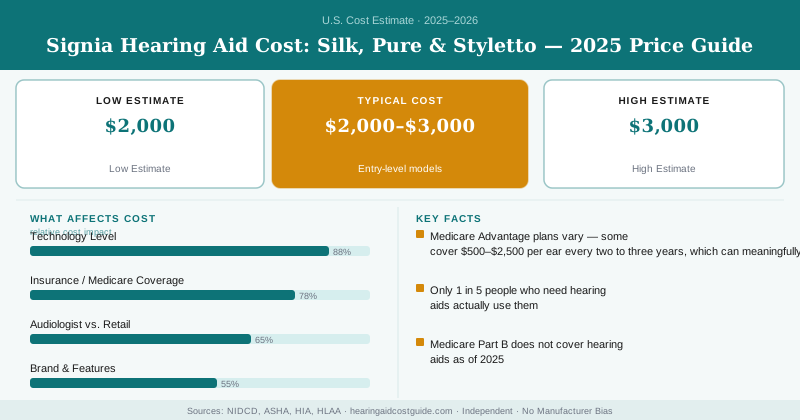
Most people shopping for hearing aids have never heard of Signia. That’s the hidden story here — because for decades, these were Siemens hearing aids. Siemens. One of the oldest and most respected names in hearing care. When the company rebranded in 2016, it kept all the engineering expertise and added something genuinely new. If you’ve overlooked Signia because the name isn’t familiar, it’s worth a closer look.
Who Makes Signia?
Signia launched as an independent brand in 2016 when Siemens divested its audiology division. The underlying engineering team and manufacturing didn’t change — just the name did. In 2019, the brand merged with Widex to form WS Audiology, now one of the world’s four largest hearing aid manufacturers. Signia has also partnered with Sennheiser on audio technology development, which shows up in sound quality benchmarks.
The current product platform is the Signia Integrated Xperience (IX), launched in 2023. The “Integrated” in the name refers to the chip’s ability to process wearers and background separately — more on that below.
Signia Models and What They Cost
| Model | Style | Technology Tier | Price Per Pair |
|---|---|---|---|
| Pure Charge&Go IX | RIC, rechargeable | Standard–Premium | $3,000–$7,000 |
| Silk Charge&Go IX | Invisible-in-canal, rechargeable | Standard–Advanced | $3,000–$5,500 |
| Styletto IX | Slim receiver-in-canal | Standard–Premium | $3,500–$7,000 |
| Insio Charge&Go IX | Custom ITE/ITC/CIC | Standard–Premium | $3,500–$7,000 |
| Active IX | Earbud-style (mild–moderate) | Standard | $2,000–$3,500 |
| Entry-level models | Various | Essential | $2,000–$3,000 |
Prices above reflect full bundle cost at an independent audiologist — professional fitting, 30–45 day trial, follow-up adjustments, and typically one to three years of warranty. You won’t find Signia at Costco; the brand sells exclusively through licensed audiologists and hearing instrument specialists.
The Silk: What Makes It Genuinely Unique
The Silk Charge&Go IX is the only rechargeable invisible-in-canal (IIC) hearing aid on the market. Every other IIC or CIC style requires tiny disposable batteries — a real frustration for anyone with dexterity issues. Signia’s Silk uses a charging case roughly the size of a dental floss container. You drop the aids in at night and they’re fully charged in the morning.
The tradeoff: the Silk fits entirely inside the ear canal, so it’s not suitable for severe hearing loss (it lacks the amplification power of behind-the-ear models). It’s also a pre-formed universal fit rather than a custom shell, which means it fits most ear canals but not all. Your audiologist will verify fit before you commit.
Own Voice Processing — the Feature That Actually Matters
Here’s the complaint Signia set out to solve: hearing aid wearers consistently say their own voice sounds wrong. Hollow. Boomy. Robotic. It’s one of the top reasons people abandon hearing aids in the first year.
Signia’s Own Voice Processing (OVP) addresses this by dedicating a separate processing channel exclusively to the wearer’s voice. The chip detects when the user is speaking and applies different amplification parameters to that signal than to all other incoming sounds. A 2017 study published in the International Journal of Audiology found that OVP significantly improved listener ratings of own-voice naturalness compared to standard hearing aid processing. No other major brand has a direct equivalent.
Own Voice Processing (OVP): Signia’s most distinctive feature — dedicated processing channel for the wearer’s own voice. Phonak and Oticon don’t offer a comparable system.
Silk Charge&Go IX: The market’s only rechargeable invisible-in-canal aid. Other IIC/CIC styles still require disposable batteries.
Sennheiser audio collaboration: Sound quality benchmarks across the product line reflect this partnership.
WS Audiology network: Shared research and distribution infrastructure with Widex.
How Signia Compares to Phonak and Oticon
Phonak (Sonova Group) is the global market leader, known for its AutoSense OS platform and Roger wireless microphone ecosystem. Phonak’s Lumity and Sphere platforms lead on speech-in-noise performance in independent testing. If maximum speech clarity in difficult environments is your top priority, Phonak belongs on your shortlist.
Oticon (Demant Group) leads on its BrainHearing philosophy and the Oticon Intent’s motion sensor-based scene detection. Oticon is often recommended for people who want the most natural, 360° sound awareness.
Signia’s edge is specifically OVP and the Silk’s rechargeable IIC design. MarkeTrak 2022 satisfaction data shows Signia users rate own-voice naturalness above the category average — a measurable outcome tied directly to the OVP technology.
Remote Fine-Tuning: TeleHear
Signia offers TeleHear, a remote fine-tuning service built into the Signia app. You can video call your audiologist and receive real-time programming adjustments without driving to the office. For follow-up tweaks — you want a bit more volume in restaurants, less wind noise on your patio — it’s genuinely convenient. Not every Signia provider offers TeleHear, so confirm before you choose a clinic.
Insurance and Financing
Medicare doesn’t cover hearing aids, and most traditional Medicare Supplement plans don’t either. Medicare Advantage plans vary — some cover $500–$2,500 per ear every two to three years, which can meaningfully offset the cost of mid-range models.
Many Signia audiologists work with CareCredit or Allegro financing — 0% interest promotions for 12–18 months are common. If you’re comparing across providers, ask each one for an itemized quote separating the aid cost from the professional service fees. That’s the only apples-to-apples comparison.
Signia doesn’t sell on Amazon or at big-box retailers. If you find a listing claiming to sell new Signia aids online at steep discounts, verify it’s an authorized dealer — unauthorized sales void the manufacturer warranty and may not include proper fitting support.
Bottom Line
Signia is a serious hearing aid brand with a direct engineering lineage from Siemens. If you’ve been told your voice sounds unnatural with hearing aids, or if you want the only rechargeable invisible aid on the market, Signia deserves a spot in your evaluation. Budget $3,000–$5,500/pair for the mid-range models most audiologists start with, and $5,500–$7,000 if you want the full IX premium platform.
Frequently Asked Questions
Signia hearing aids range from $2,000–$7,000 per pair depending on technology level. Entry-level Signia models start around $2,000/pair; premium Signia IX models run $5,500–$7,000/pair. That price typically includes professional fitting, a trial period, and follow-up adjustments.
Yes — Signia is the direct successor to Siemens Audiology Solutions. In 2016, Siemens spun off its hearing aid division and rebranded it as Signia. The engineering lineage is continuous; many Signia audiologists trained on Siemens equipment. Today Signia is part of WS Audiology, which also owns Widex.
Own Voice Processing (OVP) is Signia's patented technology that processes the wearer's own voice on a separate, dedicated channel from all other sounds. Most hearing aid wearers complain that their voice sounds hollow, tinny, or overly loud — OVP specifically corrects that. A 2017 study in the International Journal of Audiology found OVP significantly improved self-voice naturalness ratings compared to standard processing.