Most hearing aids treat the wearer’s own voice as noise to be suppressed. Signia built an entirely separate processing system to handle it differently — and that’s the central claim behind the Integrated Xperience (IX) platform. Whether that approach is worth $3,200–$7,800 per pair is a legitimate question. The answer depends mostly on whether you find your own voice sounds unnatural with hearing aids.
Signia IX Pricing by Level
| Technology Level | Price Per Pair | Price Per Aid | Notes |
|---|---|---|---|
| Signia IX 1 (entry) | $3,200–$4,200 | $1,600–$2,100 | Basic noise reduction, own-voice processing |
| Signia IX 3 (standard) | $4,200–$5,400 | $2,100–$2,700 | Better directionality, moderate social settings |
| Signia IX 5 (advanced) | $5,400–$6,600 | $2,700–$3,300 | Narrow directionality, restaurant environments |
| Signia IX 7 (premium) | $6,600–$7,800 | $3,300–$3,900 | Full feature set, complex listening, own-voice excellence |
| Styletto IX (slim RIC) | $5,800–$7,400 | $2,900–$3,700 | Fashion-forward design, premium features |
| Active IX (in-ear only) | $4,400–$5,600 | $2,200–$2,800 | AirPod-style form factor |
What “Integrated Xperience” Actually Means
Signia’s IX platform runs two separate acoustic processors simultaneously inside each hearing aid: one that handles the outside world, and one dedicated exclusively to detecting and processing the wearer’s own voice.
The problem this solves is real. Most hearing aid users report that their own voice sounds hollow, echoey, or muffled — especially when they first get aids. Traditional aids try to suppress this by reducing low-frequency output, but that can make music and some speech sound tinny.
IX detects your own voice through both a dedicated microphone and bone conduction signal analysis, processes it separately, and delivers it through an “Own Voice Processing” (OVP) channel at a different amplitude curve than environmental sounds. The result, according to patient satisfaction data from Signia’s clinical studies, is more natural-sounding own voice and faster adaptation for new users.
Important caveat: Own voice is most noticeable in the first weeks of hearing aid use. Long-term users who’ve adapted to traditional processing may not find OVP transformative. New hearing aid users are the primary beneficiaries.
Signia IX vs. Previous Signia Platforms
Signia’s prior Xperience platform (AX series, 2021) introduced the dual-processor approach but with less sophisticated OVP. IX (launched 2023) refines it significantly:
- OVP 3.0 vs. OVP 2.0 — better voice distinction in noisy conditions
- Updated Bluetooth Classic + LE Audio (compatible with more Android devices)
- Improved real-time battery tracking via the Signia app
- Telehealth-ready: Signia TeleCare allows remote fine-tuning from any internet-connected device
Rechargeable vs. Battery Options
All Signia IX models are available in rechargeable versions. Battery-powered (size 312) versions exist for some styles, which some users prefer for travel convenience or backup. The rechargeable versions use a lithium-ion system that lasts approximately 36 hours per charge, with a fast-charge feature providing 4 hours of use from a 30-minute charge.
The Signia app (iOS and Android) allows volume and program adjustments, hearing journal tracking, and the Signia Assistant — an AI chatbot that guides fine-tuning between audiologist visits. TeleCare remote sessions are available through the app, meaning your audiologist can push updated hearing aid settings without an in-office visit. This is genuinely useful for patients who don’t live near their audiologist.
Signia vs. Widex, Phonak, and Oticon
At similar price points, each premium brand has a distinct processing philosophy:
- Phonak Lumity/Sphere: Best known for StereoZoom and speech-in-noise performance. Strong for active users, crowds, and TV streaming.
- Oticon Intent/Real: Sound naturalness and spatial awareness. OpenSound Navigator approach gives a wider sound stage.
- Widex Moment Sheer: Lowest processing delay in the category (0.5ms) — best for musicians and those who find traditional aids’ latency disturbing.
- Signia IX: Best for new users who struggle with own-voice adaptation and users who talk frequently on phone calls or in groups.
Where to Buy Signia IX
Signia (owned by WSAudiology, same parent company as Widex) sells exclusively through licensed audiologists and hearing instrument specialists. They don’t have a direct-to-consumer channel.
Costco doesn’t carry Signia. The brand is primarily sold through independent audiologists, regional chains like HearingLife and AudioNova, and ENT practices.
Typical bundled purchase includes: comprehensive audiogram, fitting, 30–45 day trial period, 1–3 years of follow-up visits, and a 2-year manufacturer warranty. Extended warranty (year 3) is usually available at $300–$500 per aid.
Real-World Cost Considerations
A pair of Signia IX 5s (advanced tier) at $5,400–$6,600 is a realistic target for most adults with moderate-to-severe hearing loss. If your audiologist offers a 90-day trial, use the full period — OVP benefits are often most noticeable in the second month, once you’ve adjusted to the devices.
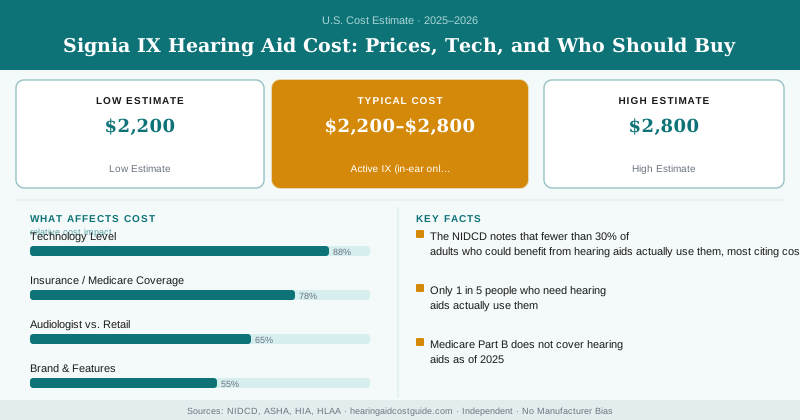
The NIDCD notes that fewer than 30% of adults who could benefit from hearing aids actually use them, most citing cost as the primary barrier. Signia’s entry-level IX 1 ($3,200–$4,200) delivers the core OVP technology at a lower price — a worthwhile trade-off for budget-conscious first-time users who want the natural voice benefit without paying for the premium tier’s directional microphone features.
Frequently Asked Questions
Signia IX hearing aids cost $3,200 to $7,800 per pair, depending on the technology level you choose. The price reflects Signia's proprietary Integrated Xperience platform, which uses a separate processing system to handle your own voice differently than standard hearing aid technology.
Most health insurance plans, including Medicare, do not cover hearing aids as a covered benefit, leaving you responsible for the full $3,200–$7,800 cost out-of-pocket. However, some supplemental insurance plans, veterans benefits (VA), and Medicaid programs in select states may offer partial or full coverage—contact your insurer directly to confirm your specific policy.
The initial fitting appointment typically takes 1–2 hours and includes a hearing test, device programming, and adjustment to your ear canals. Most patients can wear their Signia IX hearing aids home the same day, though you may need 2–3 follow-up appointments over the next few weeks to fine-tune settings as you adjust to wearing them.