37.5 million Americans report trouble hearing, according to the NIDCD — but millions more lose sleep not from hearing loss, but from hearing too much of their partner’s snoring. The irony is sharp. You don’t need a hearing test. You need a $1 foam earplug — or maybe a $200 custom pair, depending on how badly you need your sleep.
Here’s a clear breakdown of what sleep earplugs cost, what actually works for snoring noise, and when spending more is worth it.
The Snoring Problem (Noise Levels and What You’re Blocking)
Snoring registers 60–80 dB at typical bedroom distances. Loud, chronic snoring can hit 90 dB — about as loud as a lawnmower. That’s enough to disrupt sleep architecture even when you’re not fully waking up.
The goal isn’t silence — it’s bringing that noise below your personal wake threshold. For most adults, sounds below 40 dB don’t disrupt sleep consistently. That means you need 20–40+ dB of real attenuation, not just whatever number is printed on the box.
Remember the field reality of NRR ratings: OSHA’s formula gives you approximately (NRR – 7) ÷ 2 in real-world conditions. An NRR 33 earplug, properly inserted, delivers roughly 13 dB of practical attenuation. For heavy snorers, that may only get you partway there — which is why fit, material, and comfort (which affects whether you keep them in all night) matter more than the spec sheet.
Sleep Earplug Types: Cost and Performance
Disposable Foam Earplugs
The most affordable and widely available option. Roll down, insert, let expand. When worn correctly — compressed, inserted into the lower half of the canal, and allowed to fully expand — foam plugs deliver the highest NRR of any consumer option.
The catch: many people insert them too shallowly, which cuts protection by 50% or more. And after 8 hours, they’ve absorbed enough moisture that effectiveness drops further.
- Cost: $0.10–$0.50 each; $15–$40 for a box of 100–200 pairs
- NRR: 29–33 (best available in this category)
- Best picks: 3M E-A-R Ultrafit (NRR 25, shaped for sleep comfort), Howard Leight MAX (NRR 33, high-protection)
- Downsides: Cylindrical shape can cause pressure; single-use costs add up for nightly users
Wax Earplugs (Mack’s Pillow Soft)
Mack’s Pillow Soft is probably the most popular sleep earplug among snoring-adjacent sleepers. The wax-silicone blend molds to the outer ear bowl rather than going into the canal — which makes it comfortable for side sleepers and people who dislike the “blocked” feeling of foam.
- Cost: $6–$10 for 6 pairs (about $1–$1.50 per pair)
- NRR: 22
- Best for: Side sleepers, people with narrow canals, anyone who finds foam uncomfortable
- Downsides: Lower NRR than foam; can get tangled in hair; wax gets messy in warm weather
Ohropax Classic (German brand, widely available on Amazon) is a similar wax option at $7–$12 for 12 pairs, NRR 23.
Silicone Flanged Earplugs (Reusable)
Reusable flanged silicone earplugs create a seal through multiple concentric ridges. They’re washable, more durable, and comfortable for many people.
- Cost: $5–$20 per pair (reusable, 3–12 months)
- NRR: 23–28
- Best picks: Mack’s Snore Blockers (NRR 32), Hearos Xtreme Protection (NRR 33)
Loop Quiet (Reusable Silicone, Modern Design)
Loop has become one of the best-selling sleep earplugs in the US since about 2021. The round form factor sits in the ear bowl and concha rather than going into the canal, which many sleepers find more comfortable — especially for side sleeping.
- Cost: $24.95–$29.95 per pair
- NRR: 24 (SNR 27 in European testing)
- Best for: Side sleepers, people who’ve failed with traditional foam, light-to-moderate snoring
They’re reusable (comes with a carry case), washable, and come in multiple tip sizes. At NRR 24, they won’t fully block heavy snorers, but for moderate snoring they’re one of the most comfortable options available.
| Product | Type | Price | NRR | Sleep Position |
|---|---|---|---|---|
| Howard Leight MAX (box/200) | Foam disposable | $30–$40 | 33 | Back/any |
| 3M E-A-R Ultrafit | Foam disposable | $0.30–$0.50 each | 25 | Side-friendly shape |
| Mack’s Pillow Soft (6 pr) | Wax/silicone | $6–$10 | 22 | Side sleepers |
| Ohropax Classic (12 pr) | Wax | $7–$12 | 23 | Any |
| Loop Quiet | Reusable silicone | $25–$30 | 24 | Side/any |
| Flents Quiet Please | Foam reusable | $8–$12 | 29 | Any |
| Moldex Spark Plugs | Foam disposable | $15–$25/box | 33 | Any |
| Custom sleep plugs | Audiologist-molded | $150–$300 | 25–28 | Any |
Custom-Molded Sleep Earplugs
If you’re using earplugs every night, custom-molded plugs deserve serious consideration. They’re made from impressions of your ear canal, which means:
- Perfect seal — no gaps from canal shape variation
- No pressure points — they fit your anatomy, not a generic shape
- Consistent performance night after night
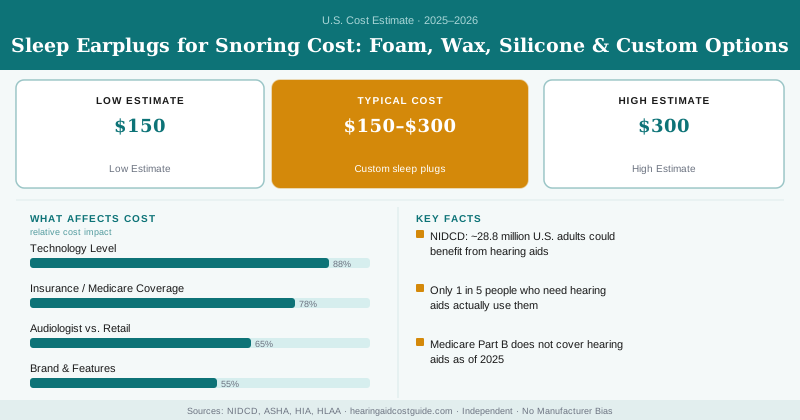
What they cost: $150–$300 per pair, including the audiologist impression appointment. The impression itself takes 15–20 minutes. Finished plugs arrive from the lab in 1–2 weeks.
Custom sleep plugs are typically made from a soft silicone with a surface finish designed for comfortable overnight wear. They’re not as high-NRR as flanged industrial plugs (a common misconception), but the improved seal from a custom fit often outperforms a poorly-fitting high-NRR plug.
For context: at $200 for a custom pair lasting 3–5 years, that’s $0.11–$0.18 per night — about the same as a foam earplug, with far better comfort.
Start with over-the-counter options. Try both foam and wax/silicone to see which you actually keep in all night. If you’re replacing foam plugs daily for six months or more, or you’ve found you can’t get a comfortable fit with any OTC option, custom-molded plugs are worth the $150–$300 investment. If the snoring is also disrupting your partner’s daytime functioning, it may be time to raise that conversation about a sleep study — loud snoring can signal sleep apnea that’s worth treating on its own merits.
The Long-Term Calculation
Nightly foam earplug use at $0.25/night: $91/year. Times 10 years: $910.
Custom-molded plugs at $250, replaced every 4 years: $62.50/year. Times 10 years: $625 — and dramatically more comfortable.
The NIDCD’s statistic that 37.5 million Americans have hearing trouble highlights how common auditory issues are. But for sleep earplug users, the concern is the opposite: protecting your sleep quality by using well-fitted protection that stays in all night and does its job.
If you’ve noticed that your hearing feels muffled in the morning after nightly earplug use, it may be worth a hearing evaluation to rule out earwax impaction — one of the more common side effects of regular earplug wear that’s easily treatable.
See also: hearing protection overview and NRR explained, custom hearing protection options and pricing.
Frequently Asked Questions
Snoring typically registers 60–80 dB at close range. To sleep comfortably, you need to bring that to below 40 dB at your ear, which means at least 20–30 dB of real-world attenuation. Foam earplugs rated NRR 29–33 can deliver 10–13 dB of practical reduction, which works for moderate snorers. Custom-molded earplugs offer NRR 25–30 with a better seal and higher wearing comfort through the night.
For most people, foam earplugs (Howard Leight MAX, 3M E-A-R Ultrafit) and wax/silicone options (Mack's Pillow Soft, Ohropax) offer the best balance of NRR and comfort for sleep. Loop Quiet ($25–$30 per pair) is a popular reusable option at NRR 24. Custom-molded sleep plugs from an audiologist ($150–$300) are the premium option for people who use earplugs every night and need a precise fit.
Yes, for most people. The main risks are earwax impaction from pushing plugs too deep into the canal, and skin irritation or infection from plugs that aren't cleaned. Foam plugs inserted correctly sit at the entrance of the canal, not deep inside. Custom-molded plugs are designed to fill the outer ear canal safely. If you develop ear pain, muffled hearing, or discharge, see a doctor — but nightly use of properly fitted earplugs is generally considered safe.