Your audiogram came back fine. Normal range, maybe mild loss in the high frequencies. And yet you can’t follow a dinner conversation at a restaurant, can’t hear your grandkids when they’re talking over each other, can’t make out dialogue on TV without subtitles. Sound familiar?
Standard audiograms test your hearing in silence. Life happens in noise. Speech-in-noise testing is the bridge between those two realities — and if you’ve ever wondered why your hearing test results don’t match your lived experience, this is probably the test you haven’t had yet.
What Speech-in-Noise Tests Cost
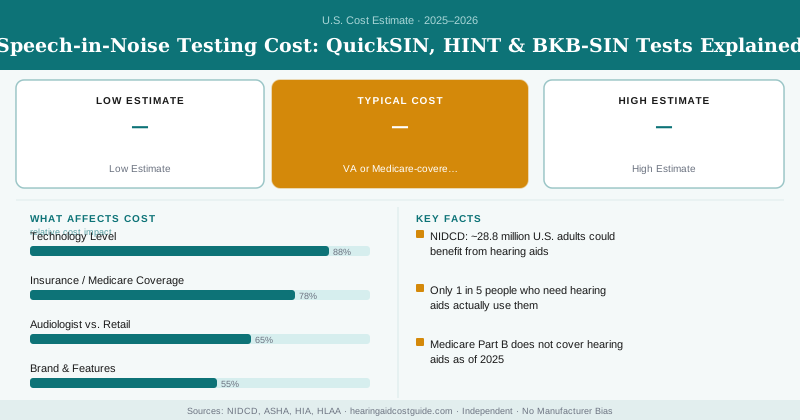
| Test | Cost | How It Works |
|---|---|---|
| QuickSIN (as part of eval) | Included in $150–$350 audiology evaluation | 6 sentences at decreasing SNR; scores SNR loss |
| QuickSIN (standalone) | $50–$100 | Standalone administration by audiologist |
| HINT (Hearing in Noise Test) | Included in $200–$400 eval | Sentences in background noise; adaptive protocol |
| BKB-SIN (pediatric) | Included in pediatric eval ($250–$500) | Child-appropriate sentence material |
| Words in Noise (WIN) test | Included in eval | NU-6 word lists in multitalker babble |
| Comprehensive eval including SNR | $200–$400 | Audiogram + SIN + word recognition |
| VA or Medicare-covered evaluation | $0 copay (eligible patients) | Varies by plan; SIN often included |
Why the Standard Audiogram Misses This
A standard pure-tone audiogram measures the softest sounds you can detect at various frequencies — in a soundproofed booth, in complete silence, with no competing noise. It’s an excellent test for what it measures. It’s also a test conducted under conditions you’ll never encounter at Thanksgiving dinner.
Speech understanding in noise depends on more than detection thresholds. It depends on:
- Neural timing and coding — how quickly your auditory nerve fires in response to rapid acoustic changes
- Auditory processing — how well your brain sorts signal from noise
- Cognitive load — the mental effort of listening, which increases with background noise
NIDCD research has documented that age-related changes in the auditory nerve and brainstem — changes that don’t show up on a standard audiogram — significantly predict a person’s real-world difficulty in noise. A 65-year-old with a “mild” audiogram may score poorly on speech-in-noise testing due to neural presbycusis (age-related neural changes independent of sensitivity loss).
According to a 2020 analysis in Ear and Hearing, approximately 34% of adults over 65 who report significant difficulty in noise have speech-in-noise scores that predict this — but a standard audiogram would classify their loss as mild or near-normal.
The QuickSIN: What It Tells You
The QuickSIN (Quick Speech-in-Noise test) is the most widely used clinical tool. Here’s what happens:
- You listen to sentences spoken by a male talker
- Background noise (four-talker babble) plays simultaneously
- The signal-to-noise ratio (SNR) starts favorable and decreases across six sentences
- Your score is your SNR loss — how many additional decibels of signal you need compared to a person with normal hearing to understand speech in noise
Interpreting QuickSIN results:
- SNR loss of 0–3 dB: Normal / near-normal
- SNR loss of 3–7 dB: Mild difficulty in noise
- SNR loss of 7–15 dB: Significant difficulty; aids and assistive technology likely needed
- SNR loss > 15 dB: Severe difficulty; hearing aids alone may provide limited benefit; FM/Roger systems strongly indicated
The QuickSIN result directly shapes hearing aid recommendations. An audiologist who knows your SNR loss can:
- Select features with more aggressive directional microphone processing
- Recommend remote microphone systems
- Set realistic expectations for hearing aid performance in noise
- Identify candidates who need audiological rehabilitation beyond just amplification
After any speech-in-noise test, ask your audiologist for your QuickSIN SNR loss score in dB. This number is portable — you can share it with any audiologist you see in the future, and it helps calibrate hearing aid programming decisions. Many audiologists include it in the evaluation report automatically, but not all. Ask specifically.
Who Should Get Speech-in-Noise Testing
You don’t need to wait for a specific referral. Speech-in-noise testing is appropriate for anyone who:
- Reports difficulty hearing in noise despite passing or near-passing a standard audiogram
- Is considering hearing aids and wants to know what to expect from them in real-world settings
- Has already been fitted for hearing aids and finds the benefit in noise disappointing
- Has a family history of auditory processing issues
- Is experiencing age-related hearing changes — NIDCD data shows that 1 in 3 adults between 65–74 have clinically significant hearing loss, and many of these individuals experience speech-in-noise difficulty disproportionate to their pure-tone thresholds
For adults 55 and older, speech-in-noise testing should arguably be standard practice at every audiology evaluation — not an add-on. Some audiologists include it routinely; others only administer it when specifically requested.
Speech-in-Noise Testing vs. Auditory Processing Disorder Evaluation
These aren’t the same thing, though they overlap. Speech-in-noise testing (QuickSIN, HINT, WIN) gives you a quick, clinical snapshot of your real-world hearing performance in noise. It takes 5–15 minutes and is often included in a standard evaluation.
An auditory processing disorder (APD) evaluation is a comprehensive battery that may include 10–15 individual subtests, takes 2–4 hours, and costs $400–$1,200. It’s designed to diagnose APD specifically and differentiate it from attention, language, or other cognitive issues.
If your speech-in-noise scores are poor, your audiologist will interpret this in the context of your full audiogram, your age, and your history. If the results suggest a central auditory processing issue rather than peripheral hearing loss, a referral for full APD evaluation may follow.
Getting the Test
Call any audiology clinic and request a “comprehensive audiological evaluation including speech-in-noise testing.” Most clinics either include QuickSIN routinely or will add it for no additional charge when asked. If there’s a separate fee, it’s typically $50–$100 — a worthwhile investment before committing to hearing aids.
Online speech-in-noise tests exist but are not clinically valid for diagnostic purposes. They’re affected by your headphone quality, room acoustics, and computer audio output. They can give you a rough sense of how you perform — but they can’t replace formal testing in a calibrated clinical environment. Don’t use online scores to make decisions about hearing aids or skip a formal evaluation.
After the Test: What Changes
A poor speech-in-noise score doesn’t mean hearing aids won’t help. It means your audiologist should:
- Program your hearing aids with stronger directional microphone features from the start
- Demonstrate a remote microphone system and let you try it before finalizing your hearing aid decision
- Set realistic expectations: even the best hearing aids can’t fully overcome a 15+ dB SNR loss in a crowded restaurant — and knowing this before you spend $4,000 matters
- Consider whether an FM/Roger system should be part of the initial prescription, not an afterthought
The test takes 10 minutes. The information it provides shapes every hearing rehabilitation decision you’ll make afterward.
Frequently Asked Questions
Usually yes, when it's part of a comprehensive audiological evaluation billed under audiological diagnostic codes. Standalone speech-in-noise testing without an accompanying hearing evaluation may not be separately billable. Ask your audiologist how they'll code the visit before scheduling.
Standard pure-tone audiograms are conducted in a sound booth with no background noise. Speech-in-noise testing replicates what your ears face in real-world environments. Many people pass a standard audiogram and still score poorly on SNR tests — particularly those with auditory processing issues or age-related neural changes.