What if your hearing aids tracked your steps, monitored if you fell, and translated languages in real time? That’s the pitch for Starkey’s Livio AI — and for some buyers, those features genuinely matter. For others, they’re impressive-sounding extras that inflate the price without helping them hear better.
Here’s what Starkey Livio AI costs, what the sensor features actually deliver, and how to decide whether you need them.
Starkey Livio AI Prices
Starkey’s Livio platform spans multiple tiers, with the “AI” designation reserved for models with the full sensor suite.
| Model | Technology Level | Pair Price (Bundled) |
|---|---|---|
| Starkey Genesis AI 24 (current flagship) | Premium | $5,000–$7,000 |
| Starkey Genesis AI 16 | Advanced | $4,000–$5,500 |
| Starkey Livio AI 2400 (previous gen) | Premium | $3,500–$6,500 |
| Starkey Livio AI 2000 | Advanced | $2,800–$4,500 |
| Starkey Livio AI 1600 | Standard | $2,200–$3,500 |
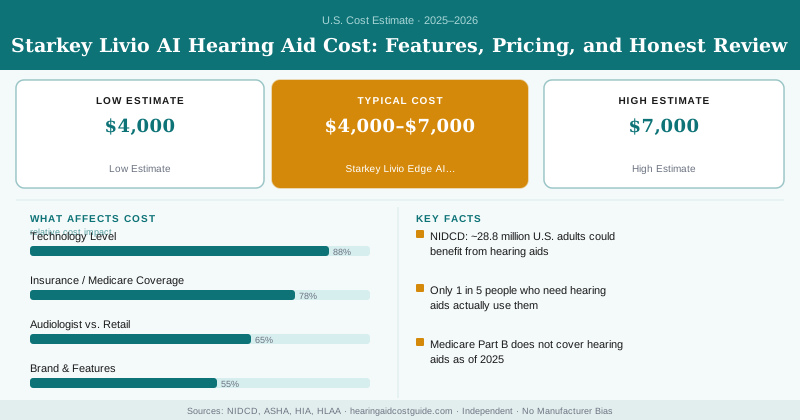
| Starkey Livio Edge AI (rechargeable) | Premium | $4,000–$7,000 |
Note: Starkey updated its platform to Genesis AI in late 2022. If you’re being quoted Livio prices today, you may be looking at prior-generation inventory — potentially a good value if the price reflects that.
The Sensor Features: What They Are and What They’re Worth
Livio AI and Genesis AI include an inertial measurement unit (accelerometer + gyroscope) inside each device. This enables:
Fall detection and alerts. The hearing aids detect if you fall and can automatically send an alert to designated contacts via the Thrive app. This is genuinely useful for adults living alone who are fall-risk. Starkey has published data showing detection accuracy in controlled testing, though real-world performance in highly variable environments is less consistent.
Activity tracking. Step counting, body engagement score, and “brain engagement” score (derived from how much social interaction/listening you’ve done). These are wellness metrics, not medical diagnostics.
Language translation. Real-time translation of 27 languages via the Thrive app. Works by streaming audio to your phone for cloud processing. Requires a smartphone and connectivity — not a standalone feature.
Tap control. Double-tapping your ear changes volume or programs. Useful, but several competitors have added this too.
The honest assessment: if fall detection matters to you — because you live alone, have balance issues, or have family members who’d benefit from automatic alerts — this is a meaningful differentiator. If you’re primarily interested in hearing performance, the sensor package adds cost without improving your hearing.
Hearing Performance: How Livio AI Stacks Up
Separating the marketing from the audiology, Livio AI and Genesis AI deliver:
- 55 dB maximum gain range, covering mild through severe hearing loss (not suitable for profound loss without custom molds)
- Bluetooth LE Audio support on Genesis AI for direct streaming from compatible phones, TVs, and accessories
- Multiflex Tinnitus Technology — built-in sound therapy for patients with tinnitus co-occurring with hearing loss
- Edge Mode — a button or tap control that applies an extra layer of processing when you enter a suddenly difficult listening situation
ASHA notes that hearing aid technology at the premium tier has largely converged in core acoustic performance across major brands. The differences between a Starkey Genesis AI, Phonak Lumity, Oticon Intent, and Signia IX are real but incremental. Brand selection at this level is often better driven by fit comfort, app preference, and audiologist expertise than by raw acoustic specs.
Starkey’s built-in tinnitus masking is worth noting if you experience both hearing loss and tinnitus. Rather than purchasing a separate tinnitus masking device, Livio AI and Genesis AI can be programmed by your audiologist to provide personalized relief sounds (broadband noise, ocean sounds, notched tones) directly through the hearing aid. This can eliminate the need for separate tinnitus devices costing $300–$1,200. Ask your audiologist to configure this at your fitting if tinnitus is a concern.
Starkey’s American Ownership: Why It Matters to Some Buyers
Starkey is the only major hearing aid manufacturer headquartered in the United States (Eden Prairie, Minnesota). For buyers who prioritize American manufacturing and local service infrastructure, this is a real differentiator. Starkey also has strong relationships with the VA system — it’s one of the primary brands used for veteran hearing aid benefits.
Insurance and the Thrive App
The Thrive Hearing app provides remote adjustments — if you’re in a situation where your hearing aids aren’t performing well, you can submit an audio sample and note to your audiologist, who can push updated programming to your devices remotely. This reduces in-office visits and is particularly valuable for patients who travel or live far from their audiologist.
NIDCD data shows that consistent hearing aid use correlates with better cognitive outcomes and slower age-related cognitive decline. The Thrive app’s tracking features — while not medical devices — can increase user engagement and daily wear time, which may have downstream benefits.
The Thrive app’s health tracking features (fall detection, activity scoring) are consumer wellness tools, not FDA-cleared medical monitoring. Don’t rely on Livio AI fall detection as your sole safety system if fall risk is a genuine medical concern. For higher-risk individuals, a dedicated medical alert system (Life Alert, Apple Watch fall detection, etc.) with 24/7 monitoring should supplement — not be replaced by — hearing aid fall detection.
Is the Starkey AI Premium Worth It?
The Livio AI and Genesis AI platform charges a meaningful premium over the hearing-only tiers of competitor brands. Whether it’s worth it comes down to a simple question: will you use the non-hearing features?
If fall detection provides genuine peace of mind (for you or family members), and you’re a smartphone user who’ll engage with the Thrive app regularly, the $500–$1,000 premium over comparable non-sensor models is reasonable. If those features sound interesting in theory but you won’t actually use them — choose a platform and tier based purely on hearing performance and audiologist relationship.
Your audiologist’s skill with fitting and programming matters far more to your daily experience than which brand’s logo is on the device.
Frequently Asked Questions
Starkey Livio AI hearing aids cost between $3,000 and $7,000 per pair, depending on the specific model and whether you choose additional features like the advanced sensor package. Most users pay closer to $4,500–$6,000 per pair when purchased through audiologists, which typically includes fitting, programming, and follow-up appointments.
Original Medicare does not cover hearing aids, leaving most seniors responsible for the full out-of-pocket cost; however, some Medicare Advantage plans offer limited hearing aid benefits covering $500–$2,000 per pair. Private insurance rarely covers hearing aids, though a small number of plans provide partial coverage—your best option is to contact your specific plan to ask about hearing aid benefits.
The fitting process typically takes 1–2 hours at your first audiologist appointment, with the hearing aids available to take home same-day or within 1–2 business days after ordering. Most users need 2–3 follow-up appointments over 4–6 weeks to optimize fit, comfort, and sound settings, though basic hearing improvement begins immediately after the initial fitting.