The $6,800 pair your audiologist recommends might have a Starkey logo. The $6,400 pair on the next shelf might be Phonak. Both claim to be “the best.” Neither claim is wrong — they’re just different tools built around different philosophies, and the one that works for you depends heavily on your hearing profile, your lifestyle, and your priorities.
Here’s the honest breakdown.
Price Comparison: Starkey vs. Phonak by Tier
| Tier | Starkey (per pair) | Phonak (per pair) |
|---|---|---|
| Entry-level | $1,500–$2,200 | $1,200–$2,000 |
| Mid-range | $2,500–$3,800 | $2,400–$3,600 |
| Premium | $4,500–$6,000 | $4,500–$6,500 |
| Ultra-premium (Edge AI / Sphere Infinio) | $5,500–$7,000 | $5,500–$8,000 |
| Single aid (one ear) | ~50% of pair price | ~50% of pair price |
Both brands sell through audiologists and hearing instrument specialists. Neither sells direct-to-consumer in the traditional sense, though both have some OTC-adjacent products. Prices above include professional fitting and bundled follow-up care at most clinics.
Starkey: The American Brand With Health Ambitions
Starkey is the only major hearing aid company headquartered in the United States (Eden Prairie, Minnesota), and that origin shapes the brand’s identity — they market aggressively on patriotism and innovation. The company’s founder, Bill Austin, built a reputation around custom fits and charitable work; today Starkey positions itself around integrated health technology.
The flagship platform, Edge AI, is the clearest expression of that ambition. These aren’t just hearing aids — they include built-in sensors that track steps, detect falls, and monitor heart rate using photoplethysmography (PPG). Some models include translation features in 27 languages. The Starkey app doubles as a health dashboard.
Where Starkey excels:
- Custom fit options — Starkey has historically led on fully custom in-the-canal (ITC, IIC, CIC) styles. If you want invisible-in-canal aids with good technology, Starkey’s custom shell manufacturing is arguably the best in the industry.
- Tinnitus relief — The Multiflex Tinnitus Technology offers highly customizable sound therapy programs, rated highly in audiologist satisfaction surveys.
- Health sensors — If activity tracking, fall detection, or fall alerts to caregivers matter to you, no competitor matches Edge AI’s sensor suite.
- US customer service — Domestic repair center means faster turnaround.
Where Starkey falls short:
- Roger compatibility — Starkey doesn’t support Roger microphones. In extremely noisy classrooms or conference rooms, that’s a gap.
- Bluetooth streaming — earlier generations lagged competitors; current Edge AI has improved but remains slightly less stable on Android.
Phonak: The Swiss Standard for Speech in Noise
Phonak is owned by Sonova Group (Switzerland) and operates with a distinctly engineering-first identity. The brand’s research focus on speech intelligibility in noise has produced some of the most clinically studied hearing aid technology available.
The current flagship is the Sphere Infinio platform, built around a dedicated AI chip that processes sound 12 million times per second (per Phonak’s published specs). Below it sits the Lumity platform, which remains excellent for most users at a lower price point.
Where Phonak excels:
- Roger compatibility — This is Phonak’s biggest differentiator. Roger is a wireless microphone system designed for noisy environments (classrooms, restaurants, meetings). When a Roger device transmits directly to your hearing aid’s built-in receiver, it effectively removes background noise from the equation. No other major brand offers this. According to a 2022 study published in the International Journal of Audiology, Roger significantly improved speech perception in noise for hearing aid users compared to hearing aid use alone.
- AutoSense OS — Phonak’s automatic scene-detection system switches between 200+ programs without user input. It genuinely works; audiologists consistently rate it among the most reliable automatic systems.
- Android and iPhone compatibility — Phonak has historically had the broadest Bluetooth connectivity, including direct streaming from Android devices when competitors required workarounds.
- Lyric extended-wear — Phonak is the only brand offering a 100% invisible, extended-wear hearing aid worn 24/7 for months at a time ($3,000–$4,500 per year per ear, subscription model).
Where Phonak falls short:
- Health sensors — there are none. If wearable health tracking matters, Phonak isn’t the brand.
- Custom styles — available but not Phonak’s strong suit; most of their technology shines in RIC (receiver-in-canal) form factors.
Technology Feature Comparison
| Feature | Starkey Edge AI | Phonak Sphere Infinio |
|---|---|---|
| AI chip / processing | Yes | Yes |
| Fall detection | Yes | No |
| Heart rate / activity tracking | Yes | No |
| Roger mic compatibility | No | Yes |
| iPhone streaming | Yes | Yes |
| Android streaming | Yes (improved) | Yes (best in class) |
| Tinnitus masking | Yes (Multiflex) | Yes (basic) |
| Rechargeable option | Yes | Yes |
| App quality | Strong (health focus) | Strong (simplicity) |
| Custom IIC/CIC styles | Excellent | Available |
| Manufacturer warranty | 3 years | 3 years |
Rechargeable Options: Both Are Good
Both brands now offer lithium-ion rechargeable options across most product lines, and both provide a full day’s charge in a few hours. Phonak’s rechargeable models (Audeo Lumity-R, Sphere Infinio-R) use a case that doubles as a power bank — useful if you’re traveling. Starkey’s rechargeable Edge AI uses a similar compact charger. Neither brand has a clear advantage here.
Choose Starkey if: You want health sensor features (fall detection, activity tracking), you prefer invisible custom-fit styles, or you want a US-made product with domestic repair service.
Choose Phonak if: You’re frequently in very noisy environments (restaurants, classrooms, meetings), you want Roger microphone compatibility, or you’re an Android user who wants the most stable Bluetooth streaming.
The honest answer: Either brand’s premium tier will perform exceptionally well for most mild-to-moderate hearing loss profiles. The biggest factor in your outcome isn’t the brand — it’s the audiologist fitting you. A well-fitted mid-range pair beats a poorly fitted premium pair every time.
A Note on Audiologist-Brand Loyalty
According to a 2023 survey by Hearing Tracker, the majority of audiologists are authorized to dispense both Starkey and Phonak, but individual clinics often carry 2–3 preferred brands. If your audiologist only shows you one brand, ask why — and consider a second opinion if the reasoning seems more commercial than clinical.
Who Each Brand Is Best For
Starkey is typically the better fit for:
- People with tinnitus who want customizable sound therapy
- Adults who want wearable health monitoring integrated into their aids
- Patients who prefer custom in-canal styles
- Anyone who values US-based customer support
Phonak is typically the better fit for:
- Teachers, students, or meeting-heavy professionals (Roger compatibility)
- Adults in loud social environments regularly
- Android smartphone users
- People who want the most extensively documented clinical research behind their purchase
Neither Starkey nor Phonak can be purchased without a hearing evaluation and professional fitting. OTC hearing aids are available for mild-to-moderate loss (PSAP devices starting under $400), but Starkey and Phonak products require audiologist dispensing. Avoid third-party resellers offering dramatically discounted “new” units — gray market devices may not carry valid manufacturer warranties.
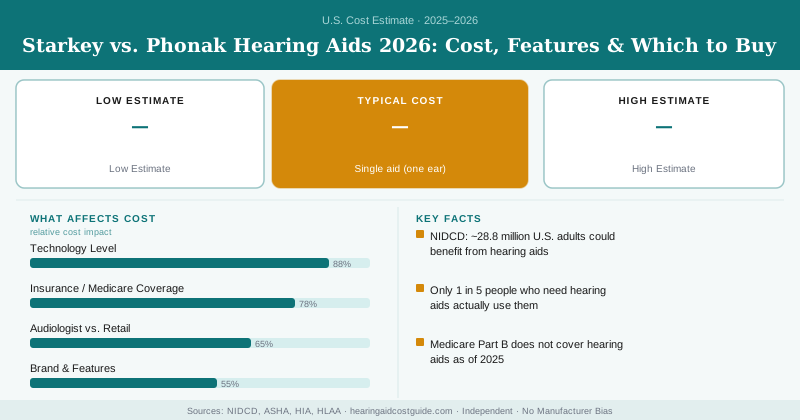
The NIDCD estimates that only about 16% of adults aged 20–69 who could benefit from hearing aids have ever used them. Cost is the most cited barrier. But spending $7,000 on the wrong premium brand — when a $3,000 mid-range pair from the right brand would serve you better — is a real cost trap. The decision between Starkey and Phonak matters less than getting properly evaluated, properly fitted, and properly followed up.
Frequently Asked Questions
Starkey hearing aids range from about $1,500–$2,000 per pair at the entry level up to $5,000–$7,000 per pair for the Edge AI premium tier. Phonak runs similarly — roughly $1,200–$2,000 for entry-level Slim or Audeo models up to $6,000–$8,000 per pair for the Sphere Infinio premium platform. Prices quoted by audiologists typically include professional fitting fees bundled in, so ask for the unbundled device-only cost if you want a true apples-to-apples comparison.
Both brands offer sophisticated directional microphone systems and noise reduction, but Phonak's AutoSense OS and Roger compatibility give it a measurable edge in very noisy group situations. Roger receivers clip onto or install inside the hearing aid and wirelessly receive a speaker's voice directly, cutting background noise in a way no standard microphone system can match. Starkey's Edge AI uses machine-learning scene classification and performs very well in noise, but Roger is a unique technological advantage Phonak holds.
Both offer a standard three-year manufacturer's warranty on most premium models, but Starkey — as an American company based in Eden Prairie, Minnesota — tends to have faster domestic repair turnaround (7–10 business days vs. Phonak's 10–14 days for international repairs). Starkey also provides a 30-day satisfaction guarantee on most purchases. Phonak's global network of Phonak-trained audiologists is larger internationally, which matters if you travel frequently outside the US.