You wake up Thursday morning and one ear is just… gone. No warning, no pain — just silence on the left side. That’s sudden sensorineural hearing loss (SSNHL), and it’s a genuine medical emergency. According to the National Institute on Deafness and Other Communication Disorders (NIDCD), roughly 66,000 new cases occur in the U.S. each year. Most people wait days before seeing a doctor. That’s a mistake that can cost you your hearing permanently — and it’s a mistake that’s completely avoidable once you understand what’s happening.
Emergency Treatment Costs for Sudden Hearing Loss
| Treatment / Setting | Average Cost | Notes |
|---|---|---|
| Emergency room visit | $800–$2,500 | With or without insurance; highest if imaging ordered |
| Urgent care visit | $150–$350 | Faster than ER for initial assessment, lower cost |
| ENT specialist visit (emergency) | $200–$600 | Critical — direct ENT is ideal route |
| Audiogram (diagnostic) | $100–$250 | Confirms sensorineural vs. conductive loss |
| Oral corticosteroids (prednisone) | $15–$60 | Generic is cheap; most common first-line treatment |
| Intratympanic steroid injections | $300–$800 per injection | 1–3 injections typically; often 3–5 days apart |
| MRI with contrast (rule out acoustic neuroma) | $800–$2,500 | Insurance often covers; cash rate varies widely |
| Total first episode (insured) | $500–$2,000 | Depends heavily on plan deductible |
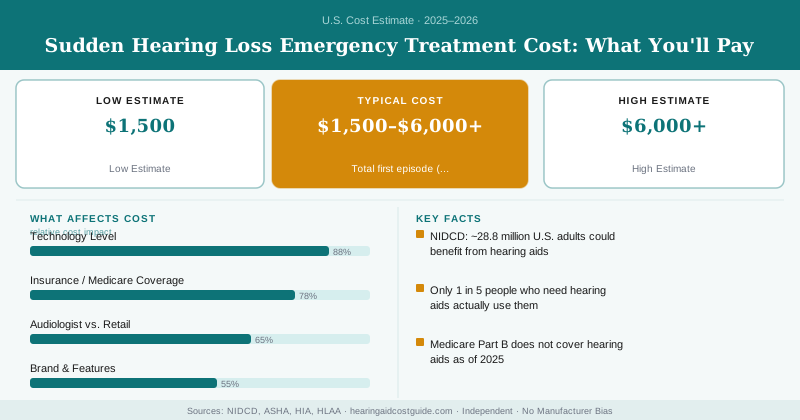
| Total first episode (uninsured) | $1,500–$6,000+ | Self-pay rates lower than billed charges |
The 72-Hour Window Nobody Tells You About
Here’s what most people don’t know: sudden hearing loss is most treatable within the first 24–72 hours. Corticosteroids — either oral or injected directly through the eardrum — are the standard treatment. They reduce inner ear inflammation and, when started quickly, improve recovery odds significantly.
Wait a week? Your odds of full recovery drop. Wait two weeks? Much lower. The NIDCD reports that approximately 32–65% of SSNHL patients recover some hearing spontaneously, but treatment within the critical window improves outcomes measurably compared to watchful waiting.
Don’t go to a general practitioner and hope they fit you in. Call an ENT directly and tell them it’s sudden hearing loss. Most ENT offices will see you same day or refer you to the ER if they can’t. That matters more than finding the cheapest visit.
What the Emergency Workup Looks Like
Your ENT will do a few things immediately:
- Audiogram — to confirm it’s sensorineural (inner ear/nerve) loss, not conductive (wax, fluid, middle ear). You need this distinction before treatment starts.
- Rule out easy causes — ear canal blockage, middle ear infection, acoustic trauma. These are treated very differently.
- Start steroids — oral prednisone (typically 40–60 mg/day for 7–14 days) is the front-line treatment if there’s no contraindication like diabetes or uncontrolled hypertension.
- Order MRI — usually within the first few weeks to rule out an acoustic neuroma (a benign tumor on the hearing nerve). This isn’t an emergency imaging order unless other neurological symptoms are present.
Go directly to an ENT if you can be seen within 24 hours. If it’s after hours on a Friday, go to the ER — don’t wait until Monday. The ER will order an audiogram, rule out stroke (which can cause sudden hearing loss), and may start steroids before an ENT is available.
Cost difference: ER visit runs $800–$2,500. ENT visit runs $200–$600. If time allows, ENT is faster and cheaper. If time doesn’t allow, the ER is still the right call.
Insurance Coverage for SSNHL Treatment
This is where it gets complicated. Sudden hearing loss treatment is medically necessary — steroids, audiograms, MRI — all of it gets coded as medical care, not hearing care. That’s actually good news for insurance coverage. Medical insurance (not hearing-specific coverage) covers it.
Under most plans:
- Audiogram for diagnosis: Covered as diagnostic (not routine hearing test)
- Oral corticosteroids: Covered as a prescription
- Intratympanic injections: Covered as an office procedure, usually with a specialist copay ($50–$200 per visit)
- MRI: Covered for medical necessity; preauthorization sometimes required
Your out-of-pocket will depend on your deductible. Someone with a $3,000 deductible and $1,500 in accumulated deductible payments faces a very different bill than someone who’s met their deductible already.
If you’re uninsured or between jobs, call the ENT office billing department before your appointment and ask about self-pay rates. Most offices offer 20–40% discounts on cash-pay accounts. For intratympanic steroid injections specifically, some ENT practices will reduce the per-injection fee significantly for patients paying out of pocket — ask directly.
What Happens If Initial Treatment Fails
About 30–40% of SSNHL patients don’t fully recover hearing even with prompt treatment. If oral steroids fail, intratympanic (IT) injections are the salvage therapy — steroids injected directly through the eardrum into the middle ear space. They’re more targeted, avoid systemic steroid side effects, and are particularly useful for patients with diabetes or other conditions where high-dose oral steroids are risky.
IT injections typically run 1–3 sessions over 1–3 weeks. Each injection costs $300–$800 out-of-pocket when it’s a specialist office procedure, though insurance often covers it at your specialist copay rate.
If significant permanent loss results, you move into hearing aid territory. A mild-to-moderate unilateral loss can often be managed with one aid ($1,000–$3,500 for the affected ear). Severe or profound single-sided loss may require CROS hearing aids or, in some cases, cochlear implant evaluation.
The bottom line: get seen fast, ask specifically about self-pay discounts if you’re uninsured, and don’t let cost delays cost you your hearing.
Frequently Asked Questions
Total costs typically range from $500 to $5,000+ depending on whether you have insurance, the type of imaging required (MRI or CT scan), and whether you receive corticosteroid injections or oral medications. Without insurance, expect to pay $200–$400 for the initial emergency room visit, $1,500–$3,000 for diagnostic imaging, and $200–$1,500 for specialist consultations and treatment.
Most major health insurance plans cover emergency department visits, diagnostic imaging, and specialist evaluations for sudden hearing loss since it is medically necessary, though your out-of-pocket cost depends on your deductible and copay structure. However, some plans may not fully cover corticosteroid injections administered in the office setting, potentially leaving you responsible for $300–$800 of that cost even with insurance.
The first 72 hours are the most critical window for treatment effectiveness; corticosteroids administered within this timeframe significantly improve the chances of partial or full hearing recovery. Delays beyond this window substantially reduce treatment effectiveness, and waiting more than 2 weeks makes recovery far less likely, potentially making the hearing loss permanent and eliminating your best medical options.