You can’t always stop tinnitus. But you can change how your brain responds to it. That’s the premise of cognitive behavioral therapy (CBT) for tinnitus — and it has more clinical evidence behind it than almost any other tinnitus intervention. The ringing doesn’t necessarily go away. The suffering does, for many patients. Here’s what CBT costs, what it involves, and when it makes sense.
What CBT for Tinnitus Actually Is
Cognitive behavioral therapy restructures the thought patterns and emotional responses that turn a background noise into a consuming problem. Tinnitus distress isn’t simply about the volume of the ringing. Two people with identical tinnitus audiograms can have radically different distress levels — one barely notices it, the other can’t sleep. The difference is neural habituation and cognitive response.
CBT for tinnitus typically involves:
- Identifying catastrophic thought patterns about tinnitus (“this will ruin my life”)
- Relaxation training to reduce hypervigilance to the sound
- Sleep hygiene protocols specific to tinnitus
- Behavioral strategies for difficult listening environments
- Gradual exposure work to reduce avoidance behaviors
According to the American Tinnitus Association, CBT has the strongest evidence base of any tinnitus management approach in peer-reviewed literature. A 2021 Cochrane systematic review found CBT significantly reduced tinnitus-related distress and improved quality of life compared to no treatment or control conditions — with effects maintained at follow-up.
CBT for Tinnitus Costs
| Service | Who Provides It | Estimated Cost |
|---|---|---|
| Individual CBT session (50 min) | Psychologist, LCSW, tinnitus specialist | $120–$300 per session |
| Group CBT program (8–10 weeks) | Hospital audiology or behavioral health | $400–$1,200 total |
| Online/telehealth CBT program | Digital therapeutic platforms | $150–$500 total |
| Initial evaluation | Audiologist or psychologist | $150–$350 |
| Combined CBT + sound therapy | Tinnitus specialty clinic | $1,500–$3,500 total |
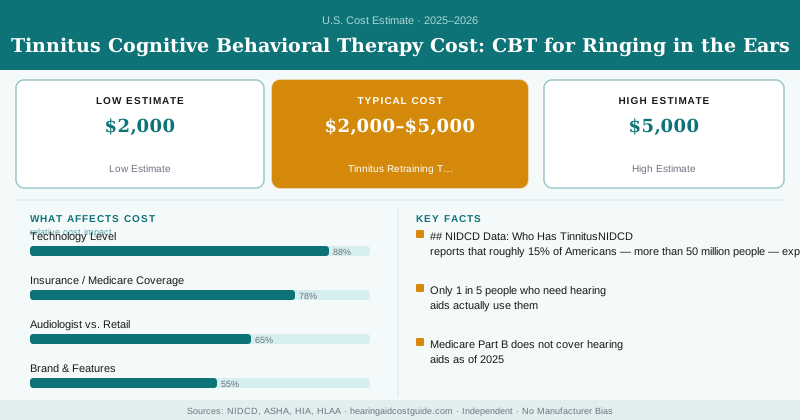
| Tinnitus Retraining Therapy (TRT) | Audiologist | $2,000–$5,000 total |
8–12 Sessions: What a Full Course Looks Like
Most structured CBT protocols for tinnitus run 8–12 weekly sessions of 50–60 minutes each. At $150–$250 per session (a typical range for a licensed psychologist in the US), a full course runs $1,200–$3,000 out of pocket.
That sounds steep — but compare it to the alternatives. Tinnitus Retraining Therapy (TRT) runs $2,000–$5,000 and takes 18–24 months. Sound therapy devices run $500–$3,000. Most of those approaches lack CBT’s evidence base.
Session 1–2 typically involve assessment: the therapist measures distress level using validated tools like the Tinnitus Handicap Inventory (THI), discusses triggers, and identifies thought patterns. Sessions 3–6 introduce cognitive restructuring — recognizing and challenging catastrophizing thoughts about the tinnitus. Sessions 7–10 involve behavioral strategies and relaxation practice. Final sessions build relapse prevention and self-management skills.
NIDCD Data: Who Has Tinnitus
NIDCD reports that roughly 15% of Americans — more than 50 million people — experience some form of tinnitus. About 20 million have chronic, bothersome tinnitus. Roughly 2 million have severe, debilitating tinnitus that disrupts daily functioning. CBT is most impactful in that severe group, but it shows meaningful benefit even in moderate cases where distress is significant.
CBT and Tinnitus Retraining Therapy (TRT) are different approaches. TRT combines directive counseling with sound therapy and runs 18–24 months. CBT is shorter (8–12 weeks), more structured, and focuses specifically on cognitive and emotional responses. Research generally shows CBT is at least as effective as TRT for distress reduction and is faster. If you’re primarily struggling with anxiety, sleep disruption, or intrusive thoughts about tinnitus, CBT is the better first step. If your main complaint is the loudness or persistence of the sound itself, sound therapy approaches (including TRT) may add complementary benefit.
Finding a Tinnitus-Specialized CBT Provider
Not all CBT therapists are familiar with tinnitus protocols. Ask specifically whether the therapist has experience with tinnitus management CBT or audiological CBT. Hospital-based tinnitus clinics (often in audiology departments at academic medical centers) are the most reliable referral path. The American Tinnitus Association’s provider directory lists specialists by region.
Some audiologists are trained in both CBT and tinnitus management. An audiologist with CBT training can address both the acoustic and cognitive aspects in a single treatment relationship — this is particularly efficient and is increasingly the model at major tinnitus specialty clinics.
Telehealth and Digital CBT: The Growing Option
Several digital programs now deliver validated CBT protocols for tinnitus via app or web platform:
- Oto (UK-developed, available in US): structured CBT for tinnitus, $150–$300/year
- Widex Sound Therapy + counseling: combined approach with audiologist telehealth
- IHEAR: online program developed from research protocols
These digital options are particularly valuable if you’re in a rural area without access to tinnitus-specialized providers. Efficacy data on digital CBT for tinnitus is generally positive in preliminary trials, though the evidence base is not yet as robust as in-person CBT.
Insurance Coverage for Tinnitus CBT
This is complicated. Mental health parity laws require most commercial insurers to cover CBT when provided by a licensed psychologist or therapist — but only when a mental health diagnosis is the presenting problem. CBT billed under a tinnitus diagnosis code alone may face coverage denials.
Many clinicians bill CBT for tinnitus under co-occurring diagnoses like anxiety disorder or adjustment disorder, which are accurate and often present. Ask your provider how they bill tinnitus-related CBT before your first session.
Avoid online programs or practitioners who promise to “cure” or “eliminate” your tinnitus through CBT. CBT doesn’t aim to stop the ringing — it aims to reduce distress and improve quality of life. Providers making elimination claims are either misinformed or misleading you. The clinical goal is habituation and reduced emotional reactivity, which for most patients is far more life-changing than any promised sound reduction.
Frequently Asked Questions
CBT for tinnitus typically costs $100–$300 per session, depending on your location, provider credentials, and whether you see a psychologist or audiologist. Most patients require 8–12 sessions to see meaningful results, bringing the total cost to approximately $800–$3,600 for a complete treatment course.
Many major health insurance plans cover CBT for tinnitus when prescribed by a licensed mental health professional, though coverage varies by plan and provider. Out-of-pocket costs typically range from $20–$50 per session after meeting your deductible, but some plans may exclude tinnitus-specific treatment or limit the number of covered sessions.
Most patients need 8–12 sessions spaced over 3–6 months to experience symptom improvement, with sessions usually occurring weekly or biweekly. The goal of CBT is to reduce your emotional response to tinnitus and help you regain focus and quality of life, rather than eliminating the ringing entirely.