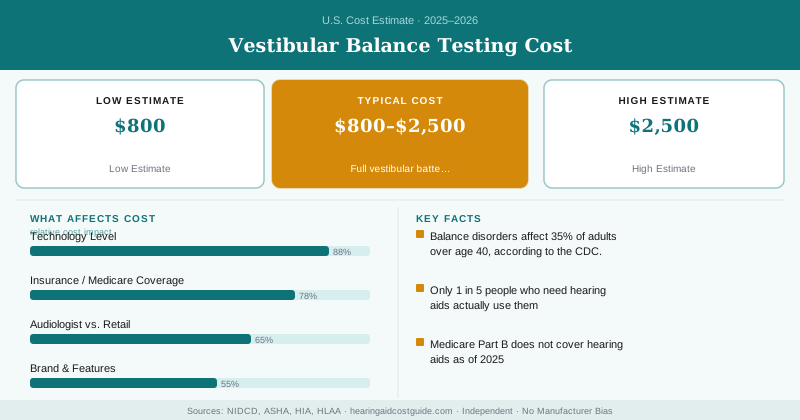
Balance disorders affect 35% of adults over age 40, according to the CDC. That’s a staggering number — and yet most people who are dizzy, unsteady, or falling don’t realize that the evaluation and diagnosis often runs through an audiologist, not just a neurologist. Your inner ear is your primary balance organ. When it malfunctions, vestibular testing maps exactly what’s broken and where. Here’s what those tests cost.
Vestibular Balance Test Cost by Type
| Test | Typical Cost (No Insurance) |
|---|---|
| VNG — videonystagmography (full battery) | $300–$800 |
| ENG — electronystagmography (older version) | $250–$600 |
| Computerized dynamic posturography (CDP) | $400–$900 |
| Rotary chair testing | $500–$1,200 |
| Video head impulse test (vHIT) | $200–$500 |
| Vestibular evoked myogenic potential (VEMP) | $200–$600 |
| Electrocochleography (ECoG) | $300–$700 |
| Full vestibular battery (multiple tests) | $800–$2,500 |
What Each Test Actually Measures
Vestibular testing is not a single procedure — it’s a battery of targeted evaluations, each designed to assess a different part of the balance system.
VNG (videonystagmography) is the workhorse of vestibular diagnostics. You wear infrared goggles that track involuntary eye movements (called nystagmus) while you follow visual targets, change head and body positions, and undergo caloric irrigation — a procedure where warm and cool air or water is introduced into the ear canal to stimulate each side of the vestibular system independently. This lets the audiologist compare how your left and right inner ears are functioning. Asymmetry between sides is a key diagnostic finding. VNG runs $300–$800 at most audiology and ENT centers.
Rotary chair testing seats you in a motorized chair that rotates at controlled speeds and accelerations while you sit in total darkness. Your eye movements are tracked throughout. This is particularly useful for identifying bilateral vestibular weakness — when both inner ears are underperforming, something that can be missed on VNG. Cost: $500–$1,200.
Computerized dynamic posturography (CDP) measures how well you maintain balance on a moving platform under various conditions — eyes open, eyes closed, surface stable, surface moving. It isolates your reliance on vision, proprioception (joint sense), and vestibular input and shows which system is contributing least to your stability. Cost: $400–$900.
VEMP (vestibular evoked myogenic potentials) uses sound to stimulate specific parts of the vestibular organ — the saccule (cervical VEMP) and utricle (ocular VEMP) — and measures the electrical response in neck or eye muscles. It’s a targeted test for conditions like superior semicircular canal dehiscence or certain vestibular nerve disorders. Cost: $200–$600.
Why Does an Audiologist Run Balance Tests?
This surprises a lot of patients. The vestibular system — the sensory organs for balance — is housed inside the inner ear, anatomically inseparable from the cochlea responsible for hearing. Many vestibular disorders cause both dizziness and hearing changes simultaneously. Audiologists with vestibular specialization are trained in the full picture, and most full vestibular testing labs are housed in audiology departments or ENT practices.
If you’ve been referred by a neurologist, primary care physician, or ENT, you’ll likely end up in an audiology-run vestibular lab for the actual testing.
- BPPV (benign paroxysmal positional vertigo) — the most common cause of vertigo, treatable with repositioning maneuvers
- Meniere’s disease — episodic vertigo, hearing loss, and tinnitus
- Labyrinthitis and vestibular neuritis — viral inflammation of the inner ear or nerve
- Superior semicircular canal dehiscence (SSCD)
- Bilateral vestibular hypofunction
- Acoustic neuroma (vestibular schwannoma)
- Perilymphatic fistula
Most of these are identifiable or confirmable with vestibular testing combined with imaging.
Does Insurance Cover Vestibular Testing?
Generally yes — vestibular testing is typically covered when ordered by a physician for a documented symptom (vertigo, dizziness, falls, imbalance). Medicare Part B covers VNG, posturography, and rotary chair testing under the durable medical procedures benefit. ASHA notes that coverage rates for vestibular testing have improved significantly as falls prevention has become a priority in Medicare quality metrics.
You’ll typically owe your Part B deductible and 20% coinsurance. Private insurers vary, but most cover vestibular testing as diagnostic audiology when prior authorized and billed with appropriate CPT codes (92540 for basic vestibular evaluation, 92541–92548 for specific subtests).
If your physician orders the referral, bring documentation of your symptoms — frequency, duration, triggers, any associated hearing changes. That documentation supports medical necessity and smooths the authorization process.
| Payer | Typical Patient Cost |
|---|---|
| Medicare Part B | $0 after deductible + 20% coinsurance |
| Medicaid | Often $0 (varies by state) |
| Private insurance (in-network) | Specialist copay to 20% coinsurance |
| Self-pay | $300–$2,500 depending on battery |
Where to Get Vestibular Testing
Not every audiology clinic has vestibular testing equipment — VNG systems, rotary chairs, and posturography platforms are expensive and space-intensive. Look for:
- University hospital audiology departments
- ENT practices with dedicated vestibular labs
- Neurotology practices (otolaryngologists who subspecialize in the inner ear)
- Balance disorder clinics
Your primary care physician or neurologist can refer you. If you’ve already seen an ENT, ask whether their clinic has an in-house vestibular lab or if they partner with an audiology program.
Dizziness that comes with sudden hearing loss in one ear, severe headache, double vision, or numbness and weakness in your face or limbs is a medical emergency. Don’t schedule a vestibular evaluation — call 911 or go to the emergency room. These symptoms can indicate stroke, which requires immediate treatment.
After the Testing: What Happens Next
A vestibular evaluation produces a report that identifies where in the balance system the problem lies — inner ear, vestibular nerve, brainstem, or central pathways. That localization tells your care team what treatment to pursue.
BPPV — by far the most common finding — is treated immediately with repositioning maneuvers in the clinic at no extra cost and often resolves the same day. Vestibular neuritis and labyrinthitis are treated with medications and vestibular rehabilitation therapy, a specialized form of physical therapy that runs $100–$300 per session and typically takes 6–12 sessions. Meniere’s disease has several treatment tiers, and acoustic neuroma requires imaging follow-up and specialist management.
The $300–$2,500 evaluation is the diagnosis. What comes after depends entirely on what it finds — and for the 35% of adults over 40 dealing with balance problems, knowing what’s actually causing the dizziness is the most valuable first step.
Frequently Asked Questions
Vestibular balance testing typically costs $300–$2,500 depending on which tests your doctor orders. A basic evaluation with videonystagmography (VNG) runs $300–$800, while comprehensive testing that includes posturography or rotary chair testing can reach $1,500–$2,500.
Most major health insurance plans cover vestibular testing when ordered by a physician for documented balance or dizziness symptoms, though your out-of-pocket cost depends on your deductible and copay—typically $50–$300 per visit. Some plans classify certain advanced tests like posturography as specialty procedures and may require prior authorization or deny coverage if deemed experimental.
A typical vestibular test appointment lasts 30–90 minutes depending on which tests are performed; VNG testing alone usually takes 20–30 minutes, while comprehensive batteries with posturography can extend to 90 minutes. The tests are non-invasive and painless, though you may experience brief dizziness during certain movements—this is normal and helps your audiologist or neurologist identify the exact source of your balance problem.