Imagine waking up one morning and the room won’t stop spinning — for hours, then days. That’s vestibular neuritis. It hits suddenly, usually after a viral illness, when the nerve carrying balance signals from your inner ear to your brain becomes inflamed. Unlike a brief BPPV spin, this vertigo is relentless and can knock you flat for a week.
The good news: it almost always improves. The cost depends mostly on how rough the acute phase is and how much rehab your brain needs afterward.
Two Cost Phases: Acute and Recovery
Vestibular neuritis has two distinct stages, and each has its own price tag.
The acute phase (first days to a week) is about controlling the spinning and nausea. Some people ride it out at home with prescriptions; others end up in the ER because the vertigo is so severe they can’t keep fluids down.
The recovery phase is about retraining your balance system, which is where vestibular rehabilitation comes in. The American Academy of Otolaryngology recognizes vestibular rehab as a primary recovery tool for inner-ear balance disorders.
Cost Breakdown
| Treatment | Cost (No Insurance) |
|---|---|
| Primary care or ENT visit | $120–$450 |
| ER visit (severe acute vertigo) | $1,000–$3,000+ |
| Anti-nausea / vestibular suppressant meds | $15–$100 |
| Steroid course (if prescribed) | $20–$120 |
| MRI to rule out other causes | $400–$3,000 |
| Vestibular rehab evaluation | $150–$350 |
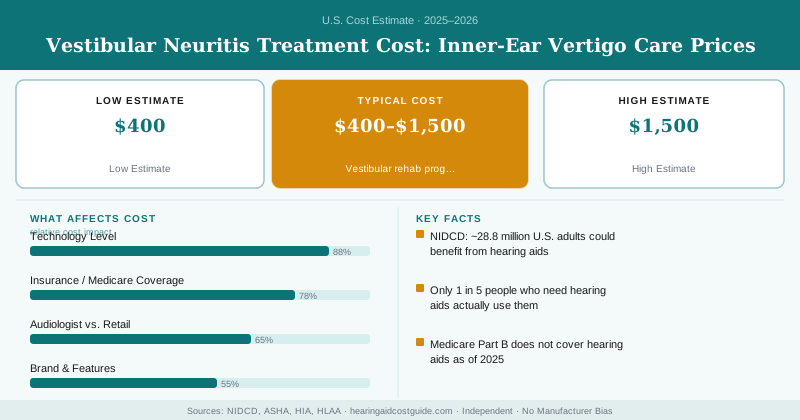
| Vestibular rehab program (4–10 sessions) | $400–$1,500 |
The MRI and the ER visit are the wild cards. Because severe one-sided vertigo can mimic a stroke, doctors sometimes order imaging to be safe — and that single scan can cost more than the rest of treatment combined.
Vestibular neuritis runs $300–$2,500 in the acute phase depending on whether you avoid the ER, plus $400–$1,500 for vestibular rehab during recovery. An MRI to rule out other causes can add $400–$3,000. Most cases resolve with time, medication, and balance therapy — no surgery.
Getting the Right Diagnosis
Sudden severe vertigo is one of those symptoms where an accurate diagnosis genuinely saves money and risk. Your provider has to separate vestibular neuritis from a balance disorder with a different cause, from labyrinthitis, and from something more serious. An ENT exam and sometimes specialized balance testing sort this out. If hearing is affected too, that points toward labyrinthitis rather than pure neuritis — which is why a hearing test is often part of the workup.
Pure vestibular neuritis spares hearing. If you have sudden hearing loss alongside the vertigo, treat it as urgent — see our sudden hearing loss treatment cost guide, because the treatment window is short.
Does Insurance Cover It?
Yes. As a diagnosed medical condition, vestibular neuritis care — visits, medications, imaging, and rehab — is covered by standard health insurance after your copays and deductible. Vestibular rehab typically bills under your physical-therapy benefit, so check your per-visit copay and visit limit. This has nothing to do with hearing aid coverage rules, since it’s a balance, not a hearing-device, issue.
Don’t rely on vestibular suppressant medications for more than the first few days. They calm the acute spinning, but taking them long-term actually slows your brain’s natural compensation — meaning a longer, costlier recovery and more rehab sessions. Use them briefly, then let balance therapy do its job.
How to Control the Cost
- Call your doctor before the ER if you can. If you can keep fluids down, an urgent telehealth or office visit with prescriptions costs a fraction of an ER trip.
- Start rehab early. The sooner you begin vestibular exercises, the faster you compensate — often fewer total sessions.
- Route rehab through your PT benefit. It’s almost always cheaper than paying cash per session.
- Ask whether the MRI is truly needed. If your exam is classic for neuritis, your doctor may safely skip costly imaging.
Bottom Line
Vestibular neuritis is frightening and miserable, but it’s rarely expensive to treat well. Most people recover with a short course of medication and a handful of vestibular rehab sessions — landing somewhere between a few hundred and a couple thousand dollars out of pocket with insurance. The costs spike only with an ER visit or an MRI. Get diagnosed promptly, use suppressant meds briefly, and lean into balance therapy to recover faster and cheaper.
Frequently Asked Questions
Acute-phase treatment typically costs $300–$2,500, depending on imaging (MRI runs $500–$2,000), emergency visits, and medications. Add another $400–$1,500 for vestibular rehabilitation therapy over 4–8 weeks, bringing total out-of-pocket costs to $700–$4,000 for uninsured patients.
Most insurance plans cover emergency care, diagnostic imaging, and vestibular rehab if prescribed by a physician, though you'll typically pay 20–40% coinsurance after your deductible. Some plans require prior authorization for physical therapy or limit rehab visits to 20–30 sessions per year, potentially leaving you responsible for additional out-of-pocket costs beyond that cap.
Most people recover naturally within 2–4 weeks with rest and anti-nausea medication ($50–$200), but vestibular rehab speeds recovery and reduces fall risk significantly. Skipping rehab may extend symptoms for months and increase risk of falls or secondary injuries; the $400–$1,500 investment typically shortens disability and prevents costlier complications.