Most people assume sudden, severe vertigo means something catastrophic is happening — a stroke, a brain tumor, something requiring immediate expensive imaging and specialist intervention. Vestibular neuronitis, an inflammation of the vestibular nerve usually triggered by a viral infection, causes exactly that kind of terrifying spinning sensation. But the treatment itself is rarely expensive, and it almost never requires surgery.
Vestibular Neuronitis Treatment Costs
| Service | Typical Cost (Uninsured) | With Insurance |
|---|---|---|
| ER visit (acute vertigo episode) | $1,000–$3,000 | $150–$500 copay |
| Urgent care visit (milder onset) | $150–$300 | $30–$75 copay |
| Anti-nausea/vestibular suppressant meds | $20–$80 | $5–$25 copay |
| Vestibular rehabilitation therapy (per session) | $75–$150 | $20–$60 copay |
| Full VRT course (6–12 sessions) | $450–$1,800 | $120–$720 copay |
| MRI (if ordered to rule out other causes) | $1,000–$3,000 | $200–$800 out-of-pocket |
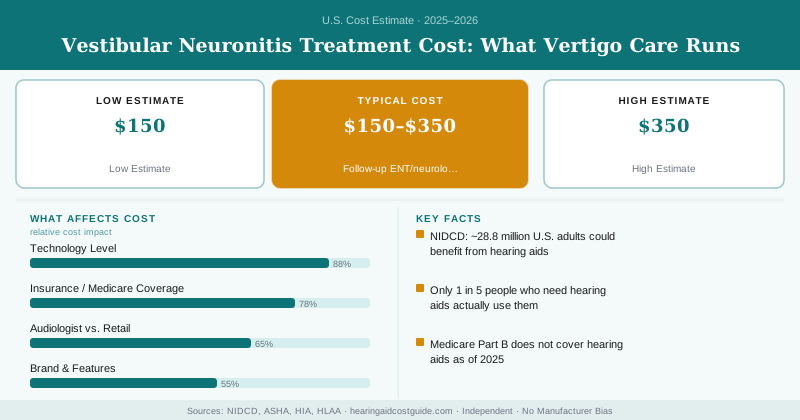
| Follow-up ENT/neurology visit | $150–$350 | $30–$75 copay |
Why the ER Isn’t Always the Right First Stop
The instinct when the room starts spinning uncontrollably is to go straight to the emergency room, and for a first severe episode, that’s reasonable — you want serious causes ruled out. But once vestibular neuronitis is confirmed (or strongly suspected based on the pattern of symptoms), subsequent care shifts to a much less expensive track: an ENT or neurologist visit, targeted medication, and vestibular rehabilitation therapy (VRT), a specialized form of physical therapy that retrains your brain to compensate for the inner ear signal disruption.
The National Institute on Deafness and Other Communication Disorders notes that vestibular disorders, including neuronitis and labyrinthitis, are among the most common reasons adults visit a doctor for dizziness — and the overwhelming majority resolve with conservative treatment rather than surgery or invasive procedures.
Vestibular Rehabilitation Therapy: The Main Cost Driver
VRT is where most of the ongoing treatment cost lives. A typical course runs 6 to 12 sessions with a physical therapist trained in vestibular rehabilitation, at $75–$150 per session before insurance. Most insurance plans cover VRT as a standard physical therapy benefit, bringing your per-session cost down to a typical copay of $20–$60.
Vestibular rehabilitation isn’t massage or general physical therapy — it’s a specific set of exercises (gaze stabilization, habituation, balance training) designed to retrain your brain’s compensation mechanisms after inner ear damage. Studies consistently show it speeds recovery compared to rest alone. Ask specifically for a therapist with vestibular rehabilitation certification, not a general physical therapist, since the exercise protocols differ meaningfully.
When Imaging Gets Added to the Bill
Most vestibular neuronitis cases are diagnosed clinically — based on the pattern and timing of symptoms plus a physical exam — without needing an MRI. Imaging gets ordered when symptoms don’t follow the typical pattern, don’t improve within the expected timeframe (usually days to a couple weeks for the acute phase), or when the physician wants to rule out a central cause like a stroke or tumor. That’s when a $1,000–$3,000 MRI enters the cost picture, and it’s the single biggest potential expense in an otherwise inexpensive treatment course.
Medication Costs
Vestibular suppressants (like meclizine) and anti-nausea medications (like ondansetron) used during the acute phase are inexpensive, generic, and typically cost $20–$80 for a course without insurance, often just a standard copay with coverage. These aren’t long-term medications — most physicians recommend limiting use to the first few days, since prolonged use can actually slow the brain’s natural compensation process.
Don’t rely on vestibular suppressant medication for more than a few days. Extended use interferes with the brain’s natural compensation mechanism, potentially prolonging your recovery and adding unnecessary follow-up visit costs. If symptoms persist beyond a week or two, the next step should be vestibular rehabilitation therapy, not more medication.
Bottom Line on Cost
For most patients, total out-of-pocket cost for vestibular neuronitis — from the initial urgent care or ER visit through a full course of vestibular rehab — lands somewhere between $300 and $1,500 with typical insurance coverage. The expensive scenarios (MRI, extended specialist follow-up, misdiagnosis leading to repeat testing) are the exception, not the rule.
Frequently Asked Questions
Treatment for vestibular neuronitis typically costs $300 to $2,500 total, covering the ER or urgent care visit, anti-nausea and vestibular suppressant medications, and a course of vestibular rehabilitation therapy. Most cases resolve without surgery or advanced imaging.
Yes, most insurance plans cover vestibular rehabilitation therapy when prescribed by a physician, typically as a physical therapy benefit, with out-of-pocket costs of $20–$60 per session copay for 6 to 12 sessions.
Not always. Physicians typically diagnose vestibular neuronitis based on symptoms, history, and a physical exam, reserving MRI (which costs $1,000–$3,000 without insurance) for cases where symptoms don't improve as expected or where a more serious cause needs to be ruled out.