Imagine waking up and feeling like the room won’t stop spinning. Or walking down a grocery store aisle and feeling like you might fall. For millions of Americans with vestibular disorders — conditions affecting the inner ear’s balance system — this is daily life.
Vestibular rehabilitation therapy (VRT) is a specialized physical therapy that retrains the brain to compensate for inner ear dysfunction. It works. And unlike many medical interventions for hearing and balance problems, it’s often covered by insurance.
Vestibular Rehabilitation Therapy Cost
| Service | Typical Cost | Notes |
|---|---|---|
| Initial evaluation (PT or audiologist) | $150–$400 | Usually 60–90 minutes |
| Individual VRT session | $100–$350 | Typically 45–60 minutes |
| Complete treatment plan (6–12 sessions) | $600–$4,200 | Most cases resolve in 8–10 sessions |
| Home exercise program only | $0–$150 | Self-directed with initial guidance |
| Canalith repositioning (Epley maneuver) | $100–$300/session | BPPV treatment; often 1–3 sessions |
| Balance and gait training (advanced) | $150–$300/session | For severe instability |
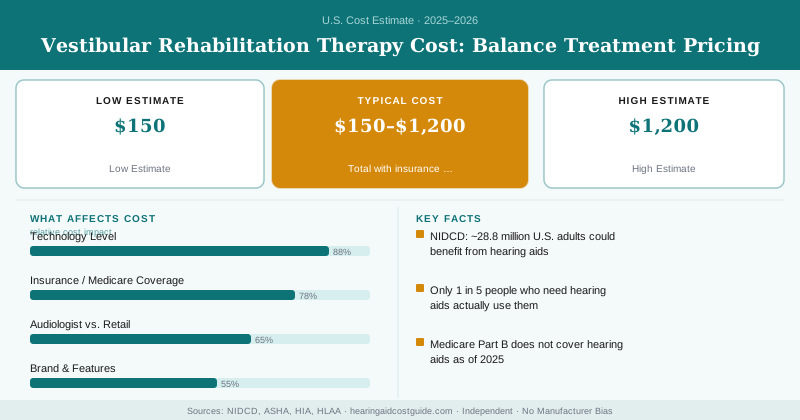
| Total with insurance copays | $150–$1,200 | Varies widely by plan |
Who Provides VRT?
Vestibular rehabilitation is provided by:
- Physical therapists with vestibular specialty training
- Audiologists (particularly those specializing in balance disorders)
- Occupational therapists in some cases
Not every physical therapist is trained in vestibular rehabilitation. Ask specifically for a therapist with vestibular certification (from APTA’s Academy of Neurologic Physical Therapy or equivalent) when seeking referrals.
Common Conditions VRT Treats
- BPPV (Benign Paroxysmal Positional Vertigo): The most common cause of vertigo; caused by displaced crystals in the inner ear. Often resolves in 1–3 sessions of canalith repositioning. The American Academy of Neurology reports BPPV affects about 2.4% of people over their lifetime.
- Labyrinthitis and vestibular neuritis: Viral inner ear inflammation causing persistent dizziness
- Meniere’s disease: Chronic condition with recurrent vertigo episodes
- Post-concussion syndrome: Balance and dizziness issues after head injury
- Unilateral vestibular hypofunction: Partial loss of balance function in one ear
Does Insurance Cover VRT?
In most cases, yes — vestibular rehabilitation is covered as physical therapy or occupational therapy under major insurance plans, including Medicare Part B.
- Medicare Part B: Covers PT services at 80% after deductible, with no annual therapy cap (since 2018 therapy cap repeal)
- Commercial insurance: Most major plans cover VRT as medically necessary PT; prior authorization often required
- Medicaid: Coverage varies by state
Most insurance plans require a physician’s referral for physical therapy reimbursement. See your primary care doctor, neurologist, or ENT first — get a formal diagnosis and written referral before scheduling VRT. This prevents claim denials. Your doctor can order imaging (MRI, CT) to rule out central causes before starting vestibular PT.
How Long Does Treatment Take?
The National Institute on Deafness and Other Communication Disorders (NIDCD) estimates that about 8 million American adults report a chronic problem with balance, and millions more experience dizziness each year. Treatment timelines vary significantly:
- BPPV: 1–3 sessions typically sufficient
- Unilateral hypofunction: 6–12 sessions; home exercises essential between visits
- Meniere’s disease: Ongoing management; flare-up treatment as needed
- Post-concussion dizziness: 8–16 sessions for full recovery
Most patients see meaningful improvement within 4–6 sessions. Complete resolution of symptoms in 8–10 sessions is typical for many diagnoses.
Home Exercise Programs
After initial evaluation, most VRT patients receive a home exercise program. These exercises — gaze stabilization, habituation exercises, balance training — are done daily at home for free. The home program is often as important as in-clinic sessions for long-term recovery.
Don’t confuse VRT with chiropractic neck manipulation marketed for dizziness. Evidence for chiropractic treatment of vestibular disorders is limited. For inner ear balance problems, evidence-based VRT with a trained physical therapist or audiologist is the recommended approach.
The Bottom Line
Vestibular rehabilitation therapy typically costs $100–$350 per session, with most patients completing 6–12 sessions. Out-of-pocket costs with insurance coverage usually run $150–$1,200 for a full treatment course. If you’ve been dealing with persistent dizziness or balance problems — especially after inner ear illness — VRT is worth pursuing. It works, it’s covered by most insurance, and it’s far less invasive than medication or surgery.
Frequently Asked Questions
Vestibular rehabilitation therapy typically costs $100–$350 per session, depending on your location, the clinic type, and whether you see a physical therapist or audiologist. Most patients complete 6–12 sessions as part of their treatment plan, bringing total costs to $600–$4,200 before insurance.
Most major health insurance plans, including Medicare and commercial insurers, cover VRT when it is prescribed by a physician for a diagnosed vestibular disorder. However, you will typically pay a copay ($20–$50 per session) or coinsurance (10–30% of the session cost) after meeting your deductible, which can range from $500–$2,500 annually.
A standard VRT treatment plan lasts 4–8 weeks with sessions 1–3 times per week, though some patients need up to 12 weeks depending on severity. Most patients notice improvement in dizziness and balance within 2–4 weeks of starting therapy, with maximum benefits typically achieved after completing the full course of treatment.