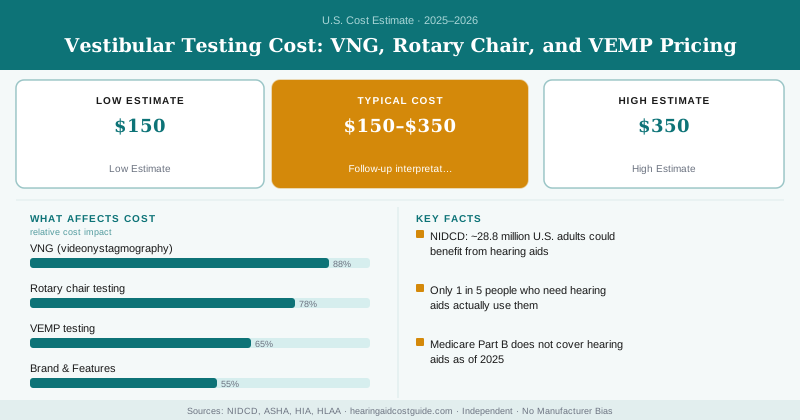
Roughly 15% of U.S. adults experience a balance problem or dizziness significant enough to affect daily life at some point each year, based on national health survey data frequently cited by vestibular researchers. Figuring out exactly which part of the inner ear or nervous system is causing it requires a specific battery of tests — and most patients have no idea what any of them cost until the bill arrives.
Vestibular Test Costs
| Test | Typical Cost (Uninsured) | With Insurance |
|---|---|---|
| VNG (videonystagmography) | $300–$800 | $50–$150 copay |
| Rotary chair testing | $500–$1,200 | $75–$250 copay |
| VEMP (vestibular evoked myogenic potential) | $300–$700 | $50–$150 copay |
| Posturography (balance platform test) | $250–$600 | $40–$120 copay |
| Full vestibular test battery (all above) | $1,500–$2,500 | $200–$600 copay |
| Follow-up interpretation visit | $150–$350 | $30–$75 copay |
Why Multiple Tests Are Often Needed
Vestibular disorders can originate from several different structures — the inner ear’s balance organs, the vestibular nerve, or the brain’s processing of balance signals — and no single test captures the full picture. That’s why a comprehensive workup often includes several components:
VNG (videonystagmography) uses infrared cameras to track eye movements while your head is placed in different positions and while air or water is used to stimulate each ear canal separately (caloric testing). It’s the most common first-line vestibular test and helps identify which ear, if either, is the source of a problem.
Rotary chair testing measures eye movements while you’re rotated in a controlled, motorized chair. It’s more reproducible than VNG and is often used when VNG results are unclear or when tracking how vestibular function changes over time.
VEMP testing measures reflexive muscle responses to sound, assessing a different part of the vestibular system than VNG or rotary chair testing — particularly useful for diagnosing conditions like superior canal dehiscence.
A full vestibular test battery isn’t automatically necessary for every dizzy patient. Many cases of benign paroxysmal positional vertigo (BPPV), one of the most common causes of vertigo, are diagnosed with a simple in-office positional test (the Dix-Hallpike maneuver) that costs nothing extra beyond the office visit. Ask your physician or audiologist to explain specifically why each ordered test is necessary for your case rather than assuming the full battery is standard.
Insurance Coverage
Vestibular testing is classified as diagnostic medical testing, similar to other neurological or ENT diagnostic procedures, and is covered by most insurance plans and Medicare when ordered by a physician for a documented complaint like vertigo, imbalance, or unexplained falls. Expect standard deductible and coinsurance rules to apply, similar to any other outpatient diagnostic test — typically 80% covered after your deductible with Medicare or comparable private insurance.
What Drives Cost Variation
Facility type matters more than most patients expect. Hospital-based vestibular testing labs often bill higher facility fees than freestanding ENT or audiology clinics performing identical tests, sometimes doubling the total cost for the same battery. If cost is a concern and your case isn’t urgent, ask specifically whether the testing can be done at a non-hospital-affiliated clinic.
Rotary chair testing equipment is expensive and not available at every clinic, meaning you may be referred to a specialized center that’s out-of-network for your insurance plan even if your regular ENT or audiologist is in-network. Confirm network status for the specific testing facility before scheduling, not just for your referring physician.
Getting the Most Value From Testing
Because vestibular testing is expensive relative to many other diagnostic procedures, make sure the ordering physician has a specific diagnostic question each test is meant to answer. A well-targeted battery of two or three specific tests, chosen based on your symptom pattern, is both cheaper and more clinically useful than a reflexive “order everything” approach.
Frequently Asked Questions
A full vestibular test battery, which may include VNG, rotary chair testing, and VEMP testing, typically costs $500 to $2,500 without insurance depending on which tests are ordered. A single test component, like VNG alone, usually runs $300 to $800.
Yes, most insurance plans and Medicare cover vestibular testing when ordered by a physician to evaluate dizziness, vertigo, or balance problems, typically covering 80% after the deductible as a diagnostic medical service.
VNG (videonystagmography) measures eye movements in response to specific head positions and calorie stimulation to assess inner ear balance function, while rotary chair testing measures eye movements during controlled rotational movement, offering a more precise and reproducible assessment often used when VNG results are inconclusive.