Most people shopping for hearing devices never hear about the Vibrant Soundbridge — until a traditional hearing aid simply won’t work for them. It’s not a hearing aid. It’s a surgically implanted middle ear device that vibrates the ossicular chain directly, bypassing the outer ear canal entirely. The result: clearer sound for patients where conventional aids fail, and no feedback, no occlusion, no ear canal irritation.
The cost is substantial. The outcomes — for the right patients — can be life-changing. Here’s what you need to know.
What Is the Vibrant Soundbridge?
Made by MED-EL, the Vibrant Soundbridge (VSB) is a partially implantable hearing device with two components:
- The implant: A receiver magnet and a tiny floating mass transducer (FMT) surgically placed against the middle ear structures — typically attached to the round window, incus, or stapes.
- The audio processor: A small external device worn behind the ear and held by magnetic attraction to the implant. It captures sound and sends signals wirelessly to the internal FMT, which vibrates middle ear structures directly.
Unlike cochlear implants, the Vibrant Soundbridge doesn’t replace hearing — it amplifies it mechanically, in a way that’s impossible for a conventional hearing aid to replicate for certain ear anatomies.
Vibrant Soundbridge Cost Breakdown
| Cost Component | Estimated Cost |
|---|---|
| Implant device (FMT + receiver) | $8,000–$18,000 |
| Surgeon’s fee | $3,000–$7,000 |
| Hospital/surgical facility fee | $4,000–$10,000 |
| Anesthesia | $1,000–$3,000 |
| Pre-surgical audiological evaluation | $300–$600 |
| Post-surgical audiological programming | $200–$400/session |
| External audio processor (replacement, if needed) | $2,000–$4,000 |
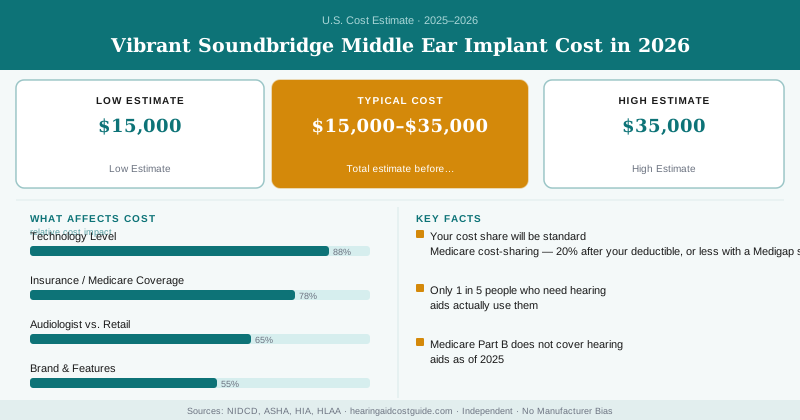
| Total estimate before insurance | $15,000–$35,000 |
Who Is This Device For?
The Vibrant Soundbridge is indicated for adults with:
- Sensorineural hearing loss who can’t tolerate a traditional hearing aid due to recurrent ear canal infections, skin conditions, or chronic drainage
- Conductive or mixed hearing loss from conditions like otosclerosis, canal atresia, chronic otitis media, or malformed ossicles
- Single-sided deafness (in some configurations with round window coupling)
It’s not a first-line device — patients typically come to the VSB after conventional hearing aids have failed or caused problems. Candidacy requires a full otological evaluation and audiological workup. The NIDCD has recognized implantable middle ear devices as an established intervention for patients where acoustic amplification is inadequate or medically contraindicated.
The bone-anchored hearing aid (BAHA) routes sound through bone conduction by vibrating the skull. The Vibrant Soundbridge directly vibrates the middle ear structures via the FMT. For patients with functioning (but underperforming) middle ear anatomy, the VSB often delivers better high-frequency amplification and more natural sound quality. Your cochlear implant surgeon or otologist can explain which approach fits your anatomy.
Does Insurance Cover the Vibrant Soundbridge?
Coverage is variable — but this is a medical device, not a hearing aid, and that distinction matters significantly.
Medicare: The VSB is covered under Medicare Part A (for the inpatient or outpatient surgical facility) and Part B (for the device and physician fees) when deemed medically necessary. Coverage typically applies for conductive, mixed, or sensorineural hearing loss when documented audiological criteria are met and conventional hearing aids have been tried and found medically inappropriate. Your cost share will be standard Medicare cost-sharing — 20% after your deductible, or less with a Medigap supplement.
Commercial insurance: Many commercial insurers cover implantable hearing devices as medical procedures (not as hearing aids, which are often excluded). Prior authorization is required. Your otologist’s billing team should work directly with your insurer before surgery. Document your history with conventional hearing aids and why they’re medically contraindicated — this is the core of the prior auth case.
What the Surgical Procedure Involves
The VSB implant surgery is performed under general anesthesia. It takes 1–2 hours. The surgeon approaches through a small incision behind the ear (similar to cochlear implant surgery) and attaches the FMT to the appropriate middle ear structure — the specific placement depends on your anatomy and type of hearing loss. Hospital stay is typically same-day or one overnight.
Activation (when the external processor is first programmed) occurs 4–6 weeks after surgery, once healing is complete. Programming requires 2–4 audiological sessions in the first few months.
Not all otologists and audiological centers offer the Vibrant Soundbridge. It requires specialized surgical training and audiological programming expertise. If your regular ENT isn’t familiar with VSB surgery, ask for a referral to a tertiary care hearing center or academic medical program. Experienced centers have significantly better outcomes data.
Realistic Out-of-Pocket Costs
For an insured patient with Medicare:
- Medicare-covered patient (with Medigap): $500–$2,000 total out-of-pocket
- Medicare-covered patient (without Medigap): $2,000–$5,000
- Commercial insurance with prior auth: $1,500–$6,000 depending on deductible and out-of-pocket maximum
- Uninsured: $15,000–$35,000 full price
The Vibrant Soundbridge is not cheap — but for patients who genuinely can’t use conventional hearing aids due to anatomy or medical conditions, it’s often the right clinical choice. The question of cost should come second to the question of candidacy. Get the evaluation first.
Frequently Asked Questions
The Vibrant Soundbridge typically costs between $15,000 and $35,000 before insurance. This price covers the device itself, surgical implantation, anesthesia, facility fees, and immediate post-operative care, though the exact cost varies by surgeon, geographic location, and hospital.
Medicare may cover the Vibrant Soundbridge for qualifying patients, though coverage is not automatic and requires prior authorization from your regional Medicare Administrative Contractor. Out-of-pocket costs typically range from $3,000 to $8,000 after Medicare approval, depending on your Part B deductible and coinsurance, while uninsured patients usually pay the full $15,000–$35,000.
Most patients can return to light activities within 1–2 weeks, though complete healing and device activation typically take 4–6 weeks post-surgery. Your surgeon will schedule follow-up appointments during this period to monitor incision healing and program the device for optimal sound transmission.