Noise-induced hearing loss is the most common work-related illness in the United States. The CDC estimates 22 million workers are exposed to potentially damaging noise at work each year — and NIOSH data shows that approximately $242 million is spent annually on workers’ compensation for hearing loss disability. Those numbers explain why OSHA has required hearing conservation programs since 1983 and why enforcement hasn’t gotten softer.
If you’re an employer, facilities manager, or occupational health coordinator figuring out what OSHA 29 CFR 1910.95 compliance actually costs, here’s the real breakdown.
Hearing Conservation Program Cost by Component
| Program Component | Cost Per Employee Per Year |
|---|---|
| Noise monitoring / industrial hygiene assessment | $5–$25 (amortized over 5 years) |
| Annual audiometric testing (baseline + annual) | $25–$75 |
| Hearing protection devices (plugs, muffs, per year) | $10–$50 |
| Training program (annual, per employee) | $10–$30 |
| Recordkeeping and program administration | $5–$20 |
| Third-party audiometric testing service (mobile van) | $35–$75 per employee |
| Audiologist oversight / program review (per year, amortized) | $3–$15 |
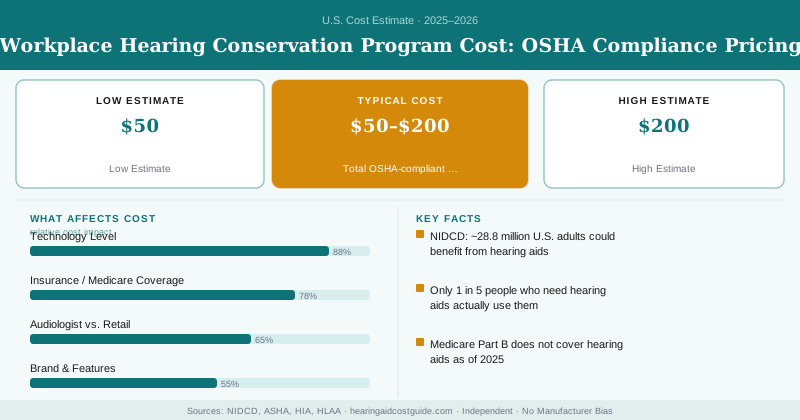
| Total OSHA-compliant program | $50–$200 per employee per year |
When OSHA Requires a Hearing Conservation Program
OSHA’s standard applies to workplaces where employee noise exposure equals or exceeds an 8-hour time-weighted average (TWA) of 85 dB — referred to as the action level. Above this threshold, employers must:
- Monitor noise exposure to determine whether employees are at or above the action level
- Provide audiometric testing — a baseline audiogram within 6 months of first exposure, then annual tests to detect standard threshold shifts
- Provide hearing protectors at no cost to employees, from an adequate selection
- Train employees annually on the effects of noise, purpose and use of hearing protectors, and audiometric testing procedures
- Maintain records of noise exposure measurements and audiometric tests for specific retention periods
At or above 90 dB TWA (the permissible exposure limit), the hearing protector requirement becomes mandatory rather than just provided.
Noise Monitoring: The Starting Point
Before you can run a compliant program, you need to know where in your facility noise levels exceed 85 dB. Industrial hygienists use sound level meters and personal noise dosimeters to characterize the work environment.
An initial industrial hygiene assessment for a mid-sized facility typically costs $1,500–$8,000, depending on facility size and complexity. This is a one-time or periodic cost — re-monitoring is required when changes to processes, equipment, or controls could increase noise exposure. Amortized over a 5-year period with 50 employees, that’s $6–$32 per employee per year.
Hearing protectors are the last line of defense in OSHA’s hierarchy, not the first. Engineering controls (quieter equipment, isolation, damping) come first. Administrative controls (job rotation, reduced exposure duration) come second. PPE — earplugs and earmuffs — is required when engineering and administrative controls don’t reduce exposure below the action level. Many employers skip straight to PPE because it’s cheaper up front. OSHA expects a documented evaluation of engineering controls first.
Audiometric Testing: The Core Medical Component
Annual audiograms for exposed workers are the backbone of OSHA hearing conservation compliance. Testing must be conducted by or under the supervision of an audiologist, otolaryngologist, or physician.
Options for delivering audiometric testing:
In-house audiometric booth: Capital cost of $8,000–$25,000 for a sound booth plus $3,000–$8,000 for an audiometer. Suitable for large facilities with 200+ tested employees annually where per-test economics favor ownership.
Mobile audiometric testing service: A third-party service drives a calibrated van to your facility and tests employees on-site. Costs $35–$75 per employee per visit, all-inclusive. Most common solution for mid-sized employers. Major providers include Audiometric Testing Associates, Workplace Integra, and regional occupational health companies.
Occupational health clinic audiometry: Employees visit an off-site clinic. Cost: $40–$100 per test, not including lost productivity for travel time.
| Testing Delivery Model | Per-Test Cost | Best For |
|---|---|---|
| In-house audiometric booth (amortized) | $10–$30 | 200+ employees, ongoing |
| Mobile testing service (on-site van) | $35–$75 | 25–200 employees |
| Occupational health clinic | $40–$100 | Small employers, urban locations |
| Telehealth audiometry (newer option) | $25–$60 | Remote workers, distributed teams |
Hearing Protectors: What You’re Required to Provide
OSHA requires that employers provide at least one earplug option and one earmuff option — a “variety” of protectors from which employees can choose. The hearing protection must be provided at no cost to the employee.
Annual hearing protection budget typically runs $10–$50 per employee, covering:
- Disposable foam earplugs (bulk supply): $0.05–$0.30 each
- Reusable earplugs with case: $2–$15 per pair
- Hearing protection earmuffs: $15–$80 per set (replace annually or when damaged)
- Custom molded earplugs (for employees with ear canal issues): $100–$300, amortized over 3–5 years
Standard Threshold Shifts: The Compliance Trap
OSHA defines a “standard threshold shift” (STS) as a change in hearing threshold of 10 dB or more at 2,000, 3,000, and 4,000 Hz in either ear compared to the baseline audiogram. When an STS is identified, OSHA requires:
- Notifying the employee within 21 days
- Reviewing hearing protector use and retraining as needed
- Referring the employee for a clinical evaluation if needed
- Considering whether engineering controls should be reassessed
STS tracking and program management — the administrative function that ties it all together — is where many programs fall short. Third-party hearing conservation program management services handle STS tracking, records management, and OSHA correspondence for $5–$15 per employee per year.
OSHA penalties for hearing conservation program violations range from $15,625 per willful violation to $156,259 per willful or repeated violation (2024 levels, adjusted annually for inflation). The most common citation is failure to conduct annual audiometric testing. The second most common is inadequate training documentation. Both are easily avoided with a structured program — and far cheaper than a citation.
Small Employer Considerations
OSHA 1910.95 applies to general industry employers of all sizes when noise levels exceed the action level. There’s no small-employer exemption. However, the practical cost scales down significantly with workforce size.
For a 10-person construction or manufacturing shop:
- Initial noise monitoring: $500–$1,500 (one-time)
- Annual mobile audiometry (10 employees): $350–$750/year
- Hearing protectors: $100–$500/year
- Training: Free (OSHA provides training materials at osha.gov)
- Total annual cost: $450–$1,250 — roughly $45–$125 per employee
The Bottom Line
A compliant OSHA hearing conservation program costs $50–$200 per exposed employee per year, depending on testing delivery model and facility complexity. It’s less expensive than a single workers’ compensation hearing loss claim, which averages $14,000–$25,000 per resolved case. The math on prevention is straightforward.
Frequently Asked Questions
Workplace hearing conservation programs typically cost between $50 and $200 per employee annually, depending on program scope and company size. Larger employers may negotiate lower per-employee rates, while smaller companies with limited resources might spend toward the higher end or use OSHA's free consultation services to reduce costs.
Yes, workers compensation insurance covers noise-induced hearing loss if the employee meets their state's requirements, though coverage varies by state and employer. Most claims require documented audiometric testing showing hearing loss and proof of workplace noise exposure above OSHA thresholds, but out-of-pocket costs are typically minimal since workers comp is employer-funded.
OSHA requires employers to provide annual audiometric testing (baseline and annual exams), hearing protection devices like earplugs or earmuffs, noise level monitoring, and employee training on hearing protection. These components must be implemented once workers are exposed to an 8-hour time-weighted average (TWA) of 85 dB or higher, which is why audiometric testing becomes mandatory at this threshold.