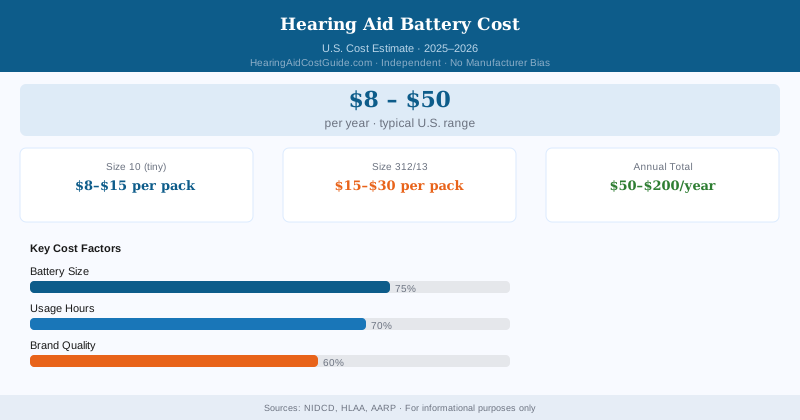
Before/after comparison: Life before you track battery costs vs. after you actually do the math.
Before: You buy a few packs at CVS whenever your aids die, spend $8–$9 each time, don’t think much about it.
After: You realize you’re going through 3–4 packs per month for a pair of aids, spending $300+ per year at retail prices — when the exact same batteries on Amazon cost a third as much.
Battery expenses are small enough per purchase that most hearing aid users never bother to optimize them. Run the numbers once and you’ll see why it’s worth a few minutes.
Hearing Aid Battery Sizes and Prices
| Battery Size | Color Code | Avg. Life (Per Battery) | Cost Per Battery | Annual Cost (2 Aids) |
|---|---|---|---|---|
| Size 10 (smallest) | Yellow | 3–5 days | $0.40–$0.70 | $60–$170 |
| Size 312 | Brown | 5–7 days | $0.35–$0.60 | $40–$130 |
| Size 13 | Orange | 8–12 days | $0.30–$0.55 | $20–$70 |
| Size 675 (largest) | Blue | 14–20 days | $0.40–$0.65 | $15–$55 |
Annual cost assumes 16 hours/day wear for both aids combined.
Battery Size by Hearing Aid Style
- Size 10: Mostly CIC (completely-in-canal) devices; smallest canal-fit aids
- Size 312: The most common size; used in most RIC/RITE and ITC devices
- Size 13: Standard BTE, larger ITC, many power devices
- Size 675: Power BTE devices for severe-to-profound loss
Your battery size is printed on the battery door — and the color code on the packaging matches universally, so yellow always means size 10 regardless of brand.
Where to Buy Hearing Aid Batteries
Retail (CVS, Walgreens, Walmart): $5–$9 for a pack of 8–10. Convenient, but you’re paying about $0.60–$0.90 per battery — the most expensive per-unit option by far.
Amazon: $12–$18 for 60-pack. About $0.20–$0.30 per battery from reputable brands like Rayovac, Duracell, and Energizer. Best value for most users.
Costco: $15–$20 for packs of 72–80. Excellent value, comparable to Amazon.
Audiologist’s office: Often $1–$2 per battery as a convenience purchase. Don’t stock up here.
Discount bulk online: $15–$25 for packs of 100–120 from brands like Power One, ZeniPower. Good for high-volume users.
Disposable hearing aid batteries are zinc-air type. They activate when you peel the tab that admits air. For maximum life, peel the tab and wait 1–2 minutes before inserting — this allows the full zinc-air activation to complete. Inserting immediately after peeling can reduce battery life by 10–15%.
Factors That Drain Batteries Faster
According to MarkeTrak data, streaming audio is one of the top factors that pushes users back to the audiologist sooner than expected — partly because battery drain surprises people.
- Bluetooth streaming: Streaming audio from your phone or TV cuts battery life by 25–40%. A size 312 rated for 5 days may last only 3 days with 4 hours of daily streaming.
- High amplification settings: Louder processing draws more power.
- High humidity: Moist ear canals and summer humidity can reduce zinc-air battery life.
- Cold temperatures: Batteries lose capacity in cold weather. Keep a pocket hearing aid case handy if you’re spending time outdoors in winter.
Rechargeable Hearing Aid Running Costs
For lithium-ion rechargeable hearing aids:
- Annual electricity cost for charging: negligible (roughly $1–$2/year)
- Charger replacement if lost or damaged: $30–$80 (manufacturer-specific)
- Lithium-ion cell replacement after 4–5 years: $200–$400 per pair (factory repair)
The NIDCD and major hearing health organizations have increasingly recommended rechargeable options for older adults specifically — eliminating the fine motor demands of swapping tiny batteries makes daily use much more manageable.
Never use standard AA, AAA, or other household batteries in hearing aids. Hearing aids use specialized zinc-air batteries that won’t work with other battery types, and attempting to modify the battery compartment can permanently damage the device.
Extending Battery Life
- Turn aids off when not in use. Open the battery door at night (for disposable) to break the circuit.
- Store batteries at room temperature. Avoid refrigerators, glove compartments.
- Keep batteries tab-sealed until ready to use — don’t peel tabs in advance.
- Use a hearing aid dehumidifier. Removes moisture from aid and battery overnight, extending both device and battery life.
- Check for earwax blockage. A clogged receiver makes the hearing aid work harder, draining the battery faster.
5-Year Battery Cost Summary
- Size 312 user (most common), disposable: $200–$650 over 5 years
- Size 13 user, disposable: $100–$350 over 5 years
- Rechargeable user: $0–$400 over 5 years (if lithium cells replaced once)
For most users, switching to rechargeable pays off within 1–3 years compared to ongoing disposable battery expenses — that math is worth factoring in when you’re choosing a new device.