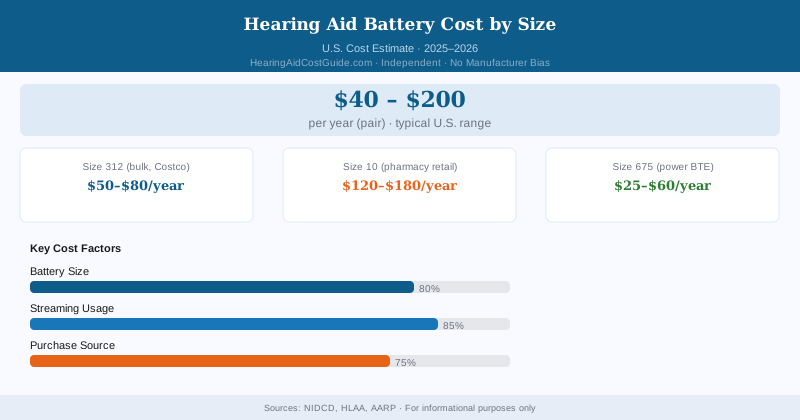
A hearing aid battery costs about 35 cents. Sounds trivial — until you do the math. At two aids, changing every 5 days, that’s roughly 150 batteries a year and $50–$75 out of pocket annually. It’s not a fortune, but it’s also not zero. And if you’re on size 10 batteries with heavy streaming, you could be changing them every 2–3 days, which doubles the cost and the frustration.
Here’s what every size actually costs and how it compares to going rechargeable.
Hearing Aid Battery Costs by Size
| Battery Size | Color Code | Typical Life | Cost per Battery | Annual Cost (Pair) |
|---|---|---|---|---|
| Size 10 | Yellow | 3–7 days | $0.30–$0.60 | $50–$150 |
| Size 312 | Brown | 5–10 days | $0.25–$0.55 | $40–$120 |
| Size 13 | Orange | 10–20 days | $0.30–$0.60 | $30–$80 |
| Size 675 | Blue | 18–30 days | $0.35–$0.75 | $25–$60 |
The Four Sizes: Who Uses Which
Size 10 (yellow) is the smallest. It fits the tiniest CIC (completely-in-canal) and IIC (invisible-in-canal) aids. Life runs 3–7 days under normal use — 2–3 days if you stream audio frequently. That means you’re changing batteries nearly every week or more. Convenient for people who prefer the smallest possible device, but operationally demanding if you have reduced dexterity.
Size 312 (brown) is the most common battery in the US, used in RIC/RITE aids and many ITE (in-the-ear) models. It offers a good balance of size and life. With moderate Bluetooth streaming, expect 5–7 days. Without streaming, many users get 8–10. NIDCD reports that the majority of hearing aid users in the US rely on size 312 devices — it’s the workhorse of the battery world.
Size 13 (orange) appears in larger BTE (behind-the-ear) and ITE hearing aids, especially those with telecoil or more powerful amplification. Life runs 10–20 days. Easier to handle for people with arthritis or reduced finger dexterity.
Size 675 (blue) is the largest and longest-lasting. Used in power BTEs for severe to profound hearing loss. Many users get 3–4 weeks per battery. Annual cost is actually the lowest of all four sizes, because you change them so rarely.
Where to Buy: Retail vs. Bulk vs. Subscription
Big-box retail (Costco, Walmart, Target): Size 312 packs of 60–80 batteries run $8–$15. Per-battery cost around $0.12–$0.25. This is consistently the best value for most buyers.
Amazon and online bulk: Rayovac, Energizer, and Power One in 60–120-packs run $10–$20. Similar value to big-box. Duracell tends to price higher without meaningful life advantage.
Pharmacy retail (CVS, Walgreens, Rite Aid): Convenient but expensive. Packs of 8–16 run $5–$10, which works out to $0.50–$0.75 per battery — roughly 3x the bulk cost.
Audiologist’s office: Many audiologists sell batteries as a courtesy, typically at retail rates or slightly above. Convenient but not cost-efficient for ongoing purchases.
Subscription services: Companies like ZipHearing and some hearing aid manufacturers offer battery subscriptions. They’re rarely cheaper than Costco bulk pricing, but they solve the “I forgot to reorder” problem.
Zinc-air batteries are sealed with a factory sticker tab. Don’t remove the tab until you’re ready to use the battery. Once you peel the sticker, air activates the zinc and the battery begins draining — whether it’s in your hearing aid or sitting in the drawer. Remove the tab and let the battery “breathe” for 60 seconds before inserting; this allows full activation and can extend life by 10–20%. Never store partially-used batteries in a humid environment — a sealed container in a cool, dry place extends shelf life for unopened batteries significantly.
Bluetooth Streaming Kills Batteries Fast
This is the most common complaint about battery life among new hearing aid users. According to ASHA research on hearing aid feature adoption, Bluetooth streaming is one of the most used features among active adults with hearing aids — and it is by far the biggest battery drain.
Real-world examples:
- Size 312, no streaming: 8–10 days
- Size 312, 2 hours/day streaming: 5–6 days
- Size 312, 4+ hours/day streaming: 3–4 days
If you stream music, phone calls, or TV audio heavily and use a battery-powered aid, you’ll spend significantly more annually than the “typical” estimates suggest. This is one of the strongest arguments for upgrading to a rechargeable model.
Rechargeable vs. Disposable: The Real Cost Comparison
Rechargeable lithium-ion hearing aids cost $200–$500 more upfront than equivalent disposable-battery models (where both options exist).
Annual battery cost for disposable: $40–$150. Annual battery cost for rechargeable: $0 (for 3–4 years, then a battery replacement service at ~$200–$400 per pair is sometimes needed).
Breakeven: 2–5 years, depending on your battery size and usage volume.
The non-financial argument for rechargeable is often stronger: no more tiny batteries to fumble with at 6am, no mid-day battery failure during an important meeting, and no running out while traveling. According to NIDCD data, hearing aid users over 65 cite ease of use as the second most important factor in device satisfaction after sound quality. Rechargeable aids score consistently higher on ease of use.
If you have grandchildren or pets in the house, be very careful with disposable hearing aid batteries. Size 10 and 312 batteries are extremely dangerous if swallowed — they’re small enough to pass a child’s throat, and the electrical charge can cause severe burns to esophageal tissue within 2 hours. Store batteries out of reach and dispose of them safely. The NCHH and FDA consider button battery ingestion a pediatric emergency. Do not wait if you suspect ingestion — go to the emergency room immediately.
Bottom Line: What You’ll Actually Spend
For a typical user with two size 312 aids and moderate streaming:
- Bulk purchase (Costco/Amazon): $50–$80/year
- Pharmacy retail: $120–$180/year
That gap — $70–$100 per year — adds up to $350–$500 over five years just from where you buy them. Buy in bulk, store properly, and consider rechargeable if you stream heavily or find battery changes difficult.