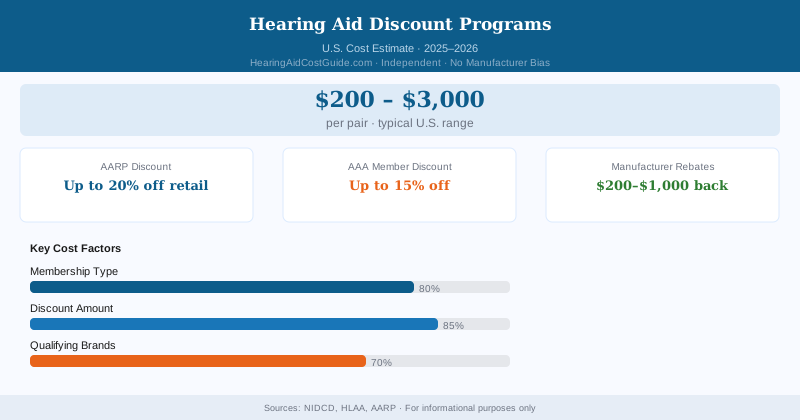
Most people think of hearing aid pricing as a binary: either you pay the full $5,000–$7,000 at a private audiology clinic, or you hope to qualify for something free through the VA or Medicaid. There’s actually a large middle ground — legitimate discount programs that cut $500–$3,000 off the cost of a pair of hearing aids for people who don’t qualify for free devices.
The HLAA notes that cost remains the number-one barrier to hearing aid adoption, and these programs exist specifically to close that gap. Here’s what’s available, what it actually costs to access, and which options make sense for different situations.
Major Hearing Aid Discount Programs
| Program | Who Qualifies | Typical Savings | Device Tier |
|---|---|---|---|
| Costco Hearing Centers | Costco members ($65–$130/yr) | $2,000–$4,000 vs. clinic | Mid-to-high |
| AARP Hearing Care (TruHearing) | AARP members ($16/yr) | $500–$2,000 via network | Entry-to-mid |
| HLAA TruHearing discount | HLAA members ($30/yr) | 15–30% off retail | Varies |
| Amplifon national network | No membership required | 10–25% off retail | Varies |
| Sam’s Club Hearing Centers | Sam’s members ($50/yr) | $1,500–$3,500 vs. clinic | Mid-tier |
| Starkey Hearing Foundation | Low-income adults | Free devices | Mid-tier |
| State vocational rehab | Working-age, needs-based | Varies (often full cost) | Prescription |
Costco: The Biggest Discount
Costco isn’t a discount “program” exactly — it’s a retailer with a fundamentally different pricing model. That model results in hearing aids costing 40–60% less than private clinic pricing for comparable technology.
Why Costco saves you money:
- Volume purchasing power — buys devices at lower wholesale cost than small practices
- Flat-margin retail model — Costco caps margins across categories; no 100% markup on hearing aids
- Self-service model — you’re working with a licensed hearing instrument specialist, not a doctoral AuD with higher overhead
- No-frills environment — warehouse store, not a medical office
The Kirkland Signature 10.0 at $1,499/pair uses technology licensed from Sonova — the same company behind Phonak. The equivalent private clinic device runs $4,500–$5,500. Members save roughly $3,000–$4,000 per pair on comparable technology.
Membership cost: $65–$130/year. Over 5 years: $325–$650 total — trivial against $3,000–$4,000 in device savings.
AARP Hearing Care Program (TruHearing)
AARP membership at $16/year provides access to the TruHearing discount network:
- Hearing exam: $0–$49 at participating providers
- Devices: $699–$1,999 per pair depending on tier (vs. $2,500–$6,000 at retail)
This is meaningful for Medicare-age adults without a Medicare Advantage hearing benefit who still want more structure than pure OTC buying. AARP’s 2024 survey of hearing loss in adults over 50 found that cost was the primary reason members who needed hearing aids hadn’t obtained them — the TruHearing benefit exists specifically to address that.
Sam’s Club Hearing Centers
Sam’s Club operates hearing centers with Signia devices at discount pricing similar to Costco. Annual Sam’s membership: $50. Sample pricing:
- Signia Silk IX rechargeable: ~$2,099/pair
- Signia Pure Charge&Go IX: ~$2,499–$2,999/pair
Good value, though Costco’s wider brand selection and the Kirkland Signature option give it an edge in most comparisons.
Both Costco and Sam’s Club hearing centers use licensed hearing instrument specialists (HIS), not doctoral audiologists. For straightforward adult hearing aid needs, this is appropriate. For complex cases — asymmetrical loss, pediatric fittings, tinnitus program needs, cochlear implant candidacy — request referral to an audiologist.
Also: not all warehouse club locations have hearing centers. Check the store’s website for your specific location before making a trip.
Starkey Hearing Foundation
The Starkey Hearing Foundation provides free hearing aids to individuals in need — both in the US and internationally. Domestic programs operate through local community partners.
To access Starkey Foundation devices in the US:
- Contact a local HLAA chapter, Lions Club, or community health center that partners with Starkey
- Eligibility is typically income-based
- Devices are fitted by partnering audiologists or hearing instrument specialists
The Foundation has provided over 2 million hearing aids in 100+ countries since inception — not a trivial footnote.
HLAA National Convention Hearing Aid Discounts
The Hearing Loss Association of America hosts an annual convention where manufacturers demonstrate products and often offer convention-exclusive pricing. Not a formal program, but a real venue for meaningful savings if you attend.
HLAA membership ($30/year) also provides access to TruHearing pricing and state chapter assistance programs.
Be cautious of discount programs that require you to commit to a specific device before getting your audiogram results. A legitimate discount program fits the device to your audiogram — not the audiogram to the device they want to sell. If a discount program representative pressures you toward a specific device before completing your evaluation, find a different provider.
AFGE (American Federation of Government Employees) and Federal Employee Benefits
Federal employees covered under FEHB plans often have some of the strongest hearing benefits in the employer insurance market. BCBS FEP covers $3,000/ear every 3 years for federal employees. Check your FEHB plan’s benefit summary for hearing coverage specifics.
The Total Hierarchy: Best to Lowest Cost
- VA benefits (eligible veterans): Free
- Medicaid (qualifying adults/all children): Free or nominal
- State vocational rehabilitation: Often free for working-age adults
- Costco / Sam’s Club: $1,499–$3,000/pair (vs. $4,000–$7,000 at clinics)
- Medicare Advantage with hearing benefit: $0–$1,999/pair copay
- OTC hearing aids (Jabra, Sony, Lexie): $599–$1,499/pair, no professional services
- TruHearing / discount networks: $1,400–$4,000/pair at discounted professional providers
- Private audiologist: $3,500–$7,000/pair, full service