Picture this: your audiologist confirms you need hearing aids. The recommendation is a mid-tier pair at $4,800. You’ve got good insurance — but it covers exactly $0, because traditional Medicare excludes hearing aids and your employer plan follows suit. The audiologist hands you a payment options brochure. You need to make a smart decision in the next 10 minutes.
That’s the situation most Americans face. The NIDCD estimates that fewer than 30% of adults who need hearing aids actually use them — cost is the single biggest barrier. Financing won’t eliminate that barrier, but it can make a $5,000 purchase feel more like $278 a month. Here’s what’s actually available, what the real costs are, and where the traps are.
Hearing Aid Financing Options
| Financing Option | APR | Term | Best For |
|---|---|---|---|
| CareCredit (promo 0%) | 0% for 6–24 months (then 26.99%) | 6–60 months | Short-term payoff |
| Wells Fargo Health Advantage | 0% for 12–18 months | 12–60 months | Good credit users |
| HearingLife internal plans | Varies by location | 12–36 months | Chain customers |
| Enhance Financial (Starkey) | Varies | 24–60 months | Starkey buyers |
| Hearing Industries Association members | Varies | 12–48 months | Through audiologists |
| Personal loan (bank/credit union) | 7–20% | 24–60 months | Long-term payoff |
| HSA monthly contributions | Tax-free | Ongoing | Self-funding |
CareCredit: The Most Widely Accepted Option
CareCredit is a healthcare credit card accepted at thousands of audiologists, hearing aid chains, and some Costco Hearing Centers. It functions like a standard credit card for medical expenses.
Promotional periods:
- No interest if paid in full within 6 months (on purchases $200+)
- No interest for 12, 18, or 24 months (on larger purchases at participating providers)
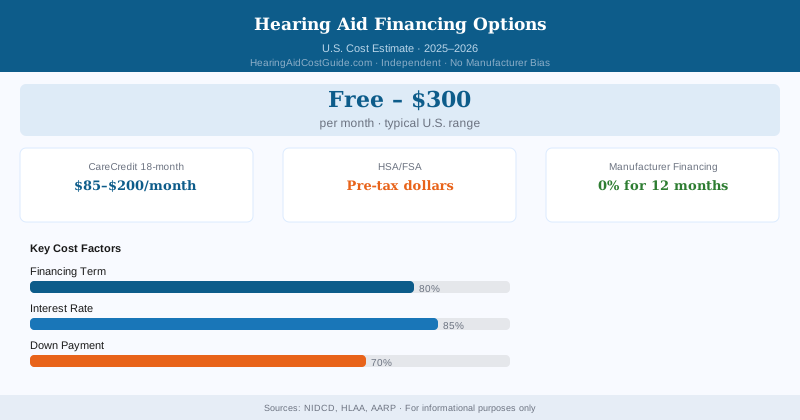
Here’s the part people miss: CareCredit promotional periods are “deferred interest,” not true 0% APR. If you don’t pay the full balance by the end of the promotional period, all accumulated interest (at 26.99% APR) is charged from the original purchase date. That’s not a fee — it’s retroactive interest calculated from day one.
Example: $5,000 hearing aids on an 18-month CareCredit promo, paid off in month 19. You’d owe approximately $1,100 in deferred interest on top of your remaining balance. Always pay the full balance before the promotional period ends — schedule reminders in your calendar the day you sign up.
$5,000 hearing aids, 18-month CareCredit promo (0% if paid in full):
- Required monthly payment to pay off in 18 months: ~$278/month
- Total if paid off in time: $5,000
- Total if NOT paid off in time: $5,000 + ~$1,000–$1,400 in retroactive interest
$5,000 hearing aids, 60-month standard rate (15% APR):
- Monthly payment: ~$119/month
- Total paid: ~$7,140 ($2,140 in interest)
The promo 0% option is dramatically better if you can manage the payment schedule.
HearingLife, Miracle-Ear, and Chain Financing
Major hearing aid chains typically offer CareCredit or in-house financing as payment options:
HearingLife: Partners with CareCredit and Lending Club Patient Solutions. Extended terms up to 84 months available through third-party lending partners.
Miracle-Ear: Offers Miracle-Ear branded financing through GreenSky at 0% APR for 36 months on approved credit.
Important note: these chains often have higher base prices than independent audiologists or Costco. Financing should be applied to a competitive base price — financing a $6,500 device when an equivalent could be had at Costco for $2,000 doesn’t make financial sense regardless of the APR.
HLAA Loan Programs and Assistance
The Hearing Loss Association of America doesn’t directly provide financing loans, but maintains a comprehensive resource list of financial assistance programs:
- State vocational rehabilitation loans and grants
- Non-profit assistance programs by region
- Manufacturer patient assistance programs
Visit hlaa.org/hearing-health/treatments-and-management/hearing-aids for current resources.
Manufacturer Patient Assistance Programs
Starkey: Offers Starkey Cares payment assistance for qualifying low-income patients. Means-tested, limited availability.
Phonak: US operations partner with audiologists for limited assistance programs.
ReSound/Jabra: Limited manufacturer assistance; primarily through the dealer and audiologist network.
These are supplemental options, not universal financing solutions. Don’t count on them without confirming eligibility first.
Credit Union Personal Loans: Often Better Than CareCredit Long-Term
If you need 36–60 months to pay off hearing aids, a credit union personal loan at 8–12% APR is often better than CareCredit’s deferred-interest structure:
$5,000 at 10% APR, 36 months: $161/month, total $5,796 ($796 in interest) $5,000 at 10% APR, 60 months: $106/month, total $6,374 ($1,374 in interest)
Predictable payments, no deferred interest surprises, and rates that are competitive with healthcare-specific financing. If your credit union offers personal loans, get a rate quote before signing up for CareCredit.
HSA Contribution Strategy: Self-Financing Tax-Free
If you can wait 6–18 months before getting hearing aids, maxing out HSA contributions is effectively a 22–37% discount:
- Max HSA contribution annually: $4,300 (2025)
- Over 2 years: $8,600 available pre-tax for hearing care
- Tax savings at 24%: ~$2,064
This requires a qualifying high-deductible health plan and some advance planning — but it’s the cheapest form of hearing care financing available if you have the flexibility to wait.
Never finance hearing aids with a high-interest credit card (18–29% APR) if you can’t pay off the balance quickly. A $5,000 hearing aid financed at 24% APR for 3 years costs a total of $7,080 — adding $2,080 to the device cost. Explore CareCredit’s 0% promotional option, credit union loans, or manufacturer assistance before putting hearing aids on a regular credit card.