Ask any musician who’s tried a standard hearing aid in a rehearsal. They’ll describe something like listening through a tin can — the dynamics flattened, the overtones smeared, the compression kicking in just as the chorus swells. Phil Collins, Eric Clapton, and Neil Young have all gone public about significant hearing loss from decades on stage. The CDC estimates 1 in 4 adults shows signs of noise-induced hearing loss, and the figure is higher among professional and semi-professional musicians. The problem isn’t just getting a hearing aid. It’s getting one that doesn’t destroy the listening experience standard aids were never designed for.
Why Standard Hearing Aids Fail Musicians
A standard hearing aid is built for speech — mainly the 500 Hz to 4,000 Hz range where consonants live. It applies aggressive compression to keep loud sounds comfortable. That compression ruins music.
A full orchestra swings from about 40 dB in a soft passage to 110 dB at full volume. When a standard hearing aid’s compression kicks in during the loud part, the dynamics flatten. Sustained tones trigger feedback suppression, which smears the pitch quality musicians need to tune by ear. The Hearing Industries Association has pointed to this mismatch between hearing aid design and musical listening as one of the most underaddressed problems in the field.
Musician-Specific Hearing Aids
Several premium manufacturers now offer dedicated music programs and wider dynamic range input — typically 95–115 dB SPL, compared to the standard 85–95 dB. Phonak, Oticon, and Starkey all have strong records with musician patients.
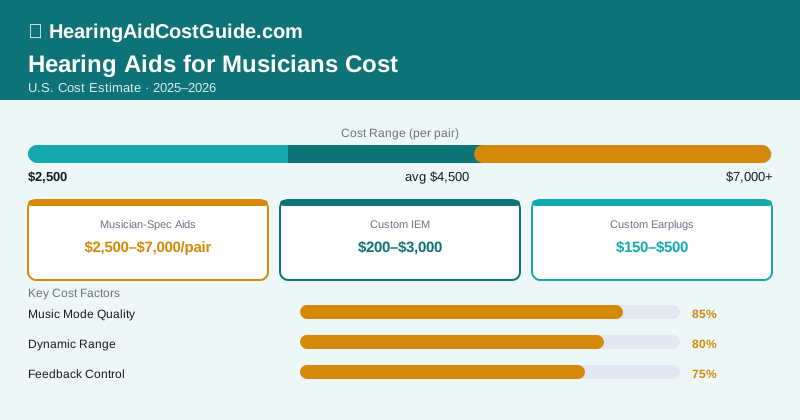
| Device Type | Typical Cost (Pair) | Notes |
|---|---|---|
| Premium hearing aid with music program | $3,500–$7,000 | Phonak Audéo, Oticon Intent, Starkey Genesis |
| Mid-tier with music mode | $2,500–$3,500 | Phonak Audéo Life, Signia Pure |
| Entry-level (limited music performance) | $1,500–$2,500 | Not recommended for performing musicians |
| Custom in-ear monitors (IEMs) | $500–$3,000 | Amplification + hearing protection combined |
| Custom musician earplugs (passive) | $150–$500 | Protection only, no amplification |
Hardware matters, but programming matters just as much. An audiologist experienced with musician patients creates a dedicated music memory — a separate program stored in your hearing aid that you switch to when playing or listening to live music. It typically disables or softens feedback cancellation, opens up the dynamic range, and preserves the overtones that give instruments their character.
Before your fitting appointment, ask these questions specifically:
- “Do you have experience programming hearing aids for musicians?”
- “Which models have the widest dynamic range input (WDRI)?”
- “Can you set up a dedicated music program separate from my speech program?”
- “Does this model let you turn off feedback management in music mode?”
If the audiologist seems uncertain about these questions, consider a second opinion from a practice that lists musician audiology as a specialty.
Custom In-Ear Monitors: A Different Path
Many performing musicians — especially those playing amplified music — use custom in-ear monitors (IEMs) instead of traditional hearing aids. IEMs are molded to your ear canal, paired with drivers tuned for music, and connected to a stage monitor mix. High-end custom IEMs from companies like Sensaphonics, Ultimate Ears Pro, or Jerry Harvey Audio run $500–$3,000 for the earpieces alone. These don’t treat hearing loss — they’re stage tools. But some audiologists fit hearing instrument drivers inside custom IEM shells, creating a device that does both at once.
Custom Hearing Protection: Before the Damage Happens
If you’re a musician who doesn’t yet have significant hearing loss, custom hearing protection is one of the smartest investments you can make right now. Foam earplugs reduce all sound uniformly, which muffles music and makes it nearly impossible to monitor your own playing.
Flat-attenuation musician earplugs use a precision acoustic filter to reduce volume evenly across all frequencies — music still sounds like music, just quieter. Common filter options cut sound by 9 dB, 15 dB, or 25 dB depending on your exposure level.
- Disposable foam earplugs: $0.10–$0.50 each (not suited for musicians)
- Off-the-shelf filtered earplugs (Etymotic ER20XS, Eargasm): $15–$40
- Custom musician earplugs with interchangeable filters: $150–$500
OSHA requires hearing protection when sound levels exceed 85 dB averaged over an 8-hour day. A live band can hit 100–110 dB regularly. At 110 dB, OSHA’s permissible exposure time is under 30 minutes. One unprotected rehearsal at high volume can cause permanent threshold shift — there’s no surgical fix for noise-induced damage. Hearing loss from noise accumulates over years and is irreversible. See our hearing protection cost guide for a full breakdown of options.
Insurance and Cost Considerations
Musician hearing aids are prescription devices and follow the same insurance rules as any other hearing aid. Medicare doesn’t cover them. Some Medicare Advantage plans contribute $500–$2,500 per ear toward the cost. Private insurance coverage varies — see our does insurance cover hearing aids guide for the full picture.
The audiologist fitting fee is typically bundled into the hearing aid price at most practices, covering 1–3 years of adjustments. For musician patients specifically, confirm upfront whether additional music-program tuning sessions are included. You’ll likely need several rounds before the music memory sounds right for your instrument and playing environment.
Bottom Line
Budget $2,500–$7,000 for a well-fitted pair of hearing aids with dedicated music programming. Don’t cut corners at the lower tiers — the performance difference in music mode is real and noticeable from the first rehearsal. If you don’t have hearing loss yet, $150–$500 for custom musician earplugs is one of the best preventive investments you can make. The hearing you protect now is the hearing you won’t have to pay $5,000 to replace later.