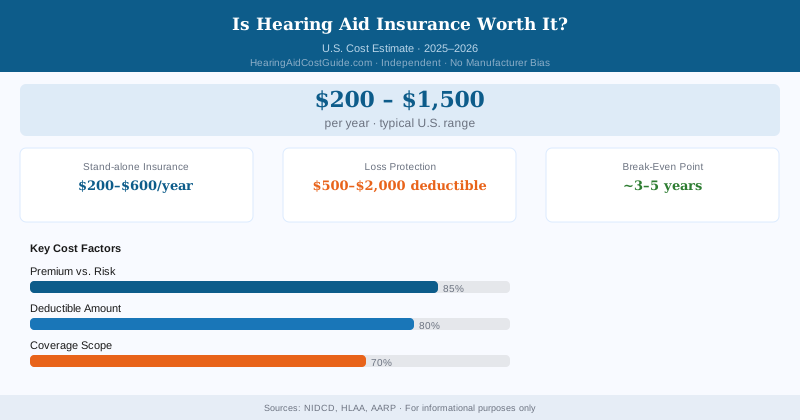
Most people assume hearing aid insurance is a straightforward good deal — you pay a few hundred dollars a year, and if you ever need $5,000 hearing aids, you’re covered. Actually, the math frequently works out the other way. Premiums accumulate, benefits have caps, and the “savings” on in-network devices sometimes aren’t savings at all compared to Costco. Here’s the real breakdown.
Three Very Different Things Called “Hearing Insurance”
Before you can evaluate whether any plan is worth it, you need to know which type you’re actually looking at. These three categories get lumped together constantly:
1. Standalone hearing insurance policies: You pay a monthly premium and receive an annual benefit toward hearing aids. This is true insurance.
2. Hearing aid discount programs: You pay a one-time fee or get free membership, then access discounted prices at network providers. This is NOT insurance — it’s a discount club.
3. Hearing aid riders on health insurance: Added to your employer health plan or Medicare Advantage. Monthly premium (often $0 extra) → aid allowance. Usually the best deal of the three.
The Actual Math
| Scenario | Annual Premium | 3-Year Benefit | Net Value |
|---|---|---|---|
| Buy aids in year 1 | $240–$480 | $1,000–$2,500 | +$520–$2,260 |
| Buy aids in year 3 | $240–$480 | $1,000–$2,500 | -$200–+$1,780 |
| Never buy aids | $240–$480 | $0 | -$720–-$1,440 |
| Buy aids every 5 years | $200–$400/yr avg | ~$500/yr avg value | Break-even or slight loss |
The pattern is simple: insurance pays if you’re buying soon. It doesn’t pay if you’re buying “just in case” years from now.
Four Questions Before Buying Any Hearing Aid Insurance
1. Do I actually have measurable hearing loss right now? If you’ve had an audiogram showing hearing loss, you’ll likely need aids within 1–3 years — insurance makes sense. If you haven’t had an audiogram, get one first. You might not need hearing aids yet, and paying premiums before you know is throwing money away.
2. What devices does the plan actually cover? Many hearing insurance programs only cover entry-level or mid-tier devices. If you need or want premium aids, the benefit may cover 30–50% of the total cost — not the whole device. Do the math on what you’d actually pay out of pocket for the device you’d actually want.
3. Are the network providers any good? TruHearing uses a nationwide network, for example — but network quality varies dramatically by location. Check whether there’s a qualified audiologist you’d actually trust in that network before committing.
4. Have you priced out Costco? Costco hearing aids run $1,499–$2,199 per pair. Costco membership is $65–$130 per year. That combination often beats insurance-benefit pricing without any premium costs or network restrictions.
Insurance claim: “Our plan provides hearing aids at just $699/aid after benefit.”
Reality: A Costco Kirkland Signature 10 is $1,499/pair = $749.50/aid, with no premium payment, no network restriction, and 3 years of follow-up included.
The TruHearing “Select” tier devices for $699/aid are legitimate mid-tier devices — but so is the Kirkland at $749.50/aid, and without the premium cost. The insurance “savings” may actually cost you more in premiums than the device price difference.
Three Concrete Scenarios
Scenario 1 — Use the benefit: You have moderate hearing loss and are ready to buy. Your Medicare Advantage plan includes TruHearing with $0 copay for Select devices and no extra monthly premium. Use it — this is exactly what the benefit is for.
Scenario 2 — Math clearly works: Your employer offers a $15/month hearing rider covering $2,000/pair every 2 years. You buy $2,500 hearing aids this year, pay $500 out of pocket, and $180 in premiums. Net savings: $1,820. Yes, buy the rider.
Scenario 3 — HSA beats insurance: You’re 60, have mild hearing loss, and might need aids in 1–3 years. Standalone insurance at $30/month would cost $360–$1,080 before you use the benefit. Better move: put $30/month into an HSA instead. After 3 years you’ve got $1,080 in pre-tax healthcare funds — and you choose exactly where to spend it.
Warranties vs. Insurance — Don’t Confuse Them
“Insurance” from your hearing aid manufacturer is almost always a product warranty, not health insurance:
- Manufacturer warranty: Covers defects, typically 1–3 years, included in device price
- Loss and damage rider: Covers accidental damage and loss, typically $150–$350, purchased separately
- Extended warranty: Extends defect coverage beyond the standard period
These are worth considering on their own merits. They’re just not the same thing as health insurance for hearing care, and they shouldn’t factor into your insurance-vs-self-pay math.
Some hearing aid retailers sell proprietary “protection plans” that look like insurance but are extended warranties with limited terms. Read the fine print: if a plan covers only “manufacturer defects” but not accidental damage or loss, it’s a standard warranty, not comprehensive protection. Confirm specifically what triggers coverage before you hand over money.
Bottom Line
- Already need hearing aids? Check your existing Medicare Advantage or employer plan first — you may already have a benefit. Then compare Costco prices to your benefit’s network devices before going elsewhere.
- Don’t have any hearing benefits? Ask: will I realistically need hearing aids in the next 24 months? If yes, a rider might pay off. If you’re not sure, redirect that premium money to an HSA instead.
- Never pay for hearing insurance you don’t plan to use within 2 years. The HLAA (Hearing Loss Association of America) consistently advises consumers to scrutinize these plans — the fine print usually tells a different story than the marketing does.