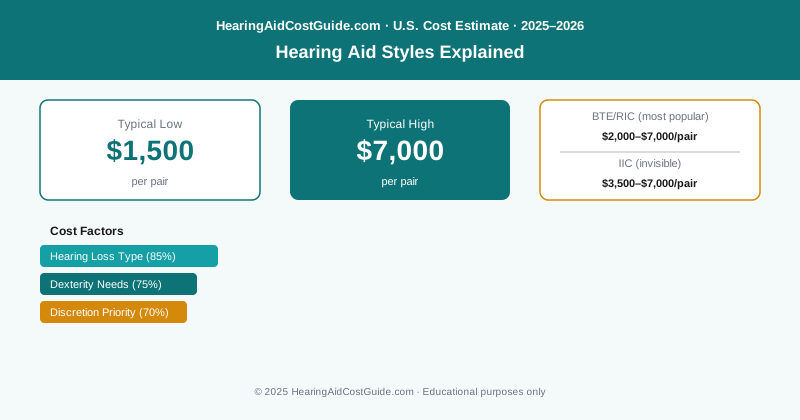
Roughly 75% of all hearing aids sold in the United States are a single style called the RIC — a slim, low-profile device that sits behind the ear and runs a thin wire to a speaker resting just inside the canal. Most people who get hearing aids end up with some version of this. But there are five main styles, and the right one for you depends on more than cosmetics.
Before we go through each one, here’s the thing audiologists say patients most often misunderstand: style and technology level are two completely separate decisions. Every major manufacturer — Phonak, Oticon, Widex, Starkey, ReSound — makes their hearing platforms in most or all styles. A premium RIC and a basic RIC look almost identical. The price difference comes from the electronics inside. More on that at the end.
A Critical Point Before the Style Guide
Style does affect performance in certain situations, and some styles fit certain types of hearing loss better than others. But the decision that most affects your daily outcomes is technology tier — the sophistication of the signal processing. Don’t let conversations about style distract you from that more important question.
BTE — Behind-the-Ear
The classic hearing aid style: a curved case that hooks over the top of the ear and sits behind it. A clear tube connects the case to a custom earmold that sits in the ear canal.
Who it’s for: BTE is the workhorse style for moderate to profound hearing loss — and it’s still the preferred choice for children because the earmold can be replaced as the ear grows without replacing the hearing aid itself. The large case houses bigger batteries and more powerful amplification than smaller styles can deliver.
Pros: Durable, easy to handle (important for people with dexterity issues), accepts both large batteries (size 13 or 675) and rechargeable options, excellent microphone placement away from the ear canal, easy to clean.
Cons: The most visible of all styles. The ear canal is mostly or completely blocked by the earmold, which can make the wearer’s own voice sound hollow or echo-y (the “occlusion effect”). Sweat and moisture around the ear can affect longevity.
Price range: $1,500–$3,500/pair for standard BTE; power BTE for severe/profound loss can reach $4,000–$6,000/pair.
RIC/RITE — Receiver-in-Canal / Receiver-in-the-Ear
RIC hearing aids are the current dominant style — accounting for roughly 75% of hearing aid sales in the US, according to Hearing Industries Association data. They look similar to a BTE but with a key difference: the speaker (receiver) is housed in the ear canal, not in the behind-the-ear case. A thin wire replaces the thick tube of traditional BTE.
The result is smaller, sleeker, and for many users more comfortable. The slim wire is nearly invisible, the behind-the-ear portion is compact, and the receiver sitting in the ear canal delivers sound more naturally.
Who it’s for: Mild to severe sensorineural hearing loss. The “open fit” dome (a soft silicone dome instead of a custom mold) leaves the ear canal partially open, which eliminates the occlusion effect and works especially well for the most common hearing loss pattern — high-frequency loss with preserved low-frequency hearing.
Pros: Cosmetically the most popular prescription style. Excellent sound quality for high-frequency loss. Available in rechargeable options. Wide range of technology levels.
Cons: The receiver sits in the ear canal where it’s exposed to earwax and moisture — the most common point of failure. Regular cleaning is essential. Not ideal for profoundly wet ear canals. The wire can be fragile.
Price range: $2,000–$7,000/pair. This broad range reflects the huge variation in technology levels within the RIC style.
ITE — In-the-Ear
ITE hearing aids are custom-molded to fill the bowl of the outer ear. All components — microphone, amplifier, battery, controls — are housed in a single shell that fits in the ear.
Who it’s for: Mild to moderately severe hearing loss. Particularly good for people who wear glasses (no behind-the-ear component to compete with temple arms) and for those with dexterity limitations — the larger shell is easier to handle than smaller canal styles.
Pros: No behind-the-ear component. Easier to insert and remove than canal styles. Directional microphone placement is good. Takes size 13 battery (longer life than smaller batteries). Some models include telecoil for loop systems.
Cons: The most visible of the in-ear styles — fills the whole outer ear. Custom mold requires an ear impression. Susceptible to earwax and moisture.
Price range: $2,500–$5,000/pair.
ITC — In-the-Canal
ITC hearing aids are smaller than ITE — they fit partially in the ear canal rather than filling the entire outer ear. Part of the device is visible at the canal opening, but the bulk sits inside.
Who it’s for: Mild to moderately severe hearing loss. Offers a good balance of discreetness and functionality. Still large enough to include directional microphones and manual controls.
Pros: Less visible than ITE. Custom fit. Easier to handle than completely-in-canal styles.
Cons: Smaller battery (size 312) means shorter battery life or more frequent charging. Fewer features possible due to smaller size. Wax and moisture exposure.
Price range: $3,000–$6,000/pair.
CIC — Completely-in-Canal
CIC hearing aids fit entirely inside the ear canal, with only a small removal handle (a thin string or tab) visible. They’re nearly invisible from most angles.
Who it’s for: Mild to moderate hearing loss. Not suitable for severe or profound loss — the small case limits amplifier power. Works best for people whose primary motivation is cosmetic discretion.
Pros: Cosmetically discreet. The ear canal’s natural shape helps with sound localization. Less wind noise than behind-the-ear styles (because the microphone is deeper in the ear, shielded by the outer ear).
Cons: Small size means small batteries (size 10 — 3–5 day life). Very difficult to handle for anyone with reduced dexterity or arthritis. No room for directional microphones on most models. Frequent wax cleaning required. Usually no Bluetooth streaming or wireless features.
Price range: $3,000–$7,000/pair.
IIC — Invisible-in-Canal
IIC hearing aids sit deeper in the ear canal than CIC — close to the eardrum — and are completely invisible from the outside under typical viewing conditions. They’re removed with a pull string.
Who it’s for: Mild to moderate sensorineural hearing loss only. Canal anatomy must be suitable — not everyone’s ear canal is shaped or sized to accommodate an IIC device. An audiologist has to evaluate fit before recommending this style.
Pros: Truly invisible. Deep canal placement provides excellent sound quality and very natural localization cues. Minimal wind noise.
Cons: All the limitations of CIC, amplified: tiny size 10 battery, no wireless features on most models, requires manual dexterity to insert and remove a very small device, must be removed at night and before bathing (can’t sleep in most IIC devices). Not appropriate for moderate-severe or worse hearing loss.
Price range: $3,500–$7,000/pair.
| Style | Visibility | Best For | Battery | Price Range/Pair |
|---|---|---|---|---|
| BTE (Behind-the-Ear) | Most visible | Moderate–profound, children | 13/675 or rechargeable | $1,500–$3,500 |
| RIC/RITE (Receiver-in-Canal) | Slim, low profile | Mild–severe (most popular) | 312 or rechargeable | $2,000–$7,000 |
| ITE (In-the-Ear) | Visible, fills outer ear | Mild–mod-severe, dexterity issues | 13 | $2,500–$5,000 |
| ITC (In-the-Canal) | Partially visible | Mild–mod-severe | 312 | $3,000–$6,000 |
| CIC (Completely-in-Canal) | Nearly invisible | Mild–moderate | 10 | $3,000–$7,000 |
| IIC (Invisible-in-Canal) | Invisible | Mild–moderate (canal-dependent) | 10 | $3,500–$7,000 |
Why “More Invisible” Doesn’t Always Mean “Better”
Wanting the smallest, least visible device is completely understandable. The stigma around hearing aids is real. But there are genuine tradeoffs worth knowing before you decide:
- Dexterity matters. An IIC is the size of a small pea. Removing it by a thin pull string, cleaning it daily, reinserting it — that requires fine motor control. If you have arthritis in your fingers, a BTE or ITE is dramatically easier to manage day to day.
- Features matter. CIC and IIC hearing aids rarely include Bluetooth streaming, rechargeable batteries, or advanced directional microphone systems. Those features matter a great deal for anyone who struggles in noise. A RIC with premium noise-reduction processing may do far more for your daily life than an invisible IIC without those capabilities.
- Canal anatomy determines your options. Not every ear canal can fit a CIC or IIC. Your audiologist will evaluate your anatomy before recommending these styles. Your preferences matter — but they’re secondary to whether the device can actually fit.
The decision that most affects hearing outcomes is technology tier — the sophistication of the signal processing — not whether the device sits behind or in your ear.
Premium tier aids offer more microphone channels, better noise reduction, and more natural sound in complex environments. They’re worth considering if you’re active in noisy situations (restaurants, family gatherings, meetings). Basic tier aids work well in quieter environments and are a reasonable choice for someone primarily watching TV and having one-on-one conversations.
Your audiologist should present options at multiple technology levels within the style that fits your hearing loss. If you’re only shown one price point, ask to see the alternatives.
Rechargeable hearing aids are increasingly the default choice, but there’s one scenario where disposable battery aids may be better: if you travel internationally or spend significant time off-grid, rechargeable aids require reliable access to charging. Size 13 and 312 batteries are available worldwide; a charging case requires a power outlet or a backup portable charger.
Most people — especially those with the classic high-frequency ski-slope pattern — do well with a well-fitted RIC at a technology level matched to their lifestyle. But the right style for you isn’t something to decide from a brochure. It’s a conversation between your audiogram, your ear canal anatomy, your dexterity, your lifestyle, and your budget. That’s exactly what the fitting appointment is designed to work through.