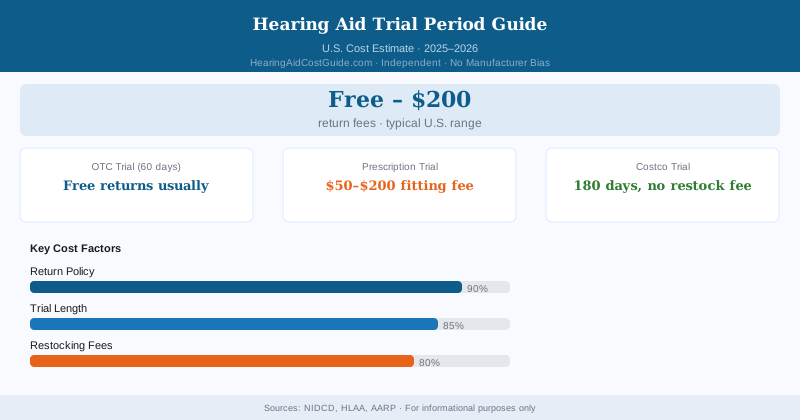
Hearing aids are one of the very few healthcare products you can legally return if they don’t work for you. Not as a courtesy — as a right. A federal regulation requires audiologists and dispensers to offer a minimum trial period, and knowing that changes how you should approach a $5,000 purchase. You don’t have to be certain. You just have to be informed.
Trial Period Comparison
| Provider / Brand | Trial Period | Return Restocking Fee |
|---|---|---|
| Private audiologist (federal minimum) | 30 days | $0–$300 (allowed) |
| HearingLife chain | 60 days | Varies |
| Costco | 180 days | $0 |
| Eargo | 45 days | $0 |
| Jabra Enhance | 100 days | $0 |
| Sony CRE (Best Buy) | 15 days (store policy) | $0 |
| Lexie Hearing | 45 days | $0 |
| Miracle-Ear | 30 days | Varies |
| Amazon OTC hearing aids | 30 days | $0 (Amazon standard) |
The Federal Regulation You Should Know About
Under FDA regulations (21 CFR Part 801.421), any hearing aid dispenser must:
- Give you a written, signed purchase agreement that spells out trial period terms
- Offer a minimum 30-day trial period
- Disclose any restocking fees before you commit to purchase
- Provide a refund policy in writing
This applies to in-person dispensers — audiologists, hearing instrument specialists, hearing aid dealers. It does NOT apply to OTC hearing aids sold through retail channels; those follow standard store return policies, which is why they vary so much.
Restocking Fees: Legal, Often Negotiable
The regulation permits restocking fees up to a reasonable amount — typically $100–$300 per pair. Practices use these to cover the cost of custom earmold impressions, your audiological evaluation time, and device handling during the trial.
Here’s what most people don’t know: these fees are frequently negotiable, especially if you’re a new patient a practice wants to retain.
How to approach it:
- Ask about the return policy and restocking fee before signing anything
- Try: “Can we waive the restocking fee if I end up needing to return these? I want to commit fully to the trial, but I’d feel better with the flexibility.”
- Request that the audiological evaluation fee be charged separately — it’s non-refundable either way, but keeping it separate means a smaller restocking fee on the devices themselves
Costco: The Standout Option
Costco’s 180-day return policy applies to hearing aids purchased at their Hearing Centers. No restocking fee. Six months. That’s an entire season — summer or winter — to evaluate how the devices perform across all your real listening environments.
The HLAA (Hearing Loss Association of America) has long pointed out that 30 days isn’t always biologically adequate for full adaptation to new hearing aids. The auditory cortex needs time to recalibrate — often 6–8 weeks of consistent wear. Costco’s 180-day policy is genuinely more appropriate for that reality than a standard 30-day window.
Make the most of your trial period:
- Wear the aids every waking hour from day 1 — adaptation requires consistent use, not occasional testing
- Keep a listening diary — note specific situations where performance is good or poor
- Schedule a 2-week follow-up — bring your diary notes for a programming adjustment
- Test in real environments — restaurant, phone call, TV, outdoor conversation
- Evaluate comfort, not just sound — physical discomfort shouldn’t be tolerated
- Make return decisions before day 25 — don’t wait until the last day if you’re unsatisfied
When to Return vs. When to Push Through
Return the aids if, after 4–6 weeks and at least one programming adjustment:
- Speech in noisy environments hasn’t improved meaningfully
- Physical discomfort persists despite earmold adjustments
- The technology tier is genuinely insufficient for your degree of hearing loss
- You’ve realized you need a different style entirely (in-canal vs. behind-ear, for example)
Don’t return just because the adjustment period is hard. Weeks 3–4 are often the most frustrating period for new hearing aid users — the aids don’t feel natural yet, you’re still conscious of wearing them, and you may feel like they’re not working. That’s normal adaptation, not device failure. If you return aids at day 25 because you’re in that adjustment valley, you’ll likely face the same thing with the next pair.
What Happens When You Return
Your money: You get back the device cost minus any disclosed restocking fee. The audiological evaluation and testing fees may or may not be refundable — this varies by practice, and you should clarify it before committing.
The device: Returned hearing aids are either refurbished for resale or sent back through the manufacturer’s certified refurbishment program.
Your audiogram: This belongs to you. Even after returning hearing aids, you’re entitled to a copy of your audiogram. Request it in writing — you can take it to any other provider without starting the evaluation process over.
OTC Return Policies: Know Before You Buy
OTC hearing aids follow the retailer’s return policy, not the federal hearing aid regulation. The variation is significant:
- Amazon: 30 days for most items
- Best Buy: 15 days for hearing aids specifically
- CVS: 30 days
- Jabra.com direct: 100 days
- Sony.com direct: 30 days
The important takeaway: buy direct from the brand’s website when they offer a longer trial than retail channels. Jabra’s 100-day trial is only available through jabra.com — not Best Buy, where you’d get 15 days instead of 100.
If a dispenser refuses to honor your trial period or return request within the legally required window, contact your state’s consumer protection office and the FDA’s MedWatch program. The FDA takes hearing aid consumer protection violations seriously. Keep all written documentation of your purchase agreement and return request — you’ll need it if there’s a dispute.