FAQ: Hearing Aids vs. Personal Sound Amplifiers
Q: What’s actually the difference between a hearing aid and a personal sound amplifier?
The difference is regulatory, functional, and safety-related — not just marketing.
A hearing aid (OTC or prescription) is an FDA-regulated Class II medical device intended for adults with perceived hearing loss. It must meet specific output limits to prevent hearing damage, include frequency-specific processing (amplifying the frequencies where your loss actually is, not all frequencies equally), and meet FDA labeling requirements.
A PSAP (Personal Sound Amplification Product) is a consumer electronics product — like any other pair of earbuds — that the FDA explicitly prohibits from being marketed to people with hearing loss. PSAPs are intended for recreational use by people with normal hearing: birdwatchers, hunters, people who want to hear a lecture from the back of an auditorium.
Q: But they look the same on Amazon. How do I tell them apart?
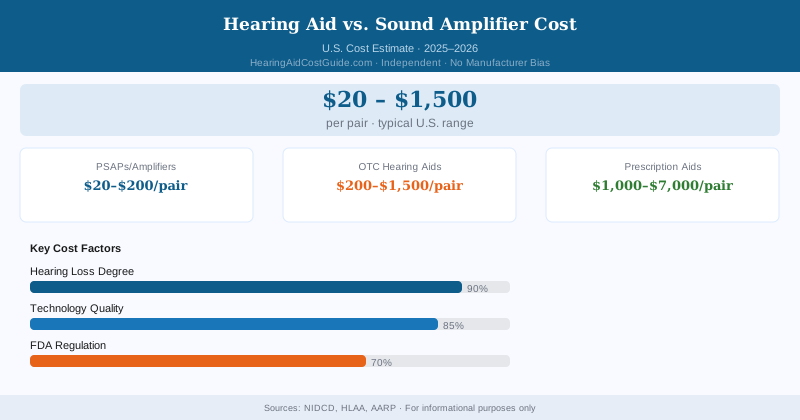
Price alone won’t tell you. Some PSAPs are $15; some are $300. Some OTC hearing aids are $200; some are $1,500. Here’s a more reliable test:
Before buying any amplification device, apply this test:
- Does the product listing say “FDA-registered OTC hearing aid”? (PSAP = no)
- Does it have an app for fitting/customization? (PSAP = usually no)
- Is it HSA/FSA eligible? (PSAP = no, hearing aids = yes)
- Does the description warn against use for people without hearing loss? (Real PSAPs should say this)
- Is it under $100? (Might be PSAP; possible with $100–$400 budget aids)
If a product fails tests 1 and 2, it’s almost certainly a PSAP regardless of what it’s called.
Q: What’s the cost difference?
| Feature | FDA OTC Hearing Aid | Personal Sound Amplifier (PSAP) |
|---|---|---|
| FDA regulation | Yes — Class II medical device | No — consumer electronics |
| Intended use | Mild-to-moderate hearing loss | Normal hearing, specific amplification |
| Frequency-specific amplification | Yes | Usually no |
| Maximum output limit | FDA-regulated (≤132 dB SPL) | Not regulated |
| HSA/FSA eligible | Yes | No |
| Typical price range | $200–$7,000/pair | $15–$350/pair |
| App-based fitting | Many models | Rare |
| Noise reduction algorithms | Yes (quality models) | Usually no |
| Audiologist programming | Available (prescription) | Not available |
Q: Can a PSAP actually damage my hearing?
Yes — and that’s the core safety concern that prompted the FDA to create the OTC hearing aid category in the first place.
A PSAP has no output limiting. If you have significant hearing loss and turn a $30 amplifier all the way up to compensate, you may be exposing yourself to amplification levels that cause additional noise-induced hearing damage on top of the loss you already have.
FDA-registered hearing aids have maximum output limits designed to prevent overamplification. PSAPs have no such requirement. If you’ve been using a PSAP for more than a year to compensate for hearing loss, get an audiogram. You may have sustained additional damage from the unregulated amplification without knowing it.
Q: What about the gray area products — the “hearables”?
Some consumer audio products sit between PSAP and hearing aid:
Nuheara IQbuds MAX ($499): Premium hearable with personalized hearing profiles via app. Not FDA-registered as a hearing aid. Good for people who want enhanced hearing in specific situations but don’t have clinically significant hearing loss.
Jabra Enhance Plus ($299): Jabra’s “hearable” tier below their OTC hearing aid line. Not a medical device. For mild enhancement in people who don’t meet OTC hearing aid criteria.
Apple AirPods with Live Listen: Uses the iPhone microphone to boost nearby sound directly to your AirPods. Free feature. Not a medical device, but a useful accessibility tool for mild listening situations.
These products have real utility. They’re just not appropriate substitutes for hearing aids when measurable hearing loss is present.
Q: When is a PSAP actually the right choice?
PSAPs are appropriate for legitimate uses:
- Normal-hearing TV viewer who wants personalized audio without cranking the volume
- Hunters or shooters who want ambient sound amplification between shots
- Birdwatchers who want enhanced environmental sound
- Concert or theater attendees who want better sound without medical devices
- Curious shoppers who want to test amplification before committing to OTC hearing aids
For all these uses, a PSAP is the correct product. For anyone with measurable hearing loss — even mild — an FDA-registered OTC hearing aid is the appropriate choice. The NIDCD reports that approximately 37.5 million American adults have some degree of hearing loss, and a significant number of them are currently using PSAPs that aren’t addressing their actual need.
Q: What are some examples of each?
FDA OTC Hearing Aids: Sony CRE series, Jabra Enhance Select, Lexie B2, Eargo 7, Phonak Audéo (prescription), Kirkland Signature 10.0 (Costco).
Common PSAPs sold as “hearing aids” on Amazon: Britzgo, generic BTE brand amplifiers, various “hearing enhancement” products under $100. If the listing doesn’t say “FDA-registered OTC hearing aid” and it’s under $100, assume it’s a PSAP.
If you’ve been using a PSAP from an online retailer for more than a year to compensate for hearing loss, get an audiogram. You may have hearing loss that’s been inadequately treated, and you may have sustained additional noise damage from the unregulated amplification. Getting a professional evaluation is free at Costco and often covered by insurance.