Marcus worked construction for 28 years. By 62, his audiogram showed 95 dB average loss in both ears — profound impairment that made communication on a job site impossible. He applied for SSDI and was approved within four months. His situation was straightforward because his test results cleared the SSA thresholds by a wide margin. Many people aren’t that lucky.
Hearing loss severe enough to prevent gainful employment can qualify for Social Security Disability Insurance (SSDI) or Supplemental Security Income (SSI). But the SSA’s criteria are strict — most people with hearing loss, even significant loss, won’t qualify. Knowing the exact thresholds before you apply saves time and frustration.
SSA Disability Criteria for Hearing Loss
| Test | SSA Qualifying Threshold |
|---|---|
| Average air conduction (better ear) | 90 dB HL or worse |
| Bone conduction (better ear) | 60 dB HL or worse |
| Word recognition score (WRS) | 40% or less in better ear |
| With cochlear implant | 1 year post-activation; WRS ≤60% |
Listing 2.10 (Hearing Loss, Not Treated with Cochlear Implant): The SSA requires either 90 dB average air conduction loss OR bone conduction ≥60 dB OR word recognition score ≤40% in the better ear to meet this listing.
Listing 2.11 (Hearing Loss, Treated with Cochlear Implant): One year after cochlear implant activation, if word recognition score remains ≤60% in the implanted ear, the individual meets the listing. Importantly, the SSA automatically considers any cochlear implant recipient disabled for the first year after activation — no separate testing required during that period.
SSDI Monthly Benefit Amounts (2025)
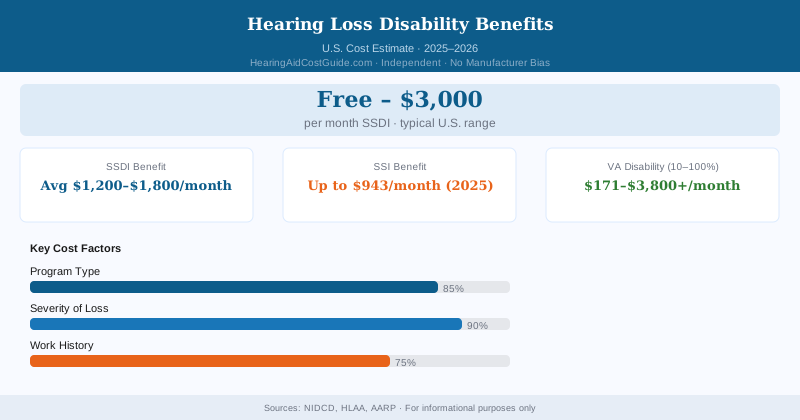
SSDI benefits are tied to your work history and average lifetime earnings. The SSA approved SSDI benefits for over 100,000 Americans with hearing impairment in recent years — and the average monthly benefit for new recipients in 2025 is approximately $1,537/month. Individual payments range from roughly $300 to $3,822/month depending on earnings history.
SSDI eligibility requires:
- Sufficient work credits — typically 40 credits, with 20 earned in the last 10 years
- A medically determinable disability expected to last 12+ months or result in death
- Hearing loss meeting the thresholds listed above
SSI for Non-Working Adults
Supplemental Security Income helps disabled adults with limited income and assets, regardless of work history. SSI maximum payment in 2025: $943/month for individuals.
SSI eligibility requires:
- Same disability criteria as SSDI
- Income below the substantial gainful activity (SGA) limit
- Limited assets (generally less than $2,000 for an individual)
If you’re a younger adult, caregiver, or someone who spent years out of the workforce, SSI may be your path even when SSDI isn’t available.
Medical Benefits After Qualifying
SSDI recipients receive Medicare after a 24-month waiting period from disability onset. SSI recipients receive Medicaid immediately. Both programs provide hearing healthcare access — including cochlear implants and audiology services — that can directly address the hearing loss that qualified you in the first place.
Even if your hearing loss doesn’t hit Listing 2.10/2.11 thresholds, you may still qualify through:
- Medical-vocational allowance: The SSA considers your age, education, work history, and all functional limitations together. A 55-year-old with moderate-severe hearing loss, limited education, and a career in physically demanding work may qualify even without meeting the listing.
- Combined conditions: Hearing loss paired with tinnitus, cognitive effects, vestibular disorders, or mental health conditions can build a stronger case than any single condition alone.
Always apply even if you’re uncertain — the SSA makes the eligibility determination, not you.
VA Disability for Hearing Loss (Veterans)
Veterans have a separate disability pathway through the Department of Veterans Affairs, completely independent of SSA. VA ratings for hearing loss:
- 0%: Hearing loss exists but doesn’t significantly impact daily function. Still establishes access to free VA hearing care and hearing aids.
- 10–100%: Based on audiometric test results. Even a low rating unlocks VA audiology benefits.
Tinnitus carries a flat 10% rating and is the single most common VA disability claim filed. A 10% rating alone provides access to VA audiologists, hearing aids, and related services at no cost to the veteran.
Veterans can receive both SSA disability benefits and VA disability compensation simultaneously — they don’t offset each other.
Vocational Rehabilitation for Hearing Loss
State vocational rehabilitation (VR) agencies help people with disabilities achieve or maintain employment. For people with significant hearing loss, VR can fund:
- Hearing aids or cochlear implants needed for work
- Assistive listening devices for the workplace
- Sign language interpretation for job training
- Communication technology (captioned phones, video relay services)
VR eligibility isn’t income-based — it’s based on vocational need. A working adult who needs hearing aids to stay employed or return to work may qualify even without SSDI or SSI eligibility. Contact your state VR agency through rsa.ed.gov.
The Application Process
- Gather audiological documentation: Recent audiogram (within 60 days preferred), word recognition score, physician records documenting your hearing condition
- Apply online or by phone: ssa.gov/disability or call 800-772-1213
- Initial decision: Expect 3–6 months; the SSA denies roughly 67% of initial applications — that’s normal, not a signal to stop
- Request reconsideration: If denied, you have 60 days to request reconsideration
- ALJ hearing: If still denied, request an Administrative Law Judge hearing — approval rates improve substantially at this stage with proper documentation
- Consider representation: Disability attorneys work on contingency (paid only if you win) with fees capped at 25% of back pay, maximum $7,200
Most initial SSDI applications are denied — approximately 67% at the initial level. Denial is not the end of the process. Request reconsideration, then an ALJ hearing. Many claims that are denied initially are approved at the ALJ level with proper documentation and representation. Don’t give up after the first denial.
HLAA and Advocacy Resources
- Hearing Loss Association of America (HLAA): hearingloss.org — disability benefits resources, chapter support
- National Disability Rights Network: Disability rights and legal assistance
- Benefits.gov: Federal benefit screening tool
- Social Security Administration: ssa.gov/disability