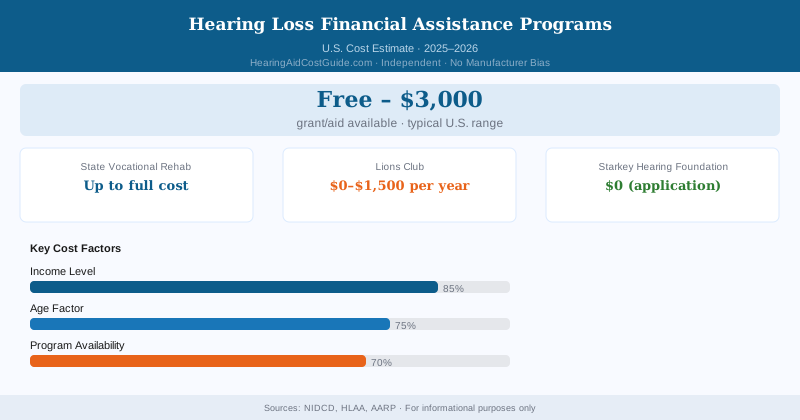
28.8 million Americans have hearing loss significant enough to benefit from hearing aids. Of those, fewer than 1 in 3 actually wear them — and the NIDCD (National Institute on Deafness and Other Communication Disorders) consistently points to cost as the primary reason. At $4,000–$7,000 per pair, prescription aids are simply out of reach for most households without help.
But assistance exists — more than most people realize. Here’s what’s available and how to access it.
Financial Assistance by Organization Type
| Organization | Who They Serve | What They Provide |
|---|---|---|
| VA (veterans.gov) | Veterans | Free hearing aids, cochlear implants |
| Medicaid | Low-income adults/children | Hearing aids, audiological care |
| State Vocational Rehab | Working-age adults | Hearing aids for employment |
| Starkey Hearing Foundation | Low-income, any age | Free hearing aids |
| Lions Clubs International | Low-income, any age | Reconditioned hearing aids |
| AG Bell Foundation | Children with hearing loss | Grants for hearing technology |
| Hands & Voices | Children, families | Regional assistance funds |
| Sertoma International | All ages, needs-based | Reconditioned aids, grants |
| Audient Alliance | Income <200% FPL | Discounted hearing aids |
| HLAA chapters | Members in need | Emergency assistance funds |
| Easter Seals | Adults/children with disabilities | Case-by-case assistance |
Government Programs: Start Here
Before applying to any nonprofit, exhaust government options — they’re more reliable, better funded, and often more generous:
VA: If you served in any branch of the military, VA audiology is likely your best resource. The VA provides free hearing aids to eligible veterans without requiring a service-connected rating for basic hearing care. Contact your nearest VA medical center’s audiology department directly.
Medicaid: For adults below roughly 138% of federal poverty level, and all children under 21. Coverage varies by state — some states cover hearing aids generously, others minimally. Contact your state Medicaid office or check healthcare.gov for your state’s specific coverage.
State Vocational Rehabilitation: For working-age adults whose hearing loss affects their ability to work. VR agencies can fund hearing aids, cochlear implants, and workplace communication technology for employment purposes. Find your state’s VR agency at rsa.ed.gov.
Medicare Advantage: If you’re 65+ enrolled in Medicare Advantage, check your plan’s hearing benefit specifically. Coverage of $500–$2,000 per pair is increasingly common — it’s one of the most frequently overlooked benefits in these plans.
Starkey Hearing Foundation
One of the most active hearing aid donation organizations in the country. The Starkey Foundation distributes new hearing aids — not used or refurbished — through community partner organizations and distribution events held year-round across the US.
How to access: Contact your local HLAA chapter, community health center, or Lions Club for upcoming events. Events typically don’t require income documentation, but they target underserved communities. Devices are professionally fitted at distribution events or through partnering audiologists.
Contact: starkeyfoundation.org or 952-941-6401
The Alexander Graham Bell Association for the Deaf and Hard of Hearing provides grants to children and young adults with hearing loss for:
- Hearing technology (hearing aids, cochlear implants, FM systems)
- Auditory-verbal therapy
- Summer camps and educational programs
- Post-secondary education
Applications are accepted through agbell.org. Grants are competitive — both merit-based and needs-based — so a complete, documented application matters.
Sertoma International
Sertoma (Service to Mankind) is a service organization with a specific focus on hearing health. Local chapters provide:
- Reconditioned hearing aids to individuals in need
- Funding for audiological services in some regions
- Annual Sertoma Hearing Health events with free screenings
Not all chapters offer hearing aid assistance — programs vary significantly by location. Find a local chapter at sertoma.org and call specifically to ask about hearing aid assistance before making the trip.
Audient Alliance: Reduced-Cost Prescription Aids
Audient Alliance (audientalliance.org) provides access to new prescription hearing aids at dramatically reduced prices for income-qualifying adults:
- Eligibility: Income at or below 200% of federal poverty level — roughly $31,200 for an individual in 2025
- Cost: $400–$1,700 per pair for professionally fitted prescription hearing aids
- Process: Apply online; audiologist matching and fitting included in the program
This isn’t free — but professionally fitted prescription devices at $400/pair represent extraordinary value. For income-qualifying adults who need real prescription aids, Audient is often the best option available.
Hearing Industries Association and Manufacturer Programs
Individual manufacturers run limited patient assistance programs:
- Phonak: Contact US headquarters for information on need-based assistance for uninsured or underinsured patients
- Starkey Cares: Means-tested financial assistance through Starkey network dispensers
- Oticon: Limited assistance through partner dispensers; contact Oticon directly
These programs are small in scale and require financial documentation. They’re most useful as a supplement once you’ve exhausted government and nonprofit options — don’t lead with them.
Easter Seals and Disability-Focused Organizations
Easter Seals provides a range of disability services, including hearing loss support. Programs vary significantly by state chapter — some run robust hearing aid assistance programs, others don’t. Contact your state Easter Seals at easterseals.com to learn what’s available in your area.
Community Health Centers
Federally Qualified Health Centers (FQHCs) provide care on a sliding-scale fee basis regardless of insurance status. Some have audiology departments or can refer patients to audiologists who work with FQHC patients at reduced rates.
Find your nearest FQHC at findahealthcenter.hrsa.gov. These centers are specifically designed to serve people who’d otherwise fall through the cracks of the healthcare system.
Many financial assistance programs have limited capacity, waitlists, or infrequent application cycles. Apply to multiple programs simultaneously — don’t wait for one response before starting another application. Also get an audiogram before applying: most programs require documentation of medical need, not just self-reported hearing difficulty.
Self-Help Advocacy: Don’t Accept “No” Too Quickly
If your insurance denies hearing aid coverage:
- File a formal appeal with a letter of medical necessity from your audiologist
- Request a peer-to-peer review — your audiologist speaks directly with the insurance medical reviewer, often with better results than written appeals alone
- File a complaint with your state insurance commissioner if the denial appears to contradict state mandate laws (more than 20 states mandate some hearing aid coverage)
- Contact your state senator or representative’s office — elected officials sometimes help constituents navigate insurance coverage disputes, particularly for medically necessary care